Thursday July 24th, 2024
I wake up with dread; the feeling of rocks in my stomach anchoring me to this day, churning of emotions like waves in a storm. This is surreal, this can’t be it. This entire experience has felt like a dream, but this day is hell. We knew the time was drawing nearer, and we knew years ago that this day would happen. Perhaps naively, I didn’t think it would come to fruition. I thought the program would be saved, the government and funding agencies would come to their senses and scramble to provide funding to keep the ship and program afloat. But that isn’t the case.
I go through my daily routine: wake up in my cabin at 22:00, take a shower, gather my things, drop off my bookbag and coat in the conference room. Meet my colleagues in the mess hall for our usual breakfast together (two eggs over medium, a bowl of fruit, a glass of water, toast with cream cheese for me). Around 22:35, head to Bridge Deck to start the French press of coffee for myself and colleagues. Head back down to the Core Lab at 22:45 for the crossover meeting with the sedimentology team. The routine is familiar, a comfort through the turmoil that is raging in my heart and stomach.
Friday July 25th, 2024
Today is the day that the research vessel JOIDES Resolution will deliver us her last sediment core. We lovingly call her ‘the JR’ for short. Since 1985, the ship has been drilling all over the world ocean, retrieving rocks and sediments from below the seafloor. The contributions this vessel has made to science are massive. The third expedition, sediments and the oceanic rocks below the sediments were drilled from the southwest Atlantic to prove the hypothesis of plate tectonics and seafloor spreading. Antarctic and Arctic ice sheet melting, and under what conditions the ice melts, has been quantified from expeditions taking place in the high latitudes of both poles. The microbial communities living within the seafloor sediments and rocks is one of the lesser-known biological communities on Earth; the JR has retrieved these rocks and sediments so scientists can study them. Viruses, bacteria, archaea, all living at depths in our ocean unattainable to humans without the help of the riserless drilling capabilities of the JR. Ancient DNA is a rather new and quickly advancing field. Scientists can attain DNA bits preserved in sediments to look at ancient ecosystems through time, and how they’ve shifted and changed in response to past warming and cooling events. The reason we know how warm the Earth was in the more recent past, and how our oceans, atmosphere, ice sheets have responded to these warming events is because of the JR. This 46-year-old ship and her skilled crew are paving the way for scientists to ask more complex and compelling questions about our Earth and how it works, who lives here, how we can harness this information for the betterment of the planet and humanity. All of these amazing discoveries, pushing the boundaries of what we know about our Earth through the geologic past, and pushing the boundaries of science, it comes to an end today.

The crew and drill team need to stop drilling at approximately noon today. By the time my team and I are on shift, it is midnight. Twelve hours until the last core, twelve hours until the program ends. We keep busy describing the sediments contained in each core section, its color, any rocks that we see, and other features that might indicate the ancient environments under which these sediments accumulated. The dread is still there, but being around the people I’ve come to love the most on the ship helps. When you’re at sea for two months, it is amazing how close you become with your colleagues. You rely on each other not just to get the scientific work done, but for laughs, for comfort, for staying in touch with your humanity. We are human first, scientists second. That’s important to keep in mind while sailing on the JR, working twelve hours a day for two months straight.

Lunch always marks the half-way point of the day. This too has become a treasured routine. 5:15 am, go downstairs to the mess hall with Kat, sometimes Nicole comes too. Glenn comes down usually a few minutes after us, we eat. Glenn and I have a commitment: one waffle a day for the entire expedition. Syrup and chocolate sauce are both necessities, and now we’ve become accustomed to including a dusting of cinnamon to really jazz up the waffles. If we’re feeling wild, ice cream too. The mood at lunch today is more sober than usual, the dread still there regardless of the laughs we have despite the day. The time is 6:00 am. Six more hours until the last core, six more hours until the program ends.

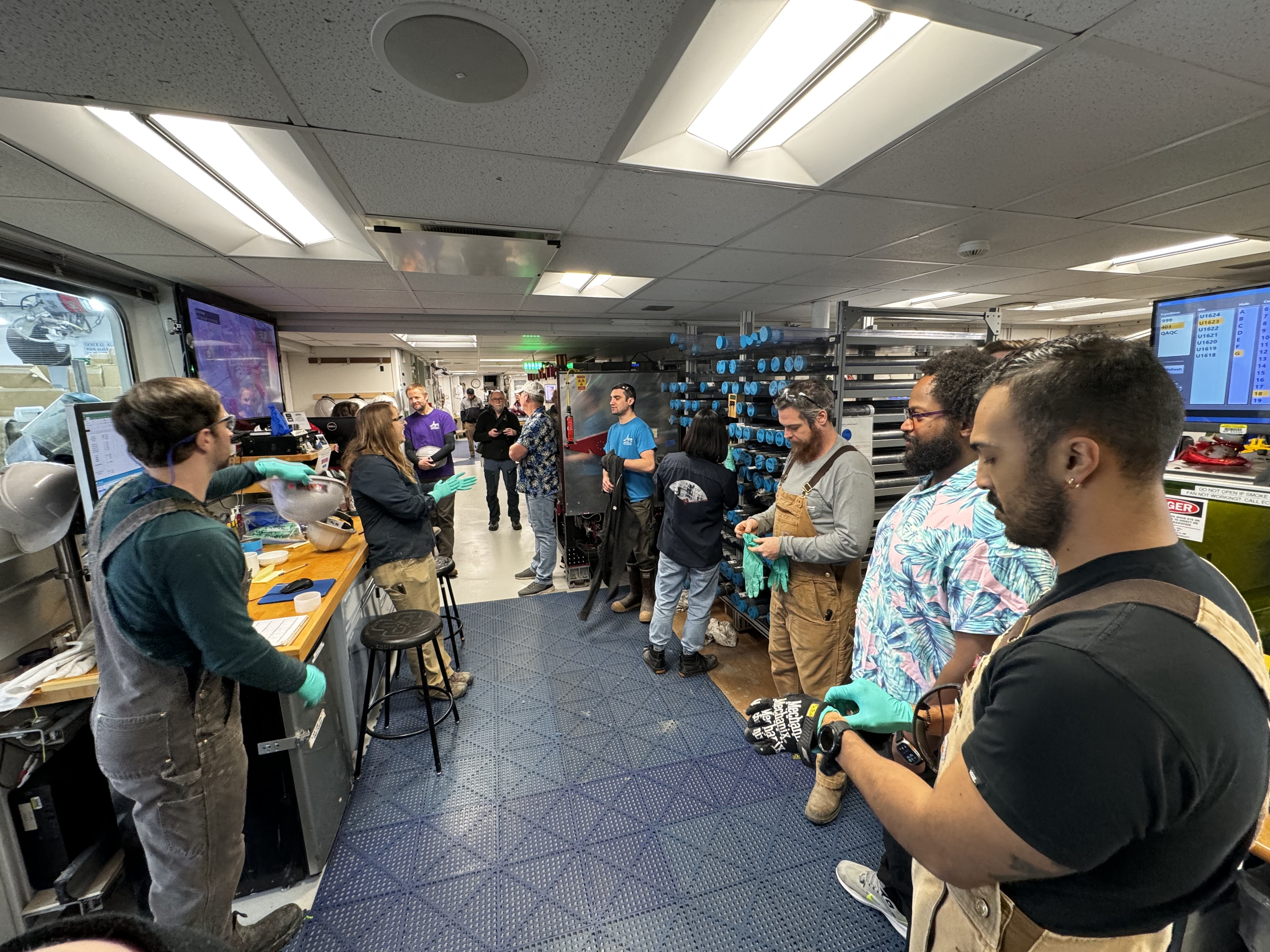
The rest of the day goes by too quickly. Process the cores, work on reports, take a break to eat sweets, back to work. I watch the time tick by on the round black and white clock that hangs on the back wall of the sedimentology lab. Watching the hands move, marking the passage of time is hell. Finally, we get word that we only have 3-4 more cores to be drilled. I decide to make the best of it and rally up the sedimentology team to help the marine science technicians (techs) bring one of the cores onto the ship. This is the first time we’ve done this as a team, and it is a blessed distraction. Pictures are taken, the techs are super accommodating of us, a grand time all around. Every expedition is a success because of the skills and expertise of the techs. They are the ones who ensure the cores make it from the drill deck into the labs safely, who curate the cores and ensure they are labeled and stored properly. Maintenance of the equipment and computer programs is up to them. More than that, they are a critical part of a well-oiled human machine synchronized to deliver the sediments to the scientists. They are the ones without whom none of these expeditions would be possible. In return, they have traveled the world together, made priceless memories, and become each other’s home away from home. The scientists leave the ship and go back to our jobs and research; most of the techs will walk off the ship jobless after this expedition. The time is approximately 8:00 am. Four more hours until the last core, four more hours until the program ends.

Hours later, one of the toolpushers comes into the Core Lab. There will only be two more cores, these are the last two that we will drill. The anxiety is full-blown at this time, there’s no way I can work in this state. I decide to do what I can, but when the third and second to last cores come up, I’m out on the core deck with the techs. Through art is comfort, and that’s what I seek. I play photographer, capturing the last moments the techs have to work together and perform a critical part of their job. Watching them do their tasks so effortlessly and in sync through my phone eases the dread. Are they feeling this dread and anxiety too? Are they okay? The techs joke with the drill floor roughnecks, who, despite working the hardest on the ship with heavy equipment 12 hours a day in all kinds of weather, keep up a positive attitude. The roughnecks are also part of the well-oiled machine: they care for the drilling equipment, build the drill strings at each new site, hoist the drilled sediment cores onto the deck. Two months on, two months off, they have made a huge sacrifice for the drilling program by being away from their homes and families for half of the year. Just last week, they were notified by the JR’s owner, SEA1, their positions will be terminated after this expedition. And it’s not just the roughnecks, it is everyone on this ship that works for SEA1: the captain, the offshore installation manager, all the way across the board. Everyone. The time is approximately 10:00 am. Two more hours until the last core, two more hours until the program ends.

It’s now 11:30 am, and I can’t work. My brain isn’t into doing the work, and neither is my heart. I can’t focus. It feels as if we’re all living through a murder, we’re all witnesses to the atrocity that is happening. And we can’t stop it. Shortly after, the expedition project manager, Thomas, comes into the sedimentology lab. ‘A few folks asked if the scientists are going to bring in the last core, but the techs should do it’. We agree heartily; this moment should be for them and we, the scientists, should stand by in solidarity and support. At 11:45, the techs and scientists each have their own crossover meetings, with the scientists assembling in the core lab, and the techs assembling near their workstations across from us. But today is different; the scientists are with the techs, we stand with them as we all await the last core to ever be drilled by the JR. TV screens in the labs show the drill floor, and a number at the top of the screen counts down, indicating the depth at which the core is. The core is coming up fast, it will be here soon. The techs are blasting ‘Whiskey in the Barrel’ by Metallica, waiting for the last ‘Core on deck!’ to be called.
The call comes at 12:20 pm. The normal ‘core on deck’ call, announced by the driller, is replaced by the voices of our expedition’s two co-chief scientists, Renata and Kristen. In the early days of scientific ocean drilling, the science parties were dominated by mid- to later-career men. The expedition we are on not only has two women co-chiefs, but it also contains a higher number of early career scientists than normal (PhD students, postdocs, those who have recently graduated from their graduate program and are a few years into their new jobs and careers). The science party contains 25 scientists, 15 of which are women. The average percentage of women from the last decade of expeditions has been about 52%; the average percent of early career scientists has averaged 33%. Career foundations have been built on this ship, scientific collaborations forged that have led to huge contributions to geology and the Earth sciences. I first learned about sailing on the JR while a naive undergraduate student. I went on to become one of those scientists who built a large foundation of my career upon scientific ocean drilling. As an Assistant Professor with four PhD students, I think of them and mourn the loss of the opportunities they will miss out on, and other graduate students, postdocs, professors, career professionals that will never get to experience this.
A stream of technicians come onto the catwalk and line up at the end, waiting for the roughnecks to pull the last core out of the core barrel and hand it off to them. I feel that I have to witness this; I can’t stand idly by in the Core Lab. Despite the chaos of the moment and the two film cameras pointed at the action, I sneak to the end of the catwalk to watch this moment, to be within it. The techs do their jobs, pulling the core onto the core deck, laying the long plastic tube containing precious seafloor sediments on the core holders. Wipe them down, measure them, cut them, cap the ends, take them into the Core Lab for labeling and to warm up to room temperature before being processed further. I sneak back inside through the Paleontology Lab side door so as not to disturb the flow of the work on the catwalk. Walking through the Core Lab, the scientists are gathered at the other end of the lab, lined up near the door where the techs bring in core sections. As the techs bring in the cut sections of the core, we cheer and clap for them.

As the last core section is put in the racks in the Core Lab, it is approximately 12:40 pm. The roughnecks will now begin to disassemble the drill string, pulling up pipe that is dangling to the bottom of the ocean. Last minute tasks will be done, and we’ll set sail back to port in a few hours. In about six days, we’ll pull into port in Amsterdam, and for the last time, the crew, techs, and scientists will disembark from the JOIDES Resolution.
I go down to the mess hall for dinner, as it’s now close to the time dinner will stop being served. Oddly, I feel some relief; the anticipation of the last core is over. The heavy sadness remains, but this will dissipate in the coming days as I decide to enjoy the last remaining time on the ship with my new science family, absorbing all the good moments that I can. I walk back up the stairs after dinner, heading past the Core Deck on my way to Bridge Deck. The door to the Core Deck has a large window, and through it is the whiteboard for which the techs write the site we are currently drilling, the cores that we’ve drilled, the time they’ve come up, and the recovered length. It is customary at the end of every expedition to write ‘EOH’, ‘EOS’, EOX’ at the base of the board. But this time, there is a different three letter acronym written in blue: ‘EOP’.
End of Hole, End of Site, End of Expedition, End of Program.

Beautiful story, Adriane! So glad, and proud(!), you were there to capture the moment and share your observations and feelings. So sad to see such an amazingly successful scientific program end. So many careers have been shaped and molded by scientific ocean drilling. So much has been learned about our fragile planet’s history from SOD. I first sailed as a first year PhD student on the Glomar Challenger, and in the years since, many of my students have had the wonderful opportunity to participate in the intense and exhilarating experience of drilling leg or expedition. There is so much yet to discover and learn! I hope we find the means to return to this wildly successful, international collaboration of exploration and discovery. Lastly, what has made each leg or expedition successful were the many people in support of the science, from the marine techs, to the amazing ship’s crew and stewards, drilling crew and roughnecks; THANK YOU!! I hope to have the opportunity to sail with you again.
Thanks Mark!! Here’s to hoping this isn’t the end, but the beginning of a new era!