I’m Mariandrea, a PhD student working on foraminifera and their shell composition, but before going into the science, let me tell you about how I came to be a scientist.
If you ask me, when did I realize I wanted to be a scientist, I will definitely tell you it was during the summer of 2006. What happened you may ask? Very simple, I took a trip with my mom to an aquarium, and I asked THE question that changed my life.
The conversation went something like this:
“Mom? Do you know who takes care of these animals? I want to learn more about them!
-Probably a marine biologist? They study them and their environments, so they can be healthy and strong.
Mom… I think I want to be a marine biologist.
If that’s what you want, do it!”
That was the first time I heard about marine biology… Who would have thought that my 6-year-old self knew what my life was going to look like in the future. In reality, there is a little more to that story, I kind of grew up in the lab (please don’t ask how/why, was I in the lab) watching my mom working and teaching. So, the lab always felt like home.
Like almost every single human, time came to choose a career path… Was I really going to let my 6-year-old self-choose my career? I was not the crazy old white man in science who is always in his lab coat. You know… the typical media representation. I was more of the very smiley, dancing-singing theatre kid, or the watercolor painting fan, or maybe the swimmer that gave everything to her sport, or the reader/writer who desperately wanted to believe in magical worlds and much more.
Well to answer the question… Yes, I did let her choose. Marine biology was and is everything I want. It was the right answer, despite the criticism and disapproval from some people.
Moana says it better:
every turn I take, every trail I track

every path I make, every road leads back

to the place I know where I cannot go…

where I long to be...

see the line where the sky meets the sea…

it calls me
(yes, I still enjoy Disney movies)
Anyway… One thing led to another, and there I was packing my whole life into a suitcase to go across the Atlantic Ocean or around 9 000 km away from everything I knew. A girl, a suitcase and a dream, it sounds like a cheesy comedy in the making, but quite literally what happened!
Back to science! I completed a bachelor’s in biology to then specialize in a master on the marine field and the impacts of humans on ecosystems.
The pictures above are of me in the field doing some sampling and measurements
Somehow, I’m currently a PhD student and I’m on my way to becoming what I was dreaming of. I still don’t know if it was luck or hard work, probably both. Science is hard but very rewarding! In the end, after getting to know them during my internships, foraminifera are my poison of choice. They are unicellular microorganisms, living in all marine ecosystems that have a carbonate shell. These shells record different sea-water parameters as they are being built. These records allow us to reconstruct past conditions to eventually have more accurate predictions for the future and allow us to try to prepare for it.
Remember kids, understanding the past is the key for the future. During my PhD, I am interested in how foraminifera will respond to different, atmospheric CO2 conditions. Atmospheric CO2 is in equilibrium with seawater and this is leading to, for example, ocean acidification. I’m spending my days between the lab working on experiments, my desk doing analyses and from time to time going out into the field. I’m also working on a secret paper, a more ecological one, that will come in the near future (or more like in a year). Stay tuned!
In fewer words, I love science but I’m still very much my non-scientific self, I’m swimming every single week, I’m trying to get back into water colours and if you’re looking for musical recommendations, go listen to MICO from Canada or if you been living under a rock Wicked.
I want to leave you with some final thoughts:
Being a scientist is not about what you see on tv or using the lab coats, it is about being curious and seeking answers. So basically, everyone can be a scientist no matter who you are. And if you are lucky enough, take AND create opportunities for yourself, it always pays back.
On a personal note, I’m not going to tell you that the sun will come after the rain, but that maybe sometimes dancing in the rain can be as fulfilling as being under the sun.
As this is only the beginning of a girl and her dream, I hope that you will be able to write your own story as the great scientist you are set to become.
Tell us a little bit about yourself. Currently, I reside in the Southern Tier of New York. I love to be outdoors. My hobbies include traveling, hiking, paddling, trail maintenance, climbing, yoga, and aerial hoop. I am a big fan of constantly learning new things and having new experiences. I am a full-time single mother with a feisty 6.5 year old daughter. We are both National Parks enthusiasts.
Me squatting down with my daughter as a toddler. We are fossil hunting in a rock field in the Alberta badlands.
What kind of scientist are you and what do you do? I love all sciences but focus my career and academics on the Earth and Atmospheric sciences. I hold a Masters in Geosciences with a concentration in teaching and a Masters in Atmospheric Sciences. Past research has examined winter storms, climatic changes and the influence of moist air, called an atmospheric river, as it interacts with mountain ranges such as the Andes. I have a lot of interest in weather and climate, but also love geology. I hope to learn more about paleontology! My upcoming research will focus on effective communication in geosciences and inclusivity within geoscience education.
I am a non-traditional graduate student as I am also a faculty member in Geography, and older than my program-mates. I have been teaching at the college level for about 8 years and have informal education experience with all ages. I have a great passion for teaching and sparking interest in science related topics. I’ve worked at a company called Science Explorers, providing after-school science enrichment to elementary schools. I’ve worked as an educator and animal care personnel at a natural history museum, a zoo, and a couple nature centers. Recently diagnosed with ADHD, this explains why I am addicted to having multiple jobs and hobbies. I’m always doing something and don’t know how to relax when there’s so much more to learn! I am currently working on my Ph.D. in order to go further in my career and to contribute more to the Geoscience community.
Sitting on the sign for Arches National Park, my daughter and I are always exploring. Photo credit to our other travel buddy, my mom.
What is your favorite part about being a scientist, and how did you get interested in science? I think every child is born with natural curiosity and those who continue with that curiosity become scientists. I was always interested in the world around me, always exploring nature. The science of the Earth fascinated me from a young age. I didn’t start honing in on my interest in Meteorology until a tornado outbreak in 1998 occurred near my hometown. It wasn’t very devastating, but I was terrified. After that memorable day, I wanted to learn all that I could. I eventually did my undergraduate work in Meteorology, but the department I was in also had geology. I joined some classes and club activities related to geology. I had an interest in it, but my career took me more towards the atmospheric and climate sciences. I felt I was lacking in my academic understanding of geology, so I obtained my first Masters in Geosciences. I pursued a Ph.D. in Atmospheric Sciences after that, but ended up with a second Masters. Now I am in a Geological Sciences Ph.D. program to further my knowledge and research interests. My favorite thing about being a scientist is seeing that spark in others when they witness the magic of science.
Just me playing in a lava field in Iceland.
How does your work contribute to the betterment of society in general? My past work has contributed to better understanding of weather/climate phenomena and climate change. I hope that my future research will add to the ever changing education of complex concepts, the lack of effective communication in geoscience, and add more inclusive modes of learning and teaching.
Holding a weather balloon to be launched into the sky. This was a project to take measurements of the atmosphere during winter storms in Albany, NY.
One of my many jobs was to educate the public on nature related topics. Here, I am showing a group of Girl Scouts a horseshoe crab’s underside.
What advice do you have for up and coming scientists? There may be people who tell you that you can’t. I certainly have had people tell me not to bother in science because I’m “a woman” or “the field is too competitive”. I didn’t listen to those voices and proved to them that I can do whatever I set my mind to. Another piece of advice is to accept that paths change, but it’ll all work out if you work hard to accomplish your goals. I didn’t think I’d be 35 and just starting a Ph.D. program, but here I am!
Solo climbing Mount Washington in the White Mountains of New Hampshire. Don’t let anyone ever tell you that you can’t!
Karla Rodriguez standing near a cliff in Pocatello, Idaho.
Tell us a little bit about yourself. Hello everyone! My name is Karla Rodriguez, and I am a B.S. of Geology undergraduate at the University of South Florida. I am set to graduate in December 2023, so I have been busy cultivating my resume and interviewing for consultant positions in Florida. My family immigrated to the United States from Cuba in 1996, and I was the first child in my family born here in the U.S. Growing up as a native Floridian, my childhood was often spent with countless visits to beaches and parks. This began my love for natural systems and piqued my curiosity on the ongoing processes which shape the environment. I love exploring the secret corners of the world, where most people don’t explore. I’ve always enjoyed learning how natural systems of Earth work and questioning why certain phenomena occurs. Questions like why the sky is blue and why the ocean is salty are intriguing to me. I also love playing first-person shooter videogames like Valorant and watching anime. I aspire to become a good enough competitive player to take part in tournaments and travel across the globe!
What kind of scientist are you and what do you do? I am currently an intern at the Southwest Florida Water Management District, specifically in the Water Quality Monitoring Program section. We collect water samples of both surface water and groundwater from Levy County (North Florida) to western Charlotte County (South Florida). These water samples are analyzed in our chemistry laboratory, where parameters like chlorophyll concentrations and ionic compounds (ammonia, nitrates, etc.) are documented within the District’s Environmental Data Portal (EDP). Nutrients like nitrates often runoff into nearby water bodies, resulting in algal blooms which can contaminate important drinking water sources. This information is freely available to the public, and organizations often utilize our data to formulate their own decisions on water management. I assist project managers in quality assurance of monitoring data into software such as KISTERS and WISKI, by reviewing field notes, and coding with R script. It feels rewarding contributing to decades long research on Southwest Florida’s water. I take pride working in the public sector; it’s nice meeting with the public to discuss findings on their local communities. I love having a role in how water is managed in Florida– it makes me feel important! Water quality is critical to understand as tens of millions of people rely on Florida’s water reservoirs to survive. It is especially important to assess the state of water supply as climate change continues to change environments globally.
Karla Rodriguez standing in a trench on a beach in Florida to examine recent lithology.
What advice do you have for up-and-coming scientists? I believe everyone should pursue their passions in life because if you lack the drive to do something, you’re likely to not reach your true potential. Everyone wants to be the best at something, and to be the best at it they must enjoy the processes (to an extent) that make it happen. Do something you like so life is more enjoyable! Another piece of advice I have would be to carefully envision their future with whatever endeavors they do/desire. It’s helpful to do things with a goal in mind, taking baby steps along the way. Everything will be ok and don’t be afraid to try new things!
Tell us a little bit about yourself. I am a second-year undergraduate student majoring in Ecological and Evolutionary Biology at the University of South Florida. I have a big love for insects and a fascination with the story of evolution and the way that it has shaped everything that we see around us today.
Outside of academics, I really enjoy reading fantasy novels, hiking, collecting insects, playing tennis, and drawing different animals!
What kind of scientist are you and what do you do? In the past year, I’ve had incredible opportunities to explore two fascinating areas of science: virology and paleontology. My first research experience was working on annotating the genomes of four newly discovered bacteria viruses, called bacteriophages. Annotating genomes is a matter of cross-referencing online gene databases and reference genomes of other viruses to determine the functions of individual genes in an organism’s entire genetic sequence. A group of peers and I were then able to analyze a specific set of reproductive genes in one of our phages, called the lysis cassette. These are the genes that break down the cell wall of the host bacteria cell for reproduction. The order and quantity of these genes is wildly varied across bacteriophage genomes. We were testing the hypothesis that our bacteriophage would possess a unique composition of its lysis cassette as compared to other bacteriophages. We found that the specific order, quantity, and length of the genes in our bacteriophage’s lysis cassette was entirely unique compared to its relative viruses. The end goal of this bacteriophage genome project is to better understand why these lysis cassette genes diversified in such a way.
Me and my peers worked together to create this poster that we presented at our university’s undergraduate research conference.
I’ve also recently begun a project in a paleontology lab that will provide some insight into the regional diversity of marine animals during the Mississippian Period, around 359–323 million years ago. I’m currently working on the first step of the project, which is simply separating the grain sizes of the sediment collected from Mississippian-age rocks in southern Illinois, USA to begin to identify the fossils present.
What is your favorite part about being a scientist, and how did you get interested in science? I have always loved animals, and I always knew I wanted to go into an animal science field before I could comprehend what science was. When I got older and realized that people out there spent their whole careers studying animals and the ways they work and interact with the world, I knew that had to be me. I became interested in insects, in particular, when I read a book about them and realized just how underappreciated they are. We see so many insects every day, but most people tend not to regard them much. Even worse, we know so little about so many of them! I knew I wanted to go into the entomology field and contribute to knowing more about these animals. Every research experience I’ve had so far has broadened the way I now imagine one could study insects—from virology to paleontology, everything applies! My favorite part about science is the exciting feeling I get when I ask “why” and no one has an answer–it’s knowing that the story has yet to be finished, and all I want to do is figure out how it ends!
How does your work contribute to the betterment of society in general? I hope that the research I have contributed to thus far will better our understanding of the world around us and the evolutionary history that has led to it. Understanding the diversity in things as small as bacteriophage reproductive genes may help us to develop effective medical applications to treat bacterial infections and understanding the past diversity patterns of extinct fauna helps us better comprehend the changes that can impact our past and present climate and ecosystems.
What advice do you have for up-and-coming scientists? The best advice I can think of is to not let the fear of rejection or inadequacy hold you back. The absolute worst you can get back from asking about an opportunity is a ‘no’, which pales in comparison to the absolute best you could get back. You can’t let your own idea of how smart or capable a scientist should be hold you back from what you want to do. You are more than capable of pushing past those times that you mess up or feel unqualified.
Tell us a little bit about yourself. My name is Elizabeth, and I use she/her. I’m currently pursuing a Masters in Geosciences from the University of South Florida. I grew up in upstate New York, near Ithaca, and hold a B.A. in Geology from Oberlin College. My hobbies include arts and crafts of all kinds (most recently, I started glassblowing!), baking, and videogames. I love museums, libraries, and driving long distances for things I could get at home.
What kind of scientist are you and what do you do? I’m a paleontologist! My undergraduate research investigated the systematics of Turritella, a cone-shaped species of sea snail. Turritella is a very common fossil, and thus has been identified and reidentified many times. Our group set out to find which of these identifications were true and represented distinct groups of organisms, and which ones were the same species under separate names (or different species under the same name), not to mention if Turritella in the fossil record could even be identified to a species level. To answer these questions , I measured and described a lot of specimens from types, a distinction used for the first named and described specimen that provide the reference for all the ones of the same species discovered after, and published figures. I’ve also spent a significant amount of time in museums—most recently, I helped curate a collection of oysters from Louisiana belonging to the Paleontological Research Institution. Now, I’m in my first semester of my master’s degree, studying invertebrate paleontology at USF.
Two earthlings, Acrocanthasaurus and me.
What is your favorite part about being a scientist, and how did you get interested in science? Like many others in this field, I was a kid who loved dinosaurs who grew into an adult who loved fossils. I remember demanding that my kindergarten teacher spell paleontologist for me when we learned about careers. As a college freshman, I took an introductory geology class and was hooked. I was very lucky to be supported by a family to whom science is very important – in fact, inspired by my love of dinosaurs, my mother started working as a museum educator. I spent a few years after graduating from my undergraduate institution, serving with the AmeriCorps program City Year and working in a library, but I’m glad to be back. I love being a scientist! I love being able to think and ask questions and solve puzzles for a living.
How does your work contribute to the betterment of society in general? With an accurate understanding of their species, Turritella can be a great index fossil. Index fossils are used to identify and date the rock layers in which they are found, and, to be useful index fossils, they must be common, widespread, and have been around for a relatively short slice of history. If Turritella can be used to provide precise and accurate temporal information of the many, many rock layers they are in, we can use them to understand the history of an area more broadly. For example, finding Turritella of the same species in two distant rock outcrops shows us that they are the same layer and allows us to say with specificity how many millions of years ago that layer was formed. This, ultimately, helps fill in puzzle pieces of our knowledge of the earth. I think just being a scientist in the world helps society, too- being able to show people the complexity of the earth in little moments really matters.
What advice do you have for up and coming scientists? Two things: one, people want to help you. Many scientists remember when they were you, just starting out. Finding a mentor is worth it. Two, there is a place here for everyone. I remember being hesitant about geology because I’m not super outdoorsy and field camps can be inaccessible for me; when I learned could work predominantly in the lab or museums, it changed a lot for me. There are a lot of ways to be a paleontologist that are not the “traditional” way. The usual stuff sort of advice, too. Try new things. There is no time limit on this. Be enthusiastic. Be patient. Be kind. You got this.
Sometimes paleontology is moving a hundred boxes of oysters out of the back of a tractor trailer. Photo from Bridget Kelly.
Figure 1: The NAPC program schedule for the meeting.
The North American Paleontological Convention (NAPC) has been a cornerstone event in the paleontological community since 1969. Taking place every four to six years at various prestigious institutions across North America, it brings together scientists and researchers from all areas of paleontology. This inclusive format provides an excellent platform for developing new research directions and establishing connections with colleagues that you might not otherwise have met. This year, at the 12th NAPC at the University of Michigan, there were over 700 delegates and presentation abstracts making for a fun-filled week in Ann Arbor!
Prior to attending the convention, I was deeply impressed by the commitment of the Paleontology Society to creating a respectful and inclusive environment. I was able to complete the PS RISE (Paleo Society Respectful and Inclusive Scientific Event) training online and served as a RISE liaison during the meeting. As a PhD student who still finds conferences rather overwhelming and anxiety-inducing, having this support present at the event was immensely comforting to me.
The conference kicked off on Monday morning with a half-day plenary session titled “Paleontology for All,” that completely blew me away. The collection of talks in this session were incredibly thought-provoking, addressing critical issues of colonialism and systemic racism rooted within paleontology, as well as introducing the limits of “global” data, discussions of fossils as the key to understand our ever-changing planet, and the incredible work of paleo-artists. These talks really inspired me, and made me think about ways to reframe aspects of my paleobiology lectures and labs that I teach to undergraduate students here at the University of Victoria.
Figure 2: NAPC opened with a half-day plenary session, “Paleontology for All”, held in the Rackham Auditorium. This event was open to the public and live-streamed for remote access.
Throughout the week, I attended numerous sessions covering a wide range of topics, including:
A model system for evolution and environmental change: the marine communities of the Neogene western Atlantic
Integrated approaches to exploring coupled biotic, landscape and climate dynamics
Proxies, sedimentological indicators, and biotic effects of oceanic anoxic events in the geological record
Recent advances in computational paleobiology
The talks I attended were exceptional and really broadened the scope of my own research, providing several novel avenues to explore.
I presented my research in the session: “Answering big questions with small fossils: high-resolution biodiversity dynamics in deep time” with a talk titled ‘Investigating the responses of deep-sea sediments to Cenozoic paleoclimate and paleoceanographic events using data synthesis and the eODP project’. In this talk, I explained the preliminary results of the first chapter of my PhD, looking at using large databases of scientific ocean drilling data to address how and why sedimentation patterns have changed across significant climate transitions in the Cenozoic. Despite my talk being rather different compared to other talks in this session, I feel like it was well-received and sparked some intriguing questions. It also allowed me to practice speaking to people who were not necessarily familiar with my methodologies or overarching concepts, which really helped with my science communication skills.
Figure 3: Belle Isle Park, Detroit
Figure 4: The B2B trail in Ann Arbor.
In addition to the amazing science at the conference, I also got the time to run along the B2B trail in Ann Arbor, explore parts of Detroit, and even attend a concert at the Ann Arbor Summer Festival. Overall, attending NAPC was a wonderfully enriching experience. I am so grateful for the opportunity and for Time Scavengers for helping to make this possible. I look forward to participating in future conferences to discuss the results of this PhD chapter further. Thank you, NAPC, for an unforgettable week!
Tell us a little bit about yourself. Originally from the United Kingdom, I made the exciting move to Canada in 2021 to pursue my PhD. Since arriving here, I have become a keen runner both on the road and on the trails (dodging the bears and cougars!). I enjoy any activities outdoors including hiking, kayaking, and have even explored parts of British Columbia by canoe. I have also started truly immersing myself into Canadian culture by regularly watching hockey and I now avidly support the Vancouver Canucks! Living in Victoria on Vancouver Island has deepened my connection with the ocean, fostering a profound appreciation for this stunning place that I am lucky enough to call home. I am fortunate enough to be living on the traditional territories of the Lkwungen (Lekwungen) peoples whose historical relationships with the land still continue to this day.
Portaging around the Powell River Lake Circuit, British Columbia.
What kind of scientist are you and what do you do? As a PhD candidate at the University of Victoria, I specialize in utilizing extensive microfossil datasets from the International Ocean Discovery Program (IODP) to unravel the complex relationships between the world’s oceans and climate over the past 65 million years. I use these datasets to generate maps of how microfossils such as planktic foraminifera, diatoms, and radiolarians have influenced deep ocean sedimentation patterns and how this relationship has changed over time. I do this using well constrained models of the Earth’s tectonic movements through the Cenozoic (~66 million years ago to present day). Additionally, two of my PhD chapters focus on the Miocene (~23-5 million years ago) where I am conducting work in the laboratory. Here, I am processing IODP deep sea drilling cores from different ocean basins to investigate how climate and tectonic shifts during this dynamic period of time have impacted upon ocean sedimentation and plankton ecology. I do this primarily by looking at abundance counts of the different carbonate- and silica-producing organisms present in the samples.
Looking at an IODP sample under the microscope.
What is your favorite part about being a scientist, and how did you get interested in science? I have always had an interest in both geography and biology growing up, however, my first field trip to Iceland in 2012 was what really inspired me to study for my undergraduate degree at the University of Exeter, England, in physical geography. Here, I specialised in peatland ecosystems and reconstructing past environments over the last ~8000 years, tracking ash cloud movements across Europe. I achieved this by looking at crypto-tephra, which are microscopic fragments of volcanic ash that are incredibly well-preserved in peatland environments across the globe. During this degree, I fell in love with being able to get a snapshot of what the world would have looked like in the past, and I went on to get my Masters in Paleobiology at the University of Bristol. This is where I moved into deep-sea micropaleontology and studying the evolution of planktic organisms over much longer time periods. One of the most rewarding aspects of being a scientist is engaging with my peers and discussing our research together. As the first paleontology student in my department at the University of Victoria, I had a unique perspective of only being able to converse with colleagues about my work who were on the peripheries of my field. As a result, I gained incredible insight and learned so much from others that have allowed me to approach my work in a more holistic way.
This is me during my undergraduate research holding a peat core section on Dartmoor, England.
How does your work contribute to the betterment of society in general? Studying the impact of climate upon planktic evolution and sedimentation rates through periods of warming and cooling across our global oceans provides critical insights into how marine ecosystems and environments might respond to future warming scenarios. By studying these historic patterns, we can better anticipate and understand the potential impacts of climate change on our oceans. I have the privilege of sharing these findings and interests, not only at conferences but also through my teaching role. As an instructor for laboratory sections in Paleobiology and Geological Oceanography classes, I teach third year undergraduate students in exploring the profound importance and influence of extinction events, tectonic processes, and oceanographic changes on evolution—from the earliest life forms to those that persist to the present day.
What advice do you have for up and coming scientists? Everyone in academia is intelligent, stand out by being kind 😊
I wake up with dread; the feeling of rocks in my stomach anchoring me to this day, churning of emotions like waves in a storm. This is surreal, this can’t be it. This entire experience has felt like a dream, but this day is hell. We knew the time was drawing nearer, and we knew years ago that this day would happen. Perhaps naively, I didn’t think it would come to fruition. I thought the program would be saved, the government and funding agencies would come to their senses and scramble to provide funding to keep the ship and program afloat. But that isn’t the case.
I go through my daily routine: wake up in my cabin at 22:00, take a shower, gather my things, drop off my bookbag and coat in the conference room. Meet my colleagues in the mess hall for our usual breakfast together (two eggs over medium, a bowl of fruit, a glass of water, toast with cream cheese for me). Around 22:35, head to Bridge Deck to start the French press of coffee for myself and colleagues. Head back down to the Core Lab at 22:45 for the crossover meeting with the sedimentology team. The routine is familiar, a comfort through the turmoil that is raging in my heart and stomach.
Friday July 25th, 2024
Today is the day that the research vessel JOIDES Resolution will deliver us her last sediment core. We lovingly call her ‘the JR’ for short. Since 1985, the ship has been drilling all over the world ocean, retrieving rocks and sediments from below the seafloor. The contributions this vessel has made to science are massive. The third expedition, sediments and the oceanic rocks below the sediments were drilled from the southwest Atlantic to prove the hypothesis of plate tectonics and seafloor spreading. Antarctic and Arctic ice sheet melting, and under what conditions the ice melts, has been quantified from expeditions taking place in the high latitudes of both poles. The microbial communities living within the seafloor sediments and rocks is one of the lesser-known biological communities on Earth; the JR has retrieved these rocks and sediments so scientists can study them. Viruses, bacteria, archaea, all living at depths in our ocean unattainable to humans without the help of the riserless drilling capabilities of the JR. Ancient DNA is a rather new and quickly advancing field. Scientists can attain DNA bits preserved in sediments to look at ancient ecosystems through time, and how they’ve shifted and changed in response to past warming and cooling events. The reason we know how warm the Earth was in the more recent past, and how our oceans, atmosphere, ice sheets have responded to these warming events is because of the JR. This 46-year-old ship and her skilled crew are paving the way for scientists to ask more complex and compelling questions about our Earth and how it works, who lives here, how we can harness this information for the betterment of the planet and humanity. All of these amazing discoveries, pushing the boundaries of what we know about our Earth through the geologic past, and pushing the boundaries of science, it comes to an end today.
Drone image of the JOIDES Resolution facing a double rainbow while drilling in the Arctic. Photo by Chris Lyons.
The crew and drill team need to stop drilling at approximately noon today. By the time my team and I are on shift, it is midnight. Twelve hours until the last core, twelve hours until the program ends. We keep busy describing the sediments contained in each core section, its color, any rocks that we see, and other features that might indicate the ancient environments under which these sediments accumulated. The dread is still there, but being around the people I’ve come to love the most on the ship helps. When you’re at sea for two months, it is amazing how close you become with your colleagues. You rely on each other not just to get the scientific work done, but for laughs, for comfort, for staying in touch with your humanity. We are human first, scientists second. That’s important to keep in mind while sailing on the JR, working twelve hours a day for two months straight.
The night shift scientists, who work 12 am to 12 pm, around one of the Sedimentology Lab tables, with the last core drilled aboard the JOIDES Resolution.
Lunch always marks the half-way point of the day. This too has become a treasured routine. 5:15 am, go downstairs to the mess hall with Kat, sometimes Nicole comes too. Glenn comes down usually a few minutes after us, we eat. Glenn and I have a commitment: one waffle a day for the entire expedition. Syrup and chocolate sauce are both necessities, and now we’ve become accustomed to including a dusting of cinnamon to really jazz up the waffles. If we’re feeling wild, ice cream too. The mood at lunch today is more sober than usual, the dread still there regardless of the laughs we have despite the day. The time is 6:00 am. Six more hours until the last core, six more hours until the program ends.
Lucinda, Nicole, and Glenn check out where everyone is from on a map after lunch waffles.
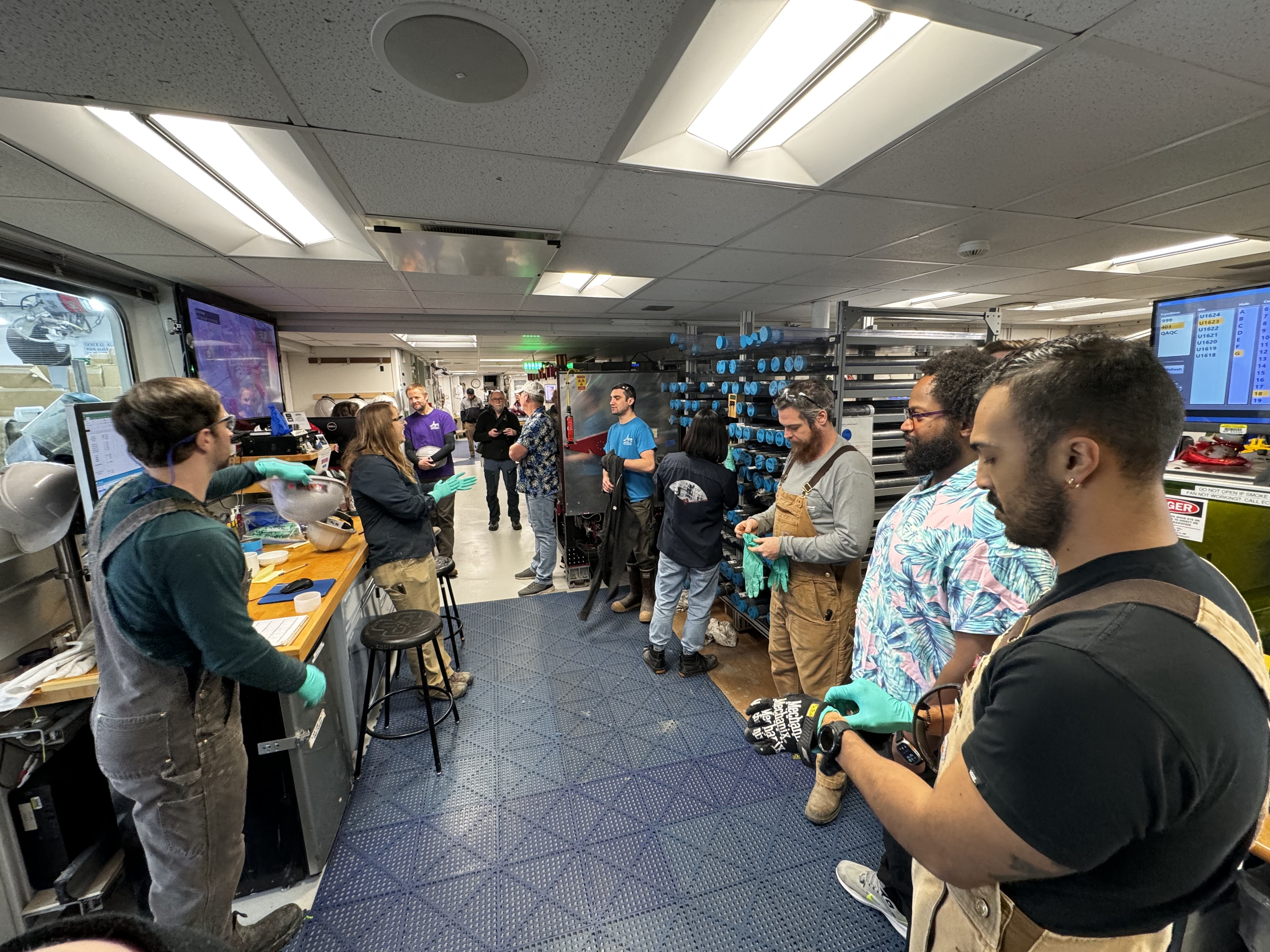
The rest of the day goes by too quickly. Process the cores, work on reports, take a break to eat sweets, back to work. I watch the time tick by on the round black and white clock that hangs on the back wall of the sedimentology lab. Watching the hands move, marking the passage of time is hell. Finally, we get word that we only have 3-4 more cores to be drilled. I decide to make the best of it and rally up the sedimentology team to help the marine science technicians (techs) bring one of the cores onto the ship. This is the first time we’ve done this as a team, and it is a blessed distraction. Pictures are taken, the techs are super accommodating of us, a grand time all around. Every expedition is a success because of the skills and expertise of the techs. They are the ones who ensure the cores make it from the drill deck into the labs safely, who curate the cores and ensure they are labeled and stored properly. Maintenance of the equipment and computer programs is up to them. More than that, they are a critical part of a well-oiled human machine synchronized to deliver the sediments to the scientists. They are the ones without whom none of these expeditions would be possible. In return, they have traveled the world together, made priceless memories, and become each other’s home away from home. The scientists leave the ship and go back to our jobs and research; most of the techs will walk off the ship jobless after this expedition. The time is approximately 8:00 am. Four more hours until the last core, four more hours until the program ends.
The Marine Science Technicians processing the second to last core on the catwalk.
Hours later, one of the toolpushers comes into the Core Lab. There will only be two more cores, these are the last two that we will drill. The anxiety is full-blown at this time, there’s no way I can work in this state. I decide to do what I can, but when the third and second to last cores come up, I’m out on the core deck with the techs. Through art is comfort, and that’s what I seek. I play photographer, capturing the last moments the techs have to work together and perform a critical part of their job. Watching them do their tasks so effortlessly and in sync through my phone eases the dread. Are they feeling this dread and anxiety too? Are they okay? The techs joke with the drill floor roughnecks, who, despite working the hardest on the ship with heavy equipment 12 hours a day in all kinds of weather, keep up a positive attitude. The roughnecks are also part of the well-oiled machine: they care for the drilling equipment, build the drill strings at each new site, hoist the drilled sediment cores onto the deck. Two months on, two months off, they have made a huge sacrifice for the drilling program by being away from their homes and families for half of the year. Just last week, they were notified by the JR’s owner, SEA1, their positions will be terminated after this expedition. And it’s not just the roughnecks, it is everyone on this ship that works for SEA1: the captain, the offshore installation manager, all the way across the board. Everyone. The time is approximately 10:00 am. Two more hours until the last core, two more hours until the program ends.
The toolpushers and roughnecks on the drill floor. Photo by Chris Lyons.
It’s now 11:30 am, and I can’t work. My brain isn’t into doing the work, and neither is my heart. I can’t focus. It feels as if we’re all living through a murder, we’re all witnesses to the atrocity that is happening. And we can’t stop it. Shortly after, the expedition project manager, Thomas, comes into the sedimentology lab. ‘A few folks asked if the scientists are going to bring in the last core, but the techs should do it’. We agree heartily; this moment should be for them and we, the scientists, should stand by in solidarity and support. At 11:45, the techs and scientists each have their own crossover meetings, with the scientists assembling in the core lab, and the techs assembling near their workstations across from us. But today is different; the scientists are with the techs, we stand with them as we all await the last core to ever be drilled by the JR. TV screens in the labs show the drill floor, and a number at the top of the screen counts down, indicating the depth at which the core is. The core is coming up fast, it will be here soon. The techs are blasting ‘Whiskey in the Barrel’ by Metallica, waiting for the last ‘Core on deck!’ to be called.
The techs and scientists lined up by the door that leads out to the catwalk, awaiting the last core on deck.
The call comes at 12:20 pm. The normal ‘core on deck’ call, announced by the driller, is replaced by the voices of our expedition’s two co-chief scientists, Renata and Kristen. In the early days of scientific ocean drilling, the science parties were dominated by mid- to later-career men. The expedition we are on not only has two women co-chiefs, but it also contains a higher number of early career scientists than normal (PhD students, postdocs, those who have recently graduated from their graduate program and are a few years into their new jobs and careers). The science party contains 25 scientists, 15 of which are women. The average percentage of women from the last decade of expeditions has been about 52%; the average percent of early career scientists has averaged 33%. Career foundations have been built on this ship, scientific collaborations forged that have led to huge contributions to geology and the Earth sciences. I first learned about sailing on the JR while a naive undergraduate student. I went on to become one of those scientists who built a large foundation of my career upon scientific ocean drilling. As an Assistant Professor with four PhD students, I think of them and mourn the loss of the opportunities they will miss out on, and other graduate students, postdocs, professors, career professionals that will never get to experience this.
A stream of technicians come onto the catwalk and line up at the end, waiting for the roughnecks to pull the last core out of the core barrel and hand it off to them. I feel that I have to witness this; I can’t stand idly by in the Core Lab. Despite the chaos of the moment and the two film cameras pointed at the action, I sneak to the end of the catwalk to watch this moment, to be within it. The techs do their jobs, pulling the core onto the core deck, laying the long plastic tube containing precious seafloor sediments on the core holders. Wipe them down, measure them, cut them, cap the ends, take them into the Core Lab for labeling and to warm up to room temperature before being processed further. I sneak back inside through the Paleontology Lab side door so as not to disturb the flow of the work on the catwalk. Walking through the Core Lab, the scientists are gathered at the other end of the lab, lined up near the door where the techs bring in core sections. As the techs bring in the cut sections of the core, we cheer and clap for them.
The technicians on the catwalk bringing in the last core to be drilled on the JOIDES Resolution.
As the last core section is put in the racks in the Core Lab, it is approximately 12:40 pm. The roughnecks will now begin to disassemble the drill string, pulling up pipe that is dangling to the bottom of the ocean. Last minute tasks will be done, and we’ll set sail back to port in a few hours. In about six days, we’ll pull into port in Amsterdam, and for the last time, the crew, techs, and scientists will disembark from the JOIDES Resolution.
I go down to the mess hall for dinner, as it’s now close to the time dinner will stop being served. Oddly, I feel some relief; the anticipation of the last core is over. The heavy sadness remains, but this will dissipate in the coming days as I decide to enjoy the last remaining time on the ship with my new science family, absorbing all the good moments that I can. I walk back up the stairs after dinner, heading past the Core Deck on my way to Bridge Deck. The door to the Core Deck has a large window, and through it is the whiteboard for which the techs write the site we are currently drilling, the cores that we’ve drilled, the time they’ve come up, and the recovered length. It is customary at the end of every expedition to write ‘EOH’, ‘EOS’, EOX’ at the base of the board. But this time, there is a different three letter acronym written in blue: ‘EOP’.
End of Hole, End of Site, End of Expedition, End of Program.
The Core Lab board as seen through the Core Deck door.
Victoria’s shipboard role is being a paleomagnetist.
Field work summer of ’22, Central Mongolia. The research team discusses structural geology problems. Victoria joined as a member of the Utah Paleomagnetic Center at the University of Utah.
Tell us a little bit about yourself. Describe your hobbies and interests outside of science. I spend a lot of time outdoors; skiing, hiking, rollerblading or skateboarding. I also read lots of fantasy books and enjoy listening to live music. I try to travel as often as I can and immerse myself in different cultures.
What kind of scientist are you and what do you do? I am a graduate student and I identify as a Rock Magnetist. I analyze the magnetic properties of rocks and minerals to learn more about geological processes, environmental conditions, and the history of Earth’s magnetic field. I am passionate about early geoscience education. I spent a year working with a local middle school, bringing hands-on experiments and facilitating field trips revolving around earth science and geology. I volunteer at outreach events as often as I can.
Field work summer of ’22, Central Mongolia. Another image of the research team discussing geology.Field work summer of ’22, Central Mongolia. I am using a Brunton to take an oriented hand sample for paleomag (to interpret the magnetic signal of the Earth from deep time).
What is your favorite part about being a scientist, and how did you get interested in science? I have a very non-linear path. I took a few years off between high school and college, working at a local bar with no thought about higher education. I decided to go back to school and entered college as an anthropology major, took one geology course and fell in love. Our Geoclub held field trips every long weekend, where I was able to spend time camping outside with friends and learning about rocks. It is those moments that made me want to become a geologist. I also have an undergraduate degree in anthropology. I try to use it as often as possible, with my senior thesis being an archeo-magnetic study on Floridan potsherds. I am also currently involved in geoarchaeology research on roman concrete. I am president of Energy Club (an adaption of AAPG) at the University of Utah. With this club, I coordinate monthly seminars with industry professionals with the aim of teaching undergraduate student’s transferable skills (importance of machine learning in geoscience, adobe Illustrator for figure making, etc) and sharing career trajectories (hosting career panels filled with government, industry, and academics). We also hold a yearly department poster session with monetary awards for both graduate and undergraduate students. This coming year, we hope to hold an “earth science art exhibit” where students and professors can show off their artistic side with paintings of field sites, ‘beautiful’ data sets, and even a ‘bake your thesis’ category.
Field work in the Tetons in Wyoming, we had to get helicoptered in and we camped on the ice!
How did you learn about scientific ocean drilling? I told my advisor I would love to be on a research vessel and he shared with me the call for a paleomagnetist for this expedition.
How does your work contribute to the betterment of society in general? Magneto stratigraphy helps us date sediments. Rock magnetism can tell us about the strength and direction of the magnetic field at a certain time and location. It is also used to better understand tectonic processes.
More field photos from the ice after we helicoptered in. ! I assisted a friend with their work, acting as a geotech as they cored lake sediments for paleoclimate studies.
What advice do you have for prospective scientists? It truly is for anyone! People from all different backgrounds find their way into geoscience.
Have you received a piece of advice from your friends/mentors/advisors that has helped you navigate your career? Don’t be in a rush. Do what makes you excited, doing it fast while stressed out helps no one.
How did you get into science? I’m a first generation student who grew up in rural East Tennessee and unfortunately didn’t have a great science education heading into college. I didn’t know science was something I liked and could be good at until college and graduate school was never on my radar. I found geology through my love of rock climbing, and luckily had a professor offer to let me tag along on some field work, which kickstarted my research career. That same professor later encouraged me to apply to grad school and helped me through the process.
How did you learn about scientific ocean drilling? My advisor sailed on Expedition 396, and I’ve been working on samples from that expedition for the past two years.
What is your role on the ship? I study lavas that come from the Earth’s mantle to see what they can tell us about what the mantle is made of since we can’t directly sample the mantle or go see it.
Do you use proxy data in your research? Using the geochemistry of basalts (the type of lava typically erupted on the ocean floor) to deduce what the mantle is made of is a type of proxy work, but it’s quite tricky. There’s still so much we don’t know! I’ve developed numerical models to help constrain the possible chemical make-up of mantle source rocks based on the composition of lavas erupted at the surface.
How does your work contribute to the understanding of our Earth? Continental rifting is a primary tectonic process and major shaper of the Earth, yet it’s still not fully understood. My research tells us about what the Earth’s mantle is doing throughout the rifting process and if/how the mantle conditions control the type of rifts produced.
How are you training the next generation of scientists? My university has a great program called the Undergraduate Mentor Development Program which allows graduate students to be certified mentors for undergraduates interested in doing research. I completed the program my first semester as a Ph.D. student and have been mentoring the same undergraduate student since my second semester. It’s so rewarding to see how excited she gets about science and it’s been great to see her grow as a scientist.
Do you conduct scientific outreach? I spent last semester in a local high school working with geology and biology classes to help bring my science to them, but also to observe and learn from their teachers how to best communicate science to teenagers.
What are your hobbies and interests outside of science? I enjoy reading and outdoor recreation, especially climbing and skiing.
Is there anything else about yourself you would like to share? I do it all for my dog and two cats.
What advice do you have for prospective scientists? Science is for everyone! Scientists are often portrayed in the media as stuffy old dudes that take themselves way too seriously, but we’re just normal people with a lot of curiosity about the world around us.
Fake it until you make it is a big one for me. Imposter syndrome is real, and sometimes it helps just to keep in mind that a lot of people feel like they’re faking it when from the outside they’re obviously crushing it.