The Significance of Cherishing BIPOC Perspectives

A picture of me at my favorite stop during the experience; the Rancho La Brea tar pits museum in LA. A black woman with blue braids wearing a black and white shirt and black pants stands in front of a fence, some sedges, and some buildings.

I recently attended a field trip and some presentations with the ADI Geo-History program at the University of Missouri. During those presentations, we learned many things about geoheritage, which is defined simply as the intersection of geology with human experiences and values. How these things overlap is crucial to being a responsible geoscientist and preserving and furthering diversity in the geosciences.

Most importantly, we discussed the experiences and struggles of those most marginalized by the colonialist history of the geosciences, those being BIPOC individuals across the planet. BIPOC people have been cruelly subjected to the theft of their land and people, while being forced to share space with the people who committed these atrocities in the first place. As part of this, their voices have historically been, and still are, devalued and overlooked, which inhibits the extent to which BIPOC individuals may participate in and contribute to the geosciences. Being Black myself, I can personally attest to how demeaning and frustrating it is to work in a field where few people look like you, and fewer still seem to have any interest in listening to your lived experiences or even giving you the space to discuss them in the first place. This creates the imperative to amplify these voices, ensuring that BIPOC people are given the space to share their perspectives and weigh in on practices that directly affect them. Too often, BIPOC people are spoken for and about rather than being the ones to tell their own stories. Attending presentations about Indigenous knowledge and perspectives and the importance of listening to and valuing these perspectives gave me hope that the discipline is making progress toward making this practice more commonplace.

A picture of some of the fossil collections in the museum that we were allowed to look at. Various fossil boxes, a picture of mammoth skeletons, a mammoth tooth, and a saber-tooth cat skull are depicted.

I heard from people who are actively working to make a difference in the state of diversity and inclusion in the geosciences. Teachers presented their work on creating databases and accessible learning resources about geoheritage sites that students themselves could edit and improve. This allows students with personal or cultural connections to sites to add their voices to the things people could learn about them, reinforcing the importance of responsible environmental stewardship and respect for the land they inhabit. Others discussed a thought process of seeing the world with two eyes, those of a scientist, and those of a person with feelings for the world around them and valuing both perspectives differently depending on the situation to create a more holistic view of the world instead of seeing things unemotionally. Scientists often see the world overly rationally, discounting personal thoughts and emotions of those affected by science and only giving weight to the scientific value of their work. We also discussed specific geoheritage sites and their significance to different kinds of people, not only focusing on the significance white people assigned to them after stripping them of their true, original value. This was very nice to see as somebody who is far too accustomed to watching these kinds of things be ignored by the greater geoscience community.

While all of this was heartwarming to see and gave me hope for the future of the geosciences, it also inspired me to want to do more work on improving the state of diversity, equity, and inclusion in my field. Moreover, I gained some new ideas on how to proceed in that work. I now have some specific objectives I want to put effort into, such as helping to contribute to communal learning resources like the ones I learned about in the program and incorporating them and elements of them into the courses I teach in the future. Furthermore, I want to impart on my students the importance of geoheritage: how to value it and the voices that shape it. Ultimately, what I took away from my time with the program was the imperative to continue working on amplifying BIPOC voices and perspectives, and the knowledge that many others are doing the same. Especially today more than ever, in these times where diversity itself is being challenged as a valid concept, and people of diverse backgrounds are being made to feel unsafe and insecure in their jobs and place of learning, I believe it is more crucial than ever to fight to protect diversity and to remember its importance to our field.

https://msstate.co1.qualtrics.com/jfe/form/SV_8vonPetQQ5IJHcG
Please consider providing feedback about your thoughts on geohistory and this post using the link or QR code above!

Challenges and Losses with the Non-Renewal of the JOIDES Resolution: An Interview

Interview with Glenn Barrett, Offshore Installation Manager of the JOIDES Resolution with SEA1 Offshore

The scientific ocean drilling (SciOD) community has relied on the riserless drilling capabilities of the research vessel JOIDES Resolution since 1985 to retrieve sediment and rock cores from below the seafloor to advance knowledge about our oceans and Earth. The loss of the JR and U.S.-led SciOD, even temporarily, has huge implications for the science community, which have been published on and written about elsewhere.  Here, we discuss the loss of expertise and equipment with the non-renewal of the contract between the National Science Foundation (NSF) and SEA1 Offshore. Importantly, challenges to building a new U.S.-owned and operated riserless drillship are also discussed.

Special thank you to Tim Lyons, Chris Lyons, and Khyber Jones of Slingshot Pictures, LLC for technical support. 


Double rainbow in the Fram Strait, in front of the research vessel JOIDES Resolution. Drone image by Chris Lyons.


End of Hole, End of Site, End of Expedition, End of Program

Thursday July 24th, 2024

I wake up with dread; the feeling of rocks in my stomach anchoring me to this day, churning of emotions like waves in a storm. This is surreal, this can’t be it. This entire experience has felt like a dream, but this day is hell. We knew the time was drawing nearer, and we knew years ago that this day would happen. Perhaps naively, I didn’t think it would come to fruition. I thought the program would be saved, the government and funding agencies would come to their senses and scramble to provide funding to keep the ship and program afloat. But that isn’t the case.

I go through my daily routine: wake up in my cabin at 22:00, take a shower, gather my things, drop off my bookbag and coat in the conference room. Meet my colleagues in the mess hall for our usual breakfast together (two eggs over medium, a bowl of fruit, a glass of water, toast with cream cheese for me). Around 22:35, head to Bridge Deck to start the French press of coffee for myself and colleagues. Head back down to the Core Lab at 22:45 for the crossover meeting with the sedimentology team. The routine is familiar, a comfort through the turmoil that is raging in my heart and stomach.

Friday July 25th, 2024

Today is the day that the research vessel JOIDES Resolution will deliver us her last sediment core. We lovingly call her ‘the JR’ for short. Since 1985, the ship has been drilling all over the world ocean, retrieving rocks and sediments from below the seafloor. The contributions this vessel has made to science are massive. The third expedition, sediments and the oceanic rocks below the sediments were drilled from the southwest Atlantic to prove the hypothesis of plate tectonics and seafloor spreading. Antarctic and Arctic ice sheet melting, and under what conditions the ice melts, has been quantified from expeditions taking place in the high latitudes of both poles. The microbial communities living within the seafloor sediments and rocks is one of the lesser-known biological communities on Earth; the JR has retrieved these rocks and sediments so scientists can study them. Viruses, bacteria, archaea, all living at depths in our ocean unattainable to humans without the help of the riserless drilling capabilities of the JR. Ancient DNA is a rather new and quickly advancing field. Scientists can attain DNA bits preserved in sediments to look at ancient ecosystems through time, and how they’ve shifted and changed in response to past warming and cooling events. The reason we know how warm the Earth was in the more recent past, and how our oceans, atmosphere, ice sheets have responded to these warming events is because of the JR. This 46-year-old ship and her skilled crew are paving the way for scientists to ask more complex and compelling questions about our Earth and how it works, who lives here, how we can harness this information for the betterment of the planet and humanity. All of these amazing discoveries, pushing the boundaries of what we know about our Earth through the geologic past, and pushing the boundaries of science, it comes to an end today.

Drone image of the JOIDES Resolution facing a double rainbow while drilling in the Arctic. Photo by Chris Lyons.

The crew and drill team need to stop drilling at approximately noon today. By the time my team and I are on shift, it is midnight. Twelve hours until the last core, twelve hours until the program ends. We keep busy describing the sediments contained in each core section, its color, any rocks that we see, and other features that might indicate the ancient environments under which these sediments accumulated. The dread is still there, but being around the people I’ve come to love the most on the ship helps. When you’re at sea for two months, it is amazing how close you become with your colleagues. You rely on each other not just to get the scientific work done, but for laughs, for comfort, for staying in touch with your humanity. We are human first, scientists second. That’s important to keep in mind while sailing on the JR, working twelve hours a day for two months straight.

The night shift scientists, who work 12 am to 12 pm, around one of the Sedimentology Lab tables, with the last core drilled aboard the JOIDES Resolution.

Lunch always marks the half-way point of the day. This too has become a treasured routine. 5:15 am, go downstairs to the mess hall with Kat, sometimes Nicole comes too. Glenn comes down usually a few minutes after us, we eat. Glenn and I have a commitment: one waffle a day for the entire expedition. Syrup and chocolate sauce are both necessities, and now we’ve become accustomed to including a dusting of cinnamon to really jazz up the waffles. If we’re feeling wild, ice cream too. The mood at lunch today is more sober than usual, the dread still there regardless of the laughs we have despite the day. The time is 6:00 am. Six more hours until the last core, six more hours until the program ends.

Lucinda, Nicole, and Glenn check out where everyone is from on a map after lunch waffles.

The rest of the day goes by too quickly. Process the cores, work on reports, take a break to eat sweets, back to work. I watch the time tick by on the round black and white clock that hangs on the back wall of the sedimentology lab. Watching the hands move, marking the passage of time is hell. Finally, we get word that we only have 3-4 more cores to be drilled. I decide to make the best of it and rally up the sedimentology team to help the marine science technicians (techs) bring one of the cores onto the ship. This is the first time we’ve done this as a team, and it is a blessed distraction. Pictures are taken, the techs are super accommodating of us, a grand time all around. Every expedition is a success because of the skills and expertise of the techs. They are the ones who ensure the cores make it from the drill deck into the labs safely, who curate the cores and ensure they are labeled and stored properly. Maintenance of the equipment and computer programs is up to them. More than that, they are a critical part of a well-oiled human machine synchronized to deliver the sediments to the scientists. They are the ones without whom none of these expeditions would be possible. In return, they have traveled the world together, made priceless memories, and become each other’s home away from home. The scientists leave the ship and go back to our jobs and research; most of the techs will walk off the ship jobless after this expedition. The time is approximately 8:00 am. Four more hours until the last core, four more hours until the program ends.

The Marine Science Technicians processing the second to last core on the catwalk.

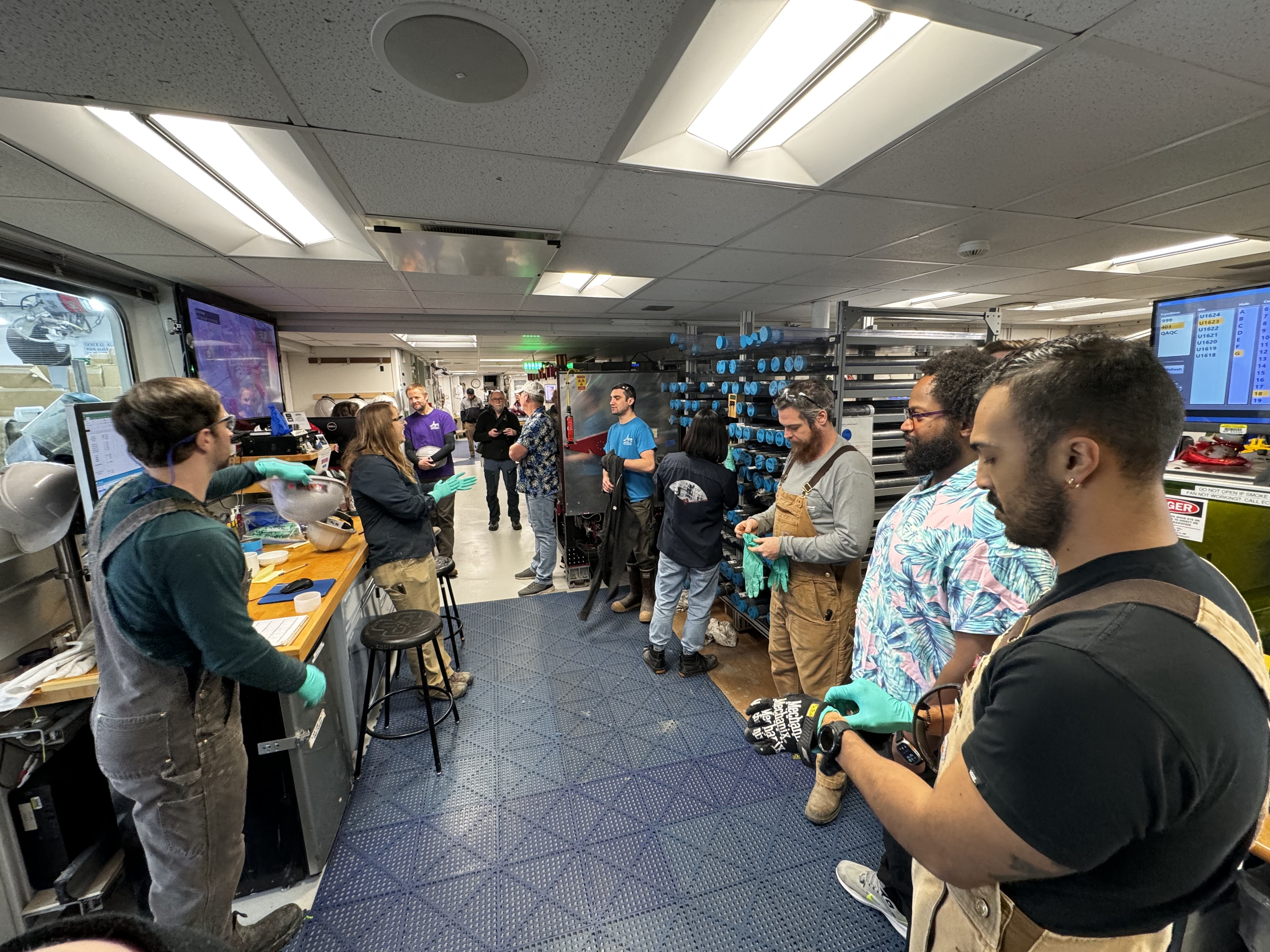
Hours later, one of the toolpushers comes into the Core Lab. There will only be two more cores, these are the last two that we will drill. The anxiety is full-blown at this time, there’s no way I can work in this state. I decide to do what I can, but when the third and second to last cores come up, I’m out on the core deck with the techs. Through art is comfort, and that’s what I seek. I play photographer, capturing the last moments the techs have to work together and perform a critical part of their job. Watching them do their tasks so effortlessly and in sync through my phone eases the dread. Are they feeling this dread and anxiety too? Are they okay? The techs joke with the drill floor roughnecks, who, despite working the hardest on the ship with heavy equipment 12 hours a day in all kinds of weather, keep up a positive attitude. The roughnecks are also part of the well-oiled machine: they care for the drilling equipment, build the drill strings at each new site, hoist the drilled sediment cores onto the deck. Two months on, two months off, they have made a huge sacrifice for the drilling program by being away from their homes and families for half of the year. Just last week, they were notified by the JR’s owner, SEA1, their positions will be terminated after this expedition. And it’s not just the roughnecks, it is everyone on this ship that works for SEA1: the captain, the offshore installation manager, all the way across the board. Everyone. The time is approximately 10:00 am. Two more hours until the last core, two more hours until the program ends.

The toolpushers and roughnecks on the drill floor. Photo by Chris Lyons.

It’s now 11:30 am, and I can’t work. My brain isn’t into doing the work, and neither is my heart. I can’t focus. It feels as if we’re all living through a murder, we’re all witnesses to the atrocity that is happening. And we can’t stop it. Shortly after, the expedition project manager, Thomas, comes into the sedimentology lab. ‘A few folks asked if the scientists are going to bring in the last core, but the techs should do it’. We agree heartily; this moment should be for them and we, the scientists, should stand by in solidarity and support. At 11:45, the techs and scientists each have their own crossover meetings, with the scientists assembling in the core lab, and the techs assembling near their workstations across from us. But today is different; the scientists are with the techs, we stand with them as we all await the last core to ever be drilled by the JR. TV screens in the labs show the drill floor, and a number at the top of the screen counts down, indicating the depth at which the core is. The core is coming up fast, it will be here soon. The techs are blasting ‘Whiskey in the Barrel’ by Metallica, waiting for the last ‘Core on deck!’ to be called.

The techs and scientists lined up by the door that leads out to the catwalk, awaiting the last core on deck.

The call comes at 12:20 pm. The normal ‘core on deck’ call, announced by the driller, is replaced by the voices of our expedition’s two co-chief scientists, Renata and Kristen. In the early days of scientific ocean drilling, the science parties were dominated by mid- to later-career men. The expedition we are on not only has two women co-chiefs, but it also contains a higher number of early career scientists than normal (PhD students, postdocs, those who have recently graduated from their graduate program and are a few years into their new jobs and careers). The science party contains 25 scientists, 15 of which are women. The average percentage of women from the last decade of expeditions has been about 52%; the average percent of early career scientists has averaged 33%. Career foundations have been built on this ship, scientific collaborations forged that have led to huge contributions to geology and the Earth sciences. I first learned about sailing on the JR while a naive undergraduate student. I went on to become one of those scientists who built a large foundation of my career upon scientific ocean drilling. As an Assistant Professor with four PhD students, I think of them and mourn the loss of the opportunities they will miss out on, and other graduate students, postdocs, professors, career professionals that will never get to experience this.

A stream of technicians come onto the catwalk and line up at the end, waiting for the roughnecks to pull the last core out of the core barrel and hand it off to them. I feel that I have to witness this; I can’t stand idly by in the Core Lab. Despite the chaos of the moment and the two film cameras pointed at the action, I sneak to the end of the catwalk to watch this moment, to be within it. The techs do their jobs, pulling the core onto the core deck, laying the long plastic tube containing precious seafloor sediments on the core holders. Wipe them down, measure them, cut them, cap the ends, take them into the Core Lab for labeling and to warm up to room temperature before being processed further. I sneak back inside through the Paleontology Lab side door so as not to disturb the flow of the work on the catwalk. Walking through the Core Lab, the scientists are gathered at the other end of the lab, lined up near the door where the techs bring in core sections. As the techs bring in the cut sections of the core, we cheer and clap for them.

The technicians on the catwalk bringing in the last core to be drilled on the JOIDES Resolution.

As the last core section is put in the racks in the Core Lab, it is approximately 12:40 pm. The roughnecks will now begin to disassemble the drill string, pulling up pipe that is dangling to the bottom of the ocean. Last minute tasks will be done, and we’ll set sail back to port in a few hours. In about six days, we’ll pull into port in Amsterdam, and for the last time, the crew, techs, and scientists will disembark from the JOIDES Resolution.

I go down to the mess hall for dinner, as it’s now close to the time dinner will stop being served. Oddly, I feel some relief; the anticipation of the last core is over. The heavy sadness remains, but this will dissipate in the coming days as I decide to enjoy the last remaining time on the ship with my new science family, absorbing all the good moments that I can. I walk back up the stairs after dinner, heading past the Core Deck on my way to Bridge Deck. The door to the Core Deck has a large window, and through it is the whiteboard for which the techs write the site we are currently drilling, the cores that we’ve drilled, the time they’ve come up, and the recovered length. It is customary at the end of every expedition to write ‘EOH’, ‘EOS’, EOX’ at the base of the board. But this time, there is a different three letter acronym written in blue: ‘EOP’.

End of Hole, End of Site, End of Expedition, End of Program.

The Core Lab board as seen through the Core Deck door.

The Importance of Mentorship

This post is written by an anonymous guest blogger

Starting a new job is one of the biggest challenges we face, no matter what stage of our careers. 

When we enter a new workspace – whether within academia, adjacent, or outside – we most likely will need a navigator to help us find our way. This can be an individual (or a group of individuals) who guides our way and helps us to understand exactly where we are and what we need to do to thrive and succeed. Supervisors, line managers and/or experienced colleagues all play the role of a mentor. Mentors don’t have to be formal and acquired through a scheme, they can be informal too – those we meet by accident, on social media, through colleagues, or at an event. Having multiple mentors who fulfil different needs can be  really helpful, and ensures that we get support in different areas of our professional life. 

New workspace environments bring new people, new protocols and processes, new cultures, new team dynamics and new spaces to figure out. If you feel different to those in your team, the start of a new role can feel even more isolating, especially if you’re the newbie joining a well established team. Starting remotely makes things even harder, because you can’t work things out just by watching folks around you and listening to what’s happening. You have snippets of your environment broken down into multiple short video calls. Constant video calls are tiring. It’s stressful not knowing if new colleagues will respect your time or working hours, or their reactions if you make a mistake. However, remote working has had many benefits for many, particularly those from historically excluded groups and caregivers and this should not be forgotten as a lesson of the ongoing COVID-19 pandemic. It has revolutionalised the way we work and the way we view life – and in this sense it has been a positive development and hopefully organisations will adapt and keep this new way of working. But settling into a role – remote or in-person – can only work well if the current staff make an effort to describe and demystify their environment, offer tips, communicate regularly, check in on new team members, and introduce them to other colleagues. Hidden curricula exist everywhere within all environments. Office politics aren’t obvious. Not everyone enjoys answering questions – some even go as far as sounding annoyed when you ask “why? or reprimand newbies for taking up their time due to asking questions.  Promotion criteria aren’t always transparent. Opportunities to get folks into higher positions aren’t always allocated equitably. Stretch work isn’t always highlighted or offered. Senior mentors in particular play a role in highlighting these types of things. 

Mentors are essential and imperative for everybody – at all career stages. They are particularly critical for those who are from historically excluded groups who are at higher risk from not being allocated progression opportunities. Effective mentors demystify the hidden curricula which permeate professional environments, make sure opportunities are equitably distributed and advise on where to find opportunities if they themselves can’t offer them.  If you have the ability to be a mentor, you are in a position of seniority, and/or see someone in need – please be that person who lights their way. Remember what you had to know to get to where you are now, and tailor your approach to ensure your mentee thrives (mentoring approaches are not a one-size-fits-all). You could change someone’s life in a positive way and help them reach their full potential by providing advice and opportunities. Only once you start being a brave and transformative leader and mentor have you reached a point of being successful in your career. There is no point generating knowledge if you can’t pass it on, and share the excitement you feel in your environment and work with others. 

Neurodiverse Perspectives in Paleontology: An example of collaborative museum exhibit design and self-advocacy, crafted for and by neurodiverse people

Please welcome guest bloggers, Taormina (Tara) and Katrina Lepore. Tara, a paleontologist, writes about the work she and her sister did to develop an exhibit for neurodiverse folks at Katrina’s life skills workplace. 

My sister and I have always been different. What does ‘being different’ mean, in a big world with endless types of people? Sometimes, our differences are really apparent; other times, they’re much more subtle. Identifying as members of both the disabled and neurodiverse communities brings an awareness to how difference is ‘embodied’ in our societies. And, we think, the perspective that difference can bring makes for better science, and a better world all around. Disabled and neurodiverse people aren’t always under the spotlight in science, but my sister and I decided to work together and make our own museum space with the perspective and ingenuity of these communities.

We began this project in summer 2020, and collaborated with my sister, Katrina’s, life skills workplace, Communitas, Inc. in Woburn, Massachusetts. I’m also affiliated with the University of California Museum of Paleontology (UCMP) at UC Berkeley. Several of Katrina’s coworkers and colleagues participated in a hands-on paleontology day, with the opportunity to make plaster fossil molds, construct a model T. rex skeleton, and identify fossil trading cards with their definitions. The highlight of our paleontology day was the creation of a small fossil museum exhibit in a lobby jewelry case, where all visitors and employees could experience an exhibit crafted with neurodiverse perspectives. It was so fun and a valuable experience to work together on what works, and what doesn’t work, in museum exhibit design for disabled and/or neurodiverse people.

Some of the things we implemented included touchable fossil items, large print labels, and fossil organization by time period and by environment (ocean vs. land, etc.). We also created some augmented reality (AR) prompts where visitors could hold up their phone to a fossil in a specific app, Adobe Aero. The Aero app would recognize the fossil and pop up with a video narrating what the label said, as a way of providing accessibility to non-readers or non-verbal people. The exhibit designers shared that some of the things that are helpful at museums include touchable objects, quiet spaces to interact with exhibits, and more than one way of interacting — for example, videos plus text panels. Things that were challenging for the designers included loud and busy museum spaces, being unable to read or interact with the text panels, and the brightness of the overhead lights in some museum spaces. After the summer museum exhibit design project was completed, Katrina sat down for an interview on the design process and how her experience with museum paleontology felt.

A few online paleontology events also happened over the next year or so, and in summer 2021 we had another in-person paleontology day, focusing on touch tables and bringing museum topics to the same cohort of museum exhibit designers from summer 2020. We’re planning on presenting some of this collaborative work together at a symposium for community connections to natural history collections, this upcoming summer! It’s our hope that my sister and I can continue to learn about paleontology together, and inspire other life skills workplaces and museums to collaborate in including neurodiverse and disabled perspectives in exhibit design.

Life Decisions

Anieke here–

It took a while, but I finally no longer feel like an imposter. My postdoc is going well. I’m confident, I know what I’m doing and I’m loving it. But the project is coming to an end and I have to think about the next steps. I’ve been in my current institute for nearly nine years, a mind-bogglingly long time in Early Career Researcher world, so a new job likely means a new institution. Quite possibly in another country, given the tight job market. Career-wise, I really like the idea of moving around the world for a few more years, work in different labs and do cool research with cool people.

Life-wise, I want to settle down, buy a house, and figure out if I want kids.

I’ll be 33 this year. After the age of 35 a woman’s chances to get pregnant decrease rapidly. These next few years, that career-wise are best spent hopping across continents, are also my last chance to have a family.  

That is, if I want kids at all. Which right now I really don’t know. I’ve always liked kids but never thought of myself as a mum. The time constraints are making this topic an increasing source of stress but I’m no closer to an answer. So what do I do with my job? Rule out major career options in favour of life question that I’ve not figured out yet? Or just go ahead with the postdoc route, likely involving some long-distance relationships with my partner and hope that life will sort itself out eventually? If I went with option 2 and changed my mind, I could always quit the post early to move back to my partner and try and start a family. But it won’t look great on my cv to walk away from a fellowship half-way through. In the hyper-competitive academic world, the tiniest drawbacks can cost you grants and job interviews.

Alternatively, my partner and I could both move. He’s super kind and supportive and would be up for it if I asked. But it would mean dragging him away from his job and life here for a temporary stay abroad. Plus, moving country is hard. It’s enriching, exhilarating and fantastic, but also terrifying, draining and lonely. If that’s how I felt moving for a job I loved, moving country for no reason other than that your partner is going will be even harder. What it would be like while at the same time trying to start a family, I don’t even want to know.

Early-career researchers hoping to balance work and life have to jump through nearly impossible hoops. I’m fully sympathetic to anyone, with women being statistically more likely, ending up leaving academia for this reason. There just aren’t any good solutions. All we can do is figure out which one is the least bad for us.


Workshop Hosting & Planning: Considerations from an Early Career Researcher

Adriane here–

For the past year and a half, I have been a steering committee member, with the purpose of the committee to develop a series of workshops. In this post, I’ll give some background of the initiative, outline the purpose of the workshops, but mainly focus on factors to think about if you, the reader, are considering creating your own workshop or participating on a workshop committee. 

The International Ocean Discovery Program IMPACT Workshops

The steering committee of which I am a part was formed with significant support from the International Ocean Discovery Program, or IODP for short. IODP is a wonderful program in which scientists from participating countries in the program get to sail for two months at sea on a research vessel, which is currently the JOIDES Resolution (JR), and drill sediment cores from the seafloor (click here to learn more about the JR, where it has most recently sailed, where it currently is, and to read blogs written by scientists currently sailing on the ship). 

Every few decades, the scientific ocean drilling community (the general name used for the community of scientists, artists, science communicators, and others who make the program work) come together to write a science framework. The framework outlines the major approaches and important scientific frontiers for the next phase of scientific ocean drilling. Included in the framework are also some broader impact goals. The new science framework was recently published, which outlines such goals and aspirations through 2050; thus, it is aptly named the 2050 Science Framework. Within the broader impacts section of the 2050 Science Framework, sections are included such as ‘Inspiring Educators and the Public through Discovery’, ‘Training the Next Generation of Scientists’, ‘International Collaboration’, ‘Advancing Diversity and Inclusion’, ‘Knowledge Sharing’, and ‘Engaging with Other Fields’.  

My colleagues and I, who are all passionate about these topics, outlined in the 2050 Science Framework broader impacts section and decided to create a series of workshops to chart the future course of science communication and education outreach for scientific ocean drilling. Such efforts are in direct support of the goals outlined in the 2050 Science Framework. Our steering committee is composed of educators and scientists with various experiences and backgrounds in education, science, and policy, all of whom are passionate about education outreach and science communication. 

We decided to name the workshops the IMPACT Workshop Series, which comprises three workshops that ran this past summer 2021, and a larger workshop to (hopefully!) be held in person in June 2022. We decided to focus on three main topics from the 2050 Science Framework: Engaging the Public, Informing Policymakers, and Preparing the Next Generation. Our main steering committee split into three groups to function as smaller steering committees to create each workshop. Specifically, I was on the Preparing the Next Generation sub-committee with three other steering committee members. 

Factors to consider when hosting workshops

Currently, I am a postdoctoral fellow at a large research university. This means I have lots of responsibilities, the most important of which is to support the students working in my lab and keep doing activities that build my experiences as a researcher, scientist, advisor, and science communicator. In other words, I have a busy schedule with lots to do and keep up with! So, before taking on any tasks or saying ‘yes’ to any opportunities, I need to consider very carefully if such opportunity will be hurtful (take up too much of my time without leading to huge outcomes and do not help build up my experiences), or advantageous (take up my time but lead to very exciting opportunities and build my experiences). In addition, before saying yes to opportunities, I also consider if the opportunity is fulfilling to me and aligns with my passions, self-interests, and goals. This bit is likely true for most early career researchers who are currently looking for permanent employment, are pre-tenured faculty, and others who have limited time but want to be involved with their communities. Thus, the advice below is tailored to help folks who may want to create a workshop or join a workshop steering committee think through the benefits of such an endeavor. 

Carefully consider time commitment and workload

In my opinion, time is the most important factor to consider when thinking about creating a workshop. The IMPACT steering committee met about once a week over a year prior to our first workshop, which ran in June 2021. We met for approximately an hour during our meetings, and because we have members from the east coast of the continental U.S. to Hawai’i, these meeting times were outside of normal workday hours for some of us (e.g., 6 pm EST) — which is not uncommon for projects such as this.

As the Next Generation workshop date approached, our sub-committee began meeting sometimes twice a week, for 2–3 hours per meeting. Such longer meetings were essential to finish outlining, planning, and organizing the workshop. Often, all sub-committee members would walk away from the meeting with a ‘To-Do’ list to accomplish before a deadline we all agreed on. Such tasks outside of meetings included things like drafting and sending emails, writing text for the workshop web pages, gathering resources for our web pages, setting up Google Drive folders, and creating slide shows for the day of the workshops. We also set up meeting times with our speakers prior to our 2-day workshop. All of these small tasks and meetings really added up to a large amount of time. About two weeks prior to the Next Generation workshop, I was spending a good chunk of my time in the office dedicated to planning. 

So, careful consideration should be given to how much time you are willing to contribute to creating a workshop, as the time invested can be immense to make the workshop run as smoothly as possible. Looking back, my time and that of my colleagues’ was a good investment, as I am quite passionate about the topics the workshop touched on and know the information we have gathered will help shape the scientific ocean drilling community. 

Fostering a supportive environment for the team

From the above section regarding time commitments, it should be clear that workshop planning takes a lot of work! It is quite easy to join a committee, board, or group and just jump in without being mindful of our behaviors and simple ways in which we may be excluding others (or being excluded ourselves by others’ behaviors), and working and/or communicating in ways that are ineffective .Thus, it is imperative to consider how you can and will create an environment that is comfortable for everyone to talk, listen, and plan together as a team. 

Along those same lines, it is also important  that the team itself is efficient, mindful of others, and works well together. I feel very fortunate that the IMPACT Steering Committee is composed of folks who have previous leadership experience, and bring a lot of different perspectives to the table. These differing perspectives, experience working with groups, and leadership capabilities have created a space where every committee member’s opinion is heard, and it is a comfortable place to voice my own concerns and opinions. This isn’t to say we always agree with one another (we are human, after all), but having a team that knows how to communicate, compromise, and listen is very valuable. 

When building your own team or committee, it is important to have folks involved who have prior leadership experience and are highly organized. In this way, those who may not have had prior leadership experience can learn from this person, and begin to develop their own methods of and style of leadership. For example, one of our steering committee members has had extensive experience organizing and planning workshops. She suggested we have our speakers meet virtually prior to our workshop in order for them to meet one another, for us to more thoroughly explain the workshop goals, and walk them through the schedule. Even though I have leadership experience, this was a new method to me, and it worked wonderfully! I have also learned a ton of other leadership and organizational tips and tricks from the more experienced members on our committee. 

It is also imperative to build a team of people who represent different identities, life experiences, stages in their careers, and specialities. Our IMPACT workshop steering committee decided from the start that we would conduct the meetings and workshops within a JEDIA (justice, equity, diversity, inclusion, accessibility) framework. Breaking down barriers within STEM, or anywhere, to create a more equitaqble, inclusive, and accessible environment for everyone, is a hard and persistent task, and one that is best done when folks from different identities and backgrounds come together and work hard. This is why it is of utmost importance to be sure you are including folks from different identities on your team. For example, I have had to advocate a few times to my group to please include more early career researchers. Other times, folks have pointed out that all of our speakers on our list of potential invitees were white folks. Every time someone on the team has pointed out an observation that does not align with our JEDIA principles, we have worked hard to correct our actions. Thus, when building your team, think about who is not in the room, and whose voices are being excluded. And it is not enough to simply include folks from different identities; ensure, as a leader, they are being heard and respected by all members of the committee. 

Be prepared to be an effective communicator and listener 

As touched on above, communication is key to any successful relationship of any nature. Working with your colleagues on a steering committee to plan a workshop is no different. Clear and concise communication is imperative to make workshop planning as smooth as possible, and can even translate to a more positive experience for your workshop speakers and attendees. Often, such workshop committees are composed of an array of folks from different backgrounds, life experiences, and ages. This means that everyone’s level of comfort with different means of communication will vary, and the best means of communication should be discussed and respected from the start. For example, the IMPACT committee uses email as our primary way of group communication, but we also set up a Slack channel. In addition, the Steering Committee chairs create an agenda for each meeting, and we take Minutes. In this way, if one of our team members is not able to make a meeting, they can easily see what we discussed and the major points of the meeting.

Good communication also includes speaking up when you don’t understand someone’s ideas or thoughts, or are uncomfortable with the direction in which an initiative is heading. But, good communication is more than talking- it also includes good listening skills. Personally, I am trying to teach myself to be a better active and mindful listener to really hear my friends, family, and colleagues. So, when thinking about planning a workshop or joining a workshop committee, get comfortable with good communication (easier said than done, I know), and be open to being more open with your colleagues. 

Acquiring funding for your workshop 

Often, workshops require some level of financial support. Other workshops, if held virtually, may not require funds. If your workshop does require funding, it is important to think about how much funding (approximately) your workshop will require, and how funding will be obtained prior to the initiation of the project. In my opinion, it is totally okay to reach out to other organizations, non-profits, societies, etc. whose missions align with the goals of your workshop and ask for financial support. In addition, there are pots of money available to support workshops, such as the U.S. Science Support Program and the European Consortium for Ocean Research Drilling’s MagellanPlus Workshop Series Programme (both to support endeavors related to scientific ocean drilling).

The Path to Becoming a Paleontologist: Hidden Struggles

This post is part of a series on Time Scavengers about Hidden Disabilities and how these affect scientists and researchers during graduate school, throughout our careers, and in the field and lab.  We welcome contributions from our community, friends, and colleagues to this impactful series.


TRIGGER WARNINGS: Domestic abuse, self harm, suicide attempts, eating disorders

I’ve always known I wanted to be a paleontologist. I was the dinosaur kid and I (kind of) stayed the dinosaur kid. I knew I didn’t look like a paleontologist – all the paleontologists I had seen on TV were white men living their cowboy fantasy, but that didn’t stop me. 

My childhood was spent watching VHS tapes of Walking with…  and Jurassic Park. I would drag my grandfather into the backyard of our tiny apartment complex to look for fossils – often just chunks of limestone with a few bivalves embedded in them. I spent hours at local book sales, looking for old paleontology tomes that I would parse for any bit of knowledge. I began volunteering in our local museum as early as possible and ended up tallying over 300+ hours by the time I finished high school. There was nothing I wanted more than being around the fossils I loved so much.

However, this is not to say there weren’t discouraging moments. During this time at the museum, I learned that museum guests didn’t take me as seriously with my hair down, or that wearing a skirt somehow meant that the facts I was sharing weren’t true. I watched parents shush their daughters and encourage their sons to get excited about the same thing. I heard my mom start repeating their words at home. 

“Stop it. They’ll think you’re weird.”

I started to hate myself, little by little. I couldn’t give up paleontology – it was the one thing I was sure of more than anything – but I hated myself for loving it. This was compounded by the fact that my mother, trying her best to protect me from society’s harsh expectations of women, told me that “boys won’t like [me]” if I kept up this “dinosaur thing”. I’d like to say that this didn’t stop me. I mean, it didn’t stop the paleontology, but I did develop an eating disorder.

There is a common misconception that eating disorders occur because of a desire to be conventionally attractive. That is often not the case. I just wanted to be smaller and have some semblance of control over my life. If you fade into the background, no one notices how you dress like a boy or that your nose is too big or that you can’t shut up about Dilophosaurus. I ended up being significantly smaller – dropping from 140 lbs to 85 lbs in approximately 3 months. Of course, this isn’t normal or healthy for most human bodies. My heart stopped working right. I was hospitalized for anorexia nervosa – a particular type of anorexia that develops in response to anxiety disorders – and missed the last quarter of 7th grade.

The weird thing about being eating-disorder-sick is that people actively encourage you to stay sick. Despite the fact that I couldn’t shower with the lights on or even run without having a heart attack, other students and parents alike told me I was finally “beautiful”. Suddenly, all these boys were paying attention to me. Girls that had bullied me were nice to me. I had my first boyfriend. He told me that when we first met, in 6th grade, he thought I was “fat and ugly” but now I was “gorgeous”. He constantly compared me to my friends. I broke up with him after 5 months. 

It is also important to mention that I was a band kid. Band kids, as the reputation goes, constantly date each other. One of my friends had an obsessive crush on this kid, C. C was quiet. In fact, I had never heard him say a single word during our entire 3 years in middle school band together. I didn’t even know what his last name was. Honestly, he didn’t even seem to have friends – he was always reading and avoiding people whenever we saw him.

Of course, due to middle school peer pressure, we ended up dating.

At first, things were really wonderful. I like to think of him as my first love; we ended up bonding over our mutual love of books and video games. He was the first boy that ever seemed to love me for who I was, and not what I looked like. Due to the large hit to my self-esteem I experienced during my eating disorder and a tumultuous home life, I became increasingly dependent on this relationship. He slowly began isolating me from my friends, insisting that they weren’t good for me or that he absolutely could not stand them. Clinging to him, I cut my friends out with no issue, hoping that it would quell the depression that I had been struggling with. Eventually, he would have anger flare-ups, pounding his hands on the dashboard of the car or throwing things. He began telling me things like, “Oh, I only love you sometimes – you’re not worth it other times.” Things began getting physical, like when he grabbed me hard enough to leave purple-yellow bruises on my shoulders or tried choking me when we got in an argument.

I didn’t leave, though. Not for 5 years. We stayed together through high school and into college, despite numerous suicide attempts on my part, which he encouraged. Somehow, I stuck through. Nothing changed my love of paleontology either; that was the only thing I kept clinging to through all of it. I funneled all that was left of my energy into volunteering at the museum or schoolwork. I knew that if I managed to get into an earth sciences program, I might finally find some sort of peace.

When I was accepted into university, the first thing I did was reach out to our collections manager and begin volunteering in the paleontology lab, months before my freshman year even started. I think I cried actually, when I first walked into the collections. Part of this was joy: it was the first light in a very, very long darkness. The other half was sadness: I had already resigned myself to being killed in a domestic dispute and had mentally given up on my future as my partner became more and more aggressive.

C began using drugs and drinking heavily; during this time, he also got much more erratic and violent. He began making threats towards me and my classmates.

During this time, though, I had managed to build a small, supportive friend group of other geoscience students. As I began opening up to them, I began to see how truly toxic my partner was. These were the first close friends I was allowed to have in years, as C didn’t go to the same college as me and thus, I could experience small tastes of freedom.

Bit by bit, I finally got the courage (and was forced by a mandated reporter) to go to the university police. This was ultimately a very dangerous decision. They notified him that someone at my university had reported him; he got kicked out of his program at his college for substance abuse. Additionally, considering that he was a loner and I was one of his only contacts, he immediately knew that it was me that had reported him. I was also told that none of his texts were immediate threats, so their hands were tied. I stayed with him another 4 months as he became even more erratic. I ended up losing my research position because I had to spend so many hours on the phone convincing him to not do something harmful and scary. I ended up with a reputation for being flaky, despite the fact that I would spend nights scanning fossils while crying into the phone. I couldn’t walk on campus alone anymore and refused to see him, even though we were still technically in a relationship. 

I was terrified that he would kill everyone I knew if I broke it off.

Eventually, I was so exhausted from living in fear that I just… never responded to another text. He responded by calling every member of my family and driving by my house. I ignored him. My family encouraged me to repair the relationship and keep the peace; I didn’t. 

He found new ways, year after year, to contact me and drag me back into his circle of influence. He kept driving by my house. He found new relatives to contact. He sent me letters. 

I found my solace in the museum. I poured every ounce of my soul into paleontology – it was my safe place. I made more friends with similar interests to mine. I became stronger and stronger. He never stopped bothering me, but he became more of a looming background presence than a main presence in my life. I had a home and a family outside of my biological family. I had research that I was immensely passionate about. No one was there to hold me back anymore; yes, C would sometimes send me threatening texts or appear around my house, but this was rare. I finally had freedom and it was amazing.

Eventually, I found my real way out: graduate school. I was able to change my location, and thus, he could no longer find my real position. I have never felt such peace of mind and I have never loved paleontology more. 

Thank you for reading.

Note: Leaving isn’t really an answer, for many people, as not everyone can uproot themselves and escape abusive situations. I urge everyone to find their own way out – my sway is not necessarily the best way to respond to a situation like this; as I said, this is *my* story, and how I managed to find (possibly momental) safety. There are also many details I left out to protect my safety.

If you or someone you love is in a domestic violence situation, the National Domestic Violence Hotline has a list of resources to begin getting help: https://www.thehotline.org/resources/victims-and-survivors/

You can also call them via:
National Domestic Violence Hotline
1-800-799-7233
1-800-787-3224 (TTY)

If you would like to learn more about eating disorders, Anorexia nervosa and Associated Disorders (ANAD; anad.org) and the National Eating Disorders Association (NEDA; nationaleatingdisorders.org) have resources.

You should apply for that: 10 tips for scholarship applications

Kristina here –

Applying for funding, scholarships, fellowships, and awards can be a daunting task, but it is an important part of most research careers. Not only can funding help you complete new research projects and have more opportunities that will lead to your growth and success, but funding and awards also look good on your CV/resume, which can also contribute to your continued success. One of the biggest lessons I’ve learned is that it truly never hurts to apply (within reason). Even if you are unsuccessful, there are still many potential benefits. Here are just a few reasons you should consider applying for that opportunity:

Why Apply?

  • The more you practice, the better your applications will become. Each time I apply for an opportunity, I learn something and find a way to make my application stronger. You also give yourself a framework that you can use for other future opportunities.
  • When I was in my last year of high-school, my dad said something that has always really stuck with me. He said, “It [the application] is the best hourly wage you’ll ever make”. If you think about the hours you put into each application, the potential financial benefit is huge.
  • For better or worse, sometimes funding begets funding. If you can show that you’ve had success in the past and used those opportunities to create tangible research products, such as posters, workshops, talks, publications, etc., you might be more likely to get further “buy-in” from potential funders. One notable exception would be funding opportunities where you are required to demonstrate financial need (being open and honest for those kinds of applications is very important, but don’t discount yourself automatically).
  • If you are successful, you might create opportunities for others. This might sound strange, and certainly is not always the case, but if you are able to fund yourself, you might allow your supervisor or lab to put more funds towards another person.
  • Don’t say no to yourself. Over the years, I’ve come to the realization that it’s hard to predict how an application will be received. There are applications that I felt good about that were rejected, and others where I didn’t think I stood a chance, yet was successful. It is unfair not to give yourself a chance.

Often, I’m asked for help or to review student applications, so I thought I would try to share some of the patterns I’ve noticed on successful applications. Most of this advice is geared toward funding opportunities for students, but I think the general patterns could be applied to many opportunities. Here are my top 10 suggestions:

Tips for applying

  1. Read the instructions and do your homework

While it sounds pretty basic, following the application instructions carefully is one of the most important things to make sure your application is well evaluated. There are going to be lots of good applications so failing to follow the instructions or not sticking to the guidelines is an easy way for the evaluators to toss or bump down your application.

Is there a rubric? Follow it! A lot of scholarships will have their rubrics or marking criteria laid out, so the best thing to do is follow that as carefully as possible. Make sure you are addressing each of the criteria given, and include the same terminology that they use. Essentially, you want to “tick” as many boxes as you can and use the same language they do.

Are there additional resources or guidelines available? Take advantages of them! For example, some funders may have a FAQ page, or might even have video resources with tips and tricks from those that are evaluating applications (see here for a YouTube series by NSERC). It might seem like overkill, but taking the time to search for those resources are often very informative and can help you avoid common mistakes, or find ways to make your application stand out. Attending info sessions is also a great idea.

Can you find examples of successful applications? Pay close attention to those! Asking someone you know for an example of their successful proposal, or looking for any that might be available online, is a great way to help you identify what makes an application successful. It can be scary to ask, but most people are happy to pay it forward. It’s also helpful to look at more than one application so you can start to identify common frameworks of successful applications.

  1. Ask for references early!

Asking people for references can be very stressful, especially when everyone is so busy and may have limited capacity. It is therefore crucial to ask early and make it as easy as possible for someone to give you a stellar reference. Choosing your referees can also be somewhat strategic, so make sure you give a lot of thought as to who would be able and willing to write or give you the best reference, which of your strengths or skills they can speak to, and how those references will be perceived (e.g., how well-rounded are your references in your application package and how well do your referees know you?).

Make it easy for your referees. There are several things they might ask of you, but it is just as important to be clear about what you need from your referees. Here are my top suggestions for helping ensure you get the best reference possible: 1) Supply each referee with detailed referee instructions and any rubrics they should follow, 2) Give your referees your proposal, an updated CV, and a list of things you’d like them to highlight, such as past successes, research, or other attributes that make you stand out for this specific application, 3) Make sure they know the deadline (I like to give myself at least one day of buffer room), and 4) Follow up about a week before the deadline to check in and see if they need anything (which also serves as a reminder).

  1. Know your audience

Again, this might seem obvious, but most of the time, the people reviewing your application are not experts in your field. It’s important to assume that most people do not have the background knowledge or passion that you have for the topic. Don’t assume people know what you do and use plain, accessible language. Even if a reviewer might be familiar with your topic, it’s always better to err on the side of caution, and will demonstrate your strong communication skills. If you use jargon or acronyms, be sure to explain them carefully. The example often used in communicating your research is to explain it to a family member. Communicating at that level can be tricky, but often helps you draw out the importance and novelty of your research. In fact, many research journals now ask authors to submit a plain-language summary, or a significance statement, that is used to identify potentially news or note-worthy research.

  1. Identify the research gap you are trying to fill

What do we know, and what do we need to know that we currently don’t understand? Not only is it important to place your research in the context of the field, but it is equally important to make sure reviewers understand the limitations of our current knowledge so they can see where you are going with your proposed project. Give some background on the basics of the problem and established research, and clearly state the gap in our current knowledge. Even if it is not a total gap in research, point out the limitations. For example, maybe your topic or question is understudied, poorly understood, or has received little funding or attention.

  1. Make your audience care

Why should the average person care? This is probably one of the most important aspects of your research in general, but it is often more challenging than you’d think to articulate clearly. Finding that balance of making your research appeal to a wide audience, while still being specific enough to your question, is not always an easy task. There are many ways to approach this, but the bottom line is that you must make people care. If you have clearly identified the research gap (see above), sometimes drawing out the importance is easier. Dedicate time to practice iterating these two points (i.e., write them out multiple times until you get the best wording down), and place them early in your proposal (usually the first paragraph). You want to “hook” the audience as soon as you can. Practicing this out loud with another person is another way to help hone your “elevator pitch” both for proposals, and for any applications that might require an interview.

  1. Value and support your worth

It can be challenging to talk about yourself and your work, especially if you suffer from impostor syndrome. In particular, I find that young/early career women often downplay their past success and the novelty of their work (here’s another post by Dr. Victoria Arbour on the subject: “You Project is Good Enough for a Talk”). I still make this mistake regularly and must remind myself that I have worked hard to earn my success (while also recognizing my privilege as a white, middle-class, cis, hetero woman). It can be overwhelming and hard to “own” your success. But making yourself and your research stand out is critical for any application.

Why are you the best person for the job? How are you uniquely positioned to do this research? Make it clear that you have the perfect skill set and background for the job. You might also want to highlight your support team and how they can help you succeed. For example, perhaps your advisor is a leading expert in the field, or has essential equipment or research skills to help you complete your project. Maybe there are also established research relationships, past work, or unique networking opportunities that will add value to your research, and help you become a leader in your field. Make sure you point out not only why the fit of yourself and/or your team is unique, but also try to indicate the potential future benefits. Often funders are looking to build and retain talent that reflects well on them, so you want to get across how this will make you successful, and how this could benefit the funders.

  1. Use clear, strong language

Again, this might seem straightforward, but it can be hard for researchers who are highly cognizant of the nuances and limitations of their fields. There is this tendency to add caveats that will protect us from potentially being wrong, or avoid overstating something, but adding too many clarifiers can weaken your argument. Instead, try to state things as simply as possible, even if you are not getting at all the minutia. Also avoid what my Ph.D. advisor, Dr. Lindsey Leighton, calls “weasel words”, such as “appears to be” or “most likely”, where it looks like you’re trying to soften a statement, even if it is unintentional. From an outside perspective, it either matters, or it doesn’t. You don’t have room for all the details, so provide only what the reader needs to know.

Where possible, create a sense of urgency. Using words like “novel” or “critical” can seem buzz-wordy, but if you back it up with enough evidence (i.e., if you have set up the research gap and its importance, as described above), they can be powerful. This is why setting up your framework is really important. You don’t want to be disingenuous, but your urgency can also convey your passion for the research topic and will hopefully convince the reviewer as well.

  1. What are your hypotheses and expected outcomes?

Make it simple and spell it out. Some of the most effective application proposals I’ve seen are those that are very upfront and clearly lay out their questions and hypotheses. Usually, you can begin by saying “the goals are…”, and then follow it with “my hypotheses are…”. If you have more than one goal and hypothesis, you can number them. One thing I’ve picked up is to use bold font for things like the research question/goals, and/or hypotheses. You want to make it obvious that you understand your objectives and have thought about the expected outcomes. Don’t try to make it too eloquent – simple and straightforward is best.

  1. What will you do to answer your questions?

How will you get there? After you’ve set out your goals and hypotheses, try to take it one step further by explaining how you plan to complete your research. You don’t necessarily need to get into excruciating detail. The goal here is to convince the reviewers that you have clearly thought about what you need to do to complete the research in a timely fashion. You also want to get across that your project is feasible. Getting rejected because a reviewer didn’t think the project was feasible or realistic is unfortunate, but I have heard of it happening.

Lay out the basic steps required to complete your research and provide some overall methodology. You can even break it out for each of your research objectives or hypotheses. For example, something along the lines of: “Goal 1 is to answer x. I expect outcome y. To answer this question, I will do a, b, and then c.” These sentences can be rearranged as you see fit, but this basic framework can be quite effective. You can even follow that with a sentence that gets across the desirable outcome or potential benefits (i.e., link it back to the “why should we care”). Be brief, though, as the methods are not as important as the question and outcomes.

  1. Room for a figure?

Use a figure to highlight your expected outcomes. Like most of what I’ve mentioned, this is just a suggestion, and you may not have the space for one. But, a figure can help a reviewer visualize the potential outcomes of your research and convey that you’ve thought a lot about your questions and even the metrics you might use. Have you ever read a paper with a graphical abstract? It’s the same idea.

Consider presenting your hypotheses graphically. What would an idealized result look like? If there is more than one alternative hypothesis, what do those scenarios look like? What would each result indicate? A figure can help the reviewer anticipate your results, and understand the project’s feasibility. It also helps communicate that you understand the different variables that you will need to test. It may sound cliché, but a picture really can say a thousand words. I recommend trying it out for your own learning purposes, if nothing else.

These are just rough guidelines and suggestions, and may not apply in every instance. You will need to make sure you tailor your application to the opportunity. One final piece of advice is to ask someone to review your application for you. Getting feedback is always really helpful, and might be an expectation of your supervisor/advisor. Even having a peer or more advanced student look over your application can be useful. Don’t feel like you have to do everything entirely on your own.

Above all, remember that it never hurts to try, and don’t say no to yourself because you never know…

My Experience at the Wyoming Dinosaur Center

Ohav here–

Earlier in the spring, I got an email containing a flyer for an internship that grabbed my attention with a simple question: “Do you like dinosaurs and digging in the dirt?”. As an aspiring paleontologist, I thought, to no surprise, “I love both of those things!”, and I looked into the offer further. A few references and an interview later, I had managed to get a position! That May, I would be going to Thermopolis, Wyoming.

When I started my first day, I was surprised at how dense with information the museum was. I knew that being in a small town, the museum would be much smaller than its contemporaries. Even so, I was not prepared for the amount of stuff in that building! Still in awe of all the beautiful specimens in the main hall, the other interns and I began our orientation. There were a handful of programs and activities available which we would work together to lead, the following of which were the most common.

First, were the Museum Tours: the most basic of the activities, but by no means the least fun. It is exactly as it sounds: a tour of the museum. However, we interns were allowed and encouraged to put our own personal spins on them. This meant making our own scripts, deciding which exhibits to focus more on and which can be breezed through, cherry-picking the coolest fun facts to share with our groups, and even including pop culture references. For example, we would often describe the length of our Supersaurus, Jimbo, by using the metric of Jeff Goldblums. Since Jimbo is 120 feet long and Jeff Goldblum is 6’4’’, we estimated that Jimbo was about 19 Jeff Goldblums long. This went over particularly well with those familiar with his iconic role in Jurassic Park.

Second, were the Bus Tours. The Bus Tours were also simple: drive a van full of people up the mountains of the Morrison Formation to our most significant dig site, Something Interesting (SI), and give them a tour of the place. The tour, in short, was a look through a window to about 150 million years ago, and explored not only the dinosaurs found there, but also the geochemistry and even the seasonality of prehistoric Thermopolis.

Third, were the Shovel Readies, which involved taking group(s) up the mountain to one of our four active sites to dig for a few hours. These would occur either in the morning or the afternoon.

Fourth, and my favorite activity of all, was the Dig For a Day program, or DFD. DFDs were a combination of the previous activities plus an expedition to the Sundance Formation, which underlies the Morrison and yields marine fossils. A DFD day would start with an SI tour, followed by a few hours of digging at one of our sites, then lunch, then prospecting (looking for new fossil sites) at Sundance. Although most guests found dinosaurs more interesting than the marine invertebrates, the promise of being able to keep whatever invertebrate fossils they found sweetened the deal. Finally, after the Sundance, we would conclude the day with a museum tour, which included a sneak peek into our collections and prep lab.

Working with so many wonderful people, who themselves are amazing scientists, was an unforgettable experience. Living with them added to the overall experience too, as we all got to know each other quite well, making the group dynamics all the more interesting. Of course, this is expected from a group of people who love dinosaurs and other prehistoric life spending seven weeks together in the same house. More than anything, though, I loved being able to teach guests about the history of life. Because the museum exhibits were organized with a “tour through time” in mind, it was especially easy and fun to walk guests through the steps life took to get to where we are today. In addition to teaching, I was able to learn a lot. The other interns’ tours alone allowed me to gleam a significant amount of information and insight, since their versions always had things I didn’t know in them. Beyond the tours, I learned much from the museum staff who trained us, learning how to find pathologies and taphonomies in fossils from the head prep lab manager and how to find and map them in the field from the dig site manager. In the lab especially, I came to see some of the most interesting things which made me think more and more about the intricacies of dinosaur morphology and what pathologies that they may have developed.

My biggest take-away from my internship was being able to learn from so many people and being able to pass that knowledge on to others. I was extremely fortunate to work in such an amazing establishment and learn so much, as well as make so many good friends. Going up the mountains of the Morrison, nearly every day for seven weeks, was something I won’t forget. Walking where the dinosaurs walked and digging their remains, and being able to educate all the while, was a small taste of what I hope to do in the future. Now, I must say: if you ever find yourself on a road-trip to Yellowstone or otherwise find yourself in Wyoming, please take the time to stop by the Wyoming Dinosaur Museum in Thermopolis. This hidden gem has much to offer, and the town is charming too!