Joy Buongiorno Altom, Geomicrobiologist

Figure 1: My very first expedition to Svalbard for collecting mud! The Arctic is especially vulnerable to ecosystem changes with continued climate warming. To understand these changes, we head up to 79 degrees North and look at carbon-cycling microbes to gain insight into their ecological structure and function.

My love for science was born freshman year of college when I was encouraged to ask questions about nature and began reading books about the evolutionary origin of life and the cosmos. Through reading, I found that science is the best tool that we have to understand the world around us and that we should never stop asking questions of our origins. However, big questions related to evolutionary histories, for example, require the collaboration and contribution of multiple different fields of science and so, I set out on an educational journey that would allow me to grow my scientific toolbox to encompass skills across multiple disciplines. My background in zoology taught me perspective on communities and how ecological linkages between different species can play crucial roles in how an ecosystem functions. I then delved into geoscience to gain an understanding of how organisms interact with their physical and chemical environment. Now, I evaluate sediment microbial communities and their contribution to biogeochemical cycling of nutrients with genomic sequencing analyses.

Figure 2: Example of a microbial network analysis from sediment in Svalbard. Each little symbol is a different type of microorganism, and lines connecting each symbol indicates that they share either a positive (solid) or negative (dashed) relationship. Colors indicate relatedness (same colors = same family history) and different shapes indicate how they eat. These networks can help us identify novel relationships between microorganisms and generate hypotheses about what is causing a positive or negative relationship.

I am currently using my cross-discipline training to paint a complete picture of microbial communities in Arctic sediments. My goal is to make useful contributions to models aimed at describing how continued climate warming will affect carbon cycling in the Arctic Circle. It is currently unknown if the biological feedbacks associated with glacial retreat and warming surface ocean temperatures will lead to a net carbon sink (removing the greenhouse gas carbon dioxide from the atmosphere) or net source (contributing to atmospheric carbon dioxide emissions). To answer these questions, I collect environmental DNA and RNA from sediments in different fjords all over Svalbard alongside geochemistry measurements. I employ microbial network analyses to find links between community members and geochemistry to unravel the hidden drivers behind microbial abundance and community composition. With genomic sequencing data and cutting-edge bioinformatics tools, I evaluate the carbon cycling potential within nearly complete microbial genomes collected from these sediments and then computationally map their genes to RNA activity in the environment. We are finding that spatial gradients in the amount and quality of organic matter control metabolic potential of sediment microbial communities.

Figure 3: Beautiful mud core. The mud in Kongsfjorden, Svalbard is a rusty red color because of the surrounding iron-rich bedrock geology. Bands of black are where iron oxide minerals form when chemical conditions are just right. The combination of sediment accumulation and biogeochemical reactions causes this lovely tiger-striped appearance.

Pursuing a career in science has allowed me to travel the world, meet new and interesting people, experience cultures different from mine, and cultivate relationships that will prove invaluable for future collaborations. I love what I do, and encourage anyone who wants to pursue a career in science to do it! My advice to aspiring young scientists is to identify a mentor you trust early on that will guide you through tough times of self-doubt that may arise, or provide strong letters of recommendation.

Follow Joy’s research and work on Twitter by clicking here!

Chris Allen, Archaeologist

In laymen’s terms, what do you do?

Chris setting up a total station, an instrument used to survey land and record sub-millimeter accuracy of spatial locations, at an archaeological site located on University of Tennessee property in Knoxville, TN (Summer 2018).
I am an archaeologist, or someone who studies the people of the past. My work focuses on prehistoric and historic populations of North America. The study of archaeology involves the scientific study of the material remains, or the physical things left behind by past human populations. Archaeologists are interested in all aspects of the people of the past from the tools they used to the houses they lived in, their diets and their beliefs, the way they treated their dead, etc. Archaeologists consider the evolution of the human lineage, the effects of the environment has on different cultures, and the influence of human ideas surrounding things like identity, power, and gender on the cultures they study. Using archaeology and the archaeological method is a great way to explore any question that pertains to the past and the people who lived in it.

Archaeology is an important scientific field because for most of the human past it is the only record of who we were, how we lived, and where we came from stored in what we call the archaeological record, or the material remains our ancestors left behind. Even for the more recent human past that has a written history, many aspects of a person’s daily life are never recorded but these can be observed through thorough scientific study.

An archaeological site in the process of archaeological excavation. This photo was taken at an archaeological site located in South Carolina (Summer 2017). The project uncovered a large area and included many more team members than pictured! Archaeology is a true collaborative scientific endeavor.
Archaeologist use a systematic methodology, called excavation, to accurately record information from places where past people performed various activities, called archaeological sites. Archaeologist tend to become specialized in various aspects of the archaeological record from the study of lithic technology (how people used stone tools) to settlement patterns (the way people move and lived on a landscape). My research is focused on two parts; first is the applications of technology in archaeology used to better recognize how information recovered from archaeological sites relates to the interpretations we archaeologists make about past human behavior. Secondly, I am additionally interested in all aspects related to foodways of past people which includes activities, rules, and meanings that surround the production and consumption of food.

Chris and Danielle (a field student) screening dirt through mesh to recover small artifacts. Artifacts will have three stages of identification attached to them. They are; the site number, the unit number, and the level of that unit. This information helps archaeologists reconstruct exactly what happened at an archaeological site when all the materials gets back to the lab.
An archaeological excavation can take on many different forms depending on the environment and questions asked by the researcher. It can be terrestrial or underwater, it can be large-scaled with multiple teams, or just one or two people, it can last years or a few days. Archaeology can and does happen practically anywhere and everywhere.

My current research is focused on pottery from a Historic Cherokee site located in Eastern Tennessee. I am using spatial technology to document how pottery from the site was distributed amongst households to understand how the community formed. Additionally, my research utilizes X-ray fluorescence (XRF) spectrometry to analyze the elemental composition of individual ceramic sherds. By studying the elemental variation of pottery, I am able to differentiate between the manufacturing processes used by various Native Peoples and make stronger conclusions about how Cherokee communities organized themselves during this time period. Archaeology is often approached as a scientific form of storytelling. By collecting data from the materials past people left behind we can perhaps tell their story and record it for future generations to learn about our shared human history and experiences.

A ceramic sherd recovered from a 2017 Summer field school in South Carolina. Small details like the pattern on the surface of the sherd help archaeologist determine the age and culture the ceramic belongs to. This ceramic was likely made by someone during the Woodland period (2,500 BCE – 1,000 CE).

What is your favorite part about being a scientist and how did you get interested in science in general?
My favorite part of being a scientist telling stories from the past! Like many people I grew interested in science at a very early age, but the number of scientific fields overwhelmed me. I was undecided about which field I wanted to pursue until I was partway through my undergraduate degree. It was then that I took a few anthropology courses and went on my first archaeological dig. I was hooked and continued taking anthropology courses, changed my major, and I am now working on obtaining a Masters degree in the field of anthropology. Being a student for so long I have discovered that life is much better when you enjoy the work you do. I decided to follow the lesson and make a career out of a scientific field I love.

What advice would you give to young aspiring scientists?
Science has the great potential to take you to new places and explore research areas not yet discovered. This is why I got started in a scientific field, but I have stayed because I found and surrounded myself with wonderful people who support my academic ideas. I would say to aspiring scientists to seek other folks who support their academic goals and interests and talk to scholars (both students and professionals) that are currently in the field! If you are interested in learning more about archaeology I would recommend finding an archaeological field school near you. Most universities with an anthropology program will have a yearly field school!

To learn more about Chris and his work check out his website by clicking here!

Ruthie Halberstadt, Glaciologist


Ruthie doing field work in the Dry Valleys, Antarctica, helping to collect a permafrost core that records ice sheet dynamics during the mid-Miocene (a very warm time period ~14 million years ago, the last time that atmospheric CO2 levels were similar to today).

What do you do, and how does your research contribute to the understanding of climate change?

I study ice sheet dynamics in Antarctica, which means that I am interested in the processes that influence how ice mass gets moved off the continent and into the ocean, in either solid (iceberg) or liquid form. The term ‘ice-sheet dynamics’ may be confusing if you think of Antarctica as a giant frozen ice cube. Instead, think of the Antarctic ice sheet as a giant cone of sand – when you pour dry sand on the top of a sand pile with steep edges, rivulets of sand start to form. These ‘streams’ move sand from the top of the pile out to the edges. In Antarctica, the same process (gravity) creates fast-moving corridors of ice – we even call them ‘ice streams’.

OK, so what about the ‘dynamics’ part? Now imagine that your pesky little sister takes a shovel, and removes a chunk of sand at the edge of the pile. Sand will flow into the newly-created hole, right? The same thing happens when warm ocean temperatures melt ice at the edges of the Antarctic continent: ice streams speed up and move more ice off the continent and into the ocean. Warm air temperatures can also increase surface meltwater production which can drain into crevasses and promote iceberg calving, also causing ice streams to drain more ice into the ocean.

These processes add to the total volume of water in the ocean. Therefore, what happens to the Antarctic ice sheet in the future will determine the rate and amount of global sea level rise.

What are your data, and how do you obtain them?

I use computer models that simplify the interactions between ice sheet and the climate, in order to reconstruct ice-sheet dynamics. We need to be confident that these models can adequately represent past time periods, though, before we can trust the computer model predictions of future Antarctic mass loss and sea level rise. Therefore, we validate these computer models by comparing them to geologic records of ice sheet behavior. My previous research project interpreted ice sheet dynamics and retreat patterns by mapping features that fast-moving ice-streams carved into the ground throughout the last glacial cycle. This information is used to calibrate the ice sheet model, ensuring that the model is physically realistic and reconstructs the same ice sheet retreat pattern as I interpret from the geologic record.

The  animation below shows a computer model projection for future sea level rise up to the year 2500. Here, the model assumes business-as-usual carbon emissions until the year 2100 (following ‘Representative Carbon Pathway’ RCP8.5). Even though the model’s carbon emissions are held constant after the year 2100, it takes the Antarctic ice sheet decades to centuries to fully respond to the high-CO2 forcing, leading to a huge amount of sea level rise. You can see the ice sheet (blue) get thinner and retreat, exposing the land (brown) of the continent underneath. I made this animation as part of a project to predict future sea level for the city of Boston; you can learn more about this project here, and see the full video I made here.  This is an example of how ice sheet computer models are used to predict future impacts of our modern decisions about carbon emissions.


What is your favorite part about being a scientist?

One of my favorite parts about being a scientist is the international community. When I go to conferences, or participate in field work, I am always in the company of international colleagues who become friends. I learn so much about science, but also about culture and history I would not be exposed to otherwise. Another favorite part of being a scientist is the opportunity to travel to amazing places, like Antarctica!

What advice would you give to young aspiring scientists?

My biggest piece of advice to young scientists (and to everyone) is: ASK STUPID QUESTIONS. Yes, there is such a thing as a stupid question, but no, it doesn’t mean that you are stupid. It means that you care more about understanding a concept and broadening your mind than what the people around you think. It’s hard – I still struggle with this, especially in a public setting like a class or lecture – but it’s so important. Asking stupid questions is by far the #1 easiest way to learn anything new, and often leads to the best conversations you’ll ever have. If you have a stupid question but feel embarrassed, just remember that there is a 99% chance that someone around you is wondering the same thing but is too shy to ask.

Marsha Allen, Cosmochemist and Hydrogeologist

What is your favorite part about being a scientist, and how did you become interested in science?

I never thought I could or would be a scientist, because I never knew that it was actually an option for me. I knew I wanted to be educated and it was along that journey I fell in love with geology at Mount Holyoke College. Under the mentorship of Dr. Harold Connolly at the American Museum of Natural History in 2009 and Dr. Steve Dunn at Mt Holyoke College, I started my first research projected analyzing a Calcium Aluminum Inclusion found within the Allende meteorite. CAI’s inclusions are the oldest rocks to form in our solar system approximately 4.5 billion years ago.

Having something that old in my hands caused so many emotions, and I wanted to understand all of the processes that formed the minerals to the creation of the rock as it moved away from the sun.

I also completed my masters’ thesis on analyzing three samples of the Chelyabinsk meteorite that impacted Russia in 2013 at Brooklyn College under the mentorship of Dr. John Chamberlain. For that project, I used the mineralogy and petrographic features to quantify the amount of impact events and mineral evolution the meteorite experienced after breaking away from its parent asteroid.

I recently started my PhD at the University of Massachusetts Amherst specializing in my other passion hydrogeology with Dr. David

An image from Marsha’s research on the Chelyabinsk meteorite. The image on the left is a thin slice of the meteorite, with chondrules (black spheres which are mineral grains that grow in meteorites), and fractures (black lines) caused by the meteorite impact. The images on the right are the same thin section under the microscope in XPL (cross-polarized light, which is used to enhance minerals under the microscope; the different colors are different minerals).

Boutt’s research group. My dissertation project aims to quantify and understand the seasonal trends of recharge to the water storage on the island of Tobago, by creating an annual water budget. It will be based on the islands annual precipitation, runoff, evapotranspiration, stream and river discharge, and infiltration into the subsurface using a transient flow groundwater modeling and geochemical analysis.

X-ray map showing different minerals within a thin section (very thin slice of rock) taken from the Chelyabinsk meteorite. The different colors represent different minerals: red is silica; green is calcium; and blue is aluminum.

What do you do?

In a nutshell, I am trying to quantify the amount of water stored in the subsurface of the island as time passes. This means that the hydrologic water budget depends on the changes of variables such as precipitation, evapotranspiration, and runoff.

I am also learning how to use isotopic ratio of hydrogen (tritium) to determine the age of water. This is important since you have an understanding of whether the water from a well is recharged by rainfall or by a deep (i.e. old) underground source.

How does your research contribute to the betterment of society?

Today, it is becoming more imperative to understand and use potable water sustainably. We see many countries or regions of the world experiencing drastic shifts in climate leading to severe droughts or massive flooding related issues. My research is directly related to climate change, since its behavior completely shifts the amount of groundwater stored in the subsurface. Thus, quantifying the amount of water stored in the subsurface at any period in time is important to sustainable water management for all countries.

Marsha doing field work in Death Valley, California, as part of her PhD research.

What are your data, and how do you obtain it?

In hydrogeology, we use a combination of data types and sources to complete an analysis. Some of these are: geological maps, well information (i.e. hydraulic conductivity and depth to water table) precipitation samples and amounts, surface water samples, and remote sensing just to name a few. All of these types of data and samples are then analyzed through various processes to produce the final result.

What advice would you give to young aspiring scientists?

I would tell any budding scientist to make sure to study a topic they are passionate about, because it actually makes the entire process enjoyable. I think it is also important to be well rounded and have a strong foundation in all science topics.

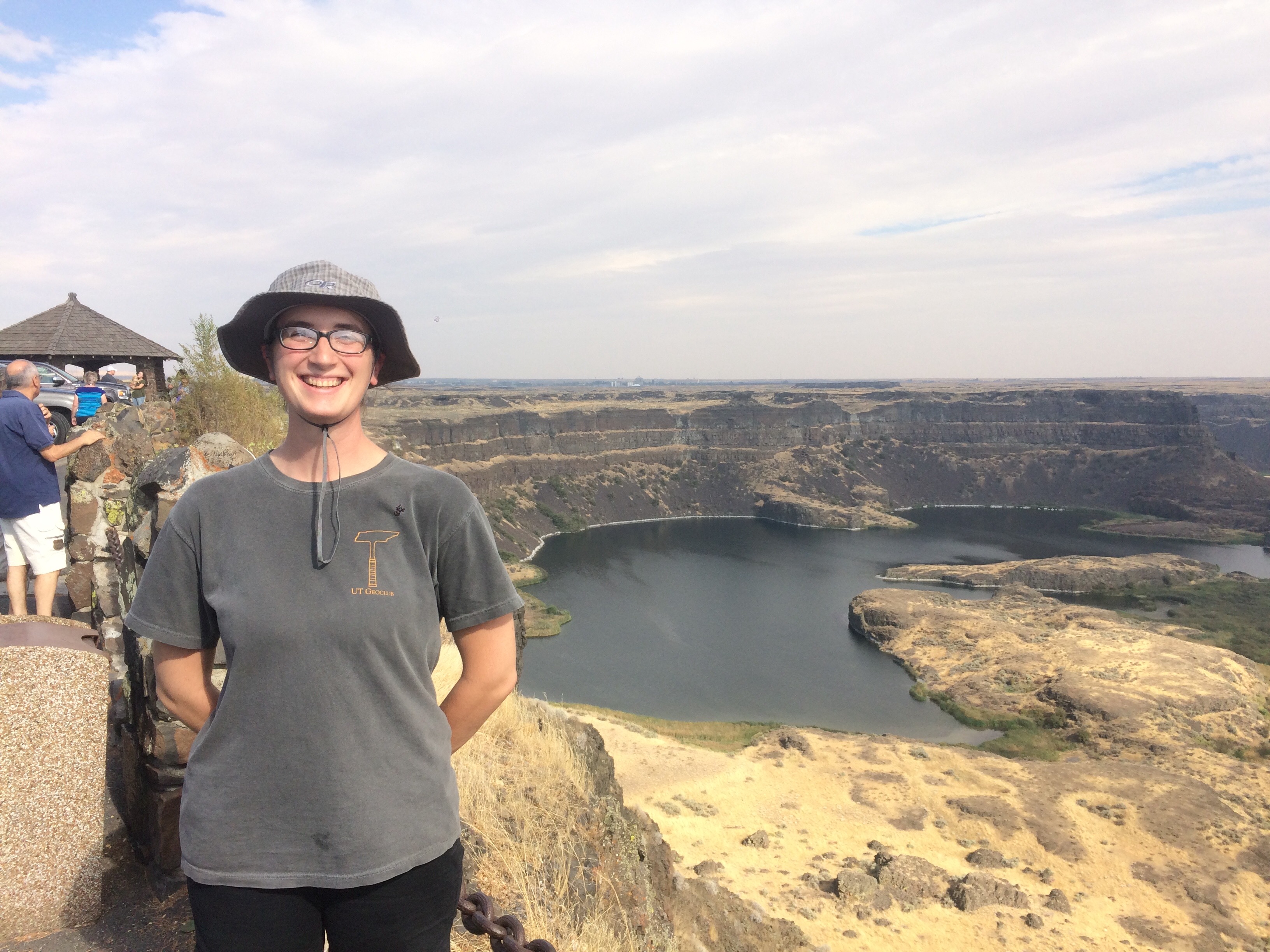
Rose Borden, Structural and Planetary Geologist

At Dry Falls, Washington, U.S.A.
My favorite part of being a scientist is discovering new things. I get to see things that no one has seen before and try to figure out how different pieces of evidence and types of information fit together to solve puzzles about how the universe works. My interest in science started when I was very young. I loved going on walks in my neighborhood and finding cool leaves and rocks and bugs. It’s super cool that now I get to study them as my job!

One of the wrinkle ridges I have mapped, with black arrows showing the location of the ridge. The colors are different elevations, with warm colors (orange and yellow) being higher and cool colors (green) being lower.
I am a structural geologist. This means I study how rocks move against each other, on the Earth and other planets. My current research project involves studying some features on Mars that were made by what is called compressive stress (rocks being pulled toward each other and pushed up to form a ridge shape). For this project I am looking at images sent back to Earth from spacecraft that orbit Mars. The data I use for my research are from cameras and other scientific instruments on spacecraft that orbit Mars. I have visual images (photographs) and topographic data (elevations of different features). I am trying to find all the ridges formed by compressive stress in a certain region near the equator of Mars called Aeolis Dorsa. When I find the features I am looking for, I measure how tall and long and wide they are to calculate how much the rocks have moved and in what direction.

My research helps us understand the different types of geologic processes that have happened on Mars in the past. Based on the many studies people have already done on Mars, we know that some of the process occurring on Mars include lots of rain causing rivers and lakes, giant volcanoes creating large lava plains, and wind storms depositing sand dunes and eroding rocks away to form ridges called yardangs. My research contributes to our knowledge of the tectonic processes that have occurred. This can help scientists decide what areas on Mars would be the best landing places for future rovers and manned missions and what kinds of scientific instruments or other equipment would be useful there.

Ranjeev Epa, Invertebrate Paleontologist

Fig. 1: End to an intense day of fossil collecting

I am an invertebrate paleontologist. My research interests are mainly focused on paleoecological themes, especially investigating biotic interactions (predator-prey relationships, paleoparasitism) and exploring how variations in body morphology (the form of living things) can be used as a proxy to interpret paleoenvironmental attributes. As an example, in snails, shell shapes and ornamentation (ex. spines or other shell modifications) can be influenced by predators (biotic) and/or by abiotic factors, like flow rate or nature of the substrate (the sediment or rock on which the animal lives).

I work primarily on marine invertebrates. My favorites include gastropods (snails), bivalves (clams), elephant tusk snails (which are very cool), sea urchins, and foraminfera. I started my journey in my home country, Sri Lanka, where I worked on Miocene marine fossils of Aruwakkalu in Sri Lanka (Epa et al., 2011). After joining Ohio University for my masters, I studied the late Oligocene freshwater ampullariid snails of Tanzania (Epa et al., 2017 in press). Currently, I am investigating predatory and parasitic interactions within a collection of Plio-Pleistocene marine bivalves from Florida. Here, I look at predatory drill holes (Fig.2C) and trematode (a group of flatworms) parasitic traces (blisters and pits; see Fig.2A and B) to explore taxonomic selectivities (specific animals getting harmed) and to investigate potential relationships between environmental factors and variability in intensity of such biotic interactions.

Fig 2. A – B: Potential traces of trematode parasitism. A. Pits. B. Blisters.
C. Oichnus paraboloides Bromley, 1981, predatory drill hole produced by a naticid gastropod

Bivalves (clams) are not only pretty (Fig.3) but also one of the key contributors in maintaining good ecosystem health, thus acting as keystone species at local geographic scales. In addition, throughout human history, bivalves (mollusks  in general) have been an important component in the food industry and many communities around the world have direct interactions/dependence on their regional mollusc communities (malacofauna).  Thus, community structure and population dynamics of bivalves affect ecosystem health, human health and, to a large extent, economies of coastal communities.

One of the research questions I address in my doctoral research is the effects and factors governing trematode parasitism among bivalves. Parasitism is known to cause detrimental effects on bivalves. However, little work has been done on paleoparasitology compared with other biotic interactions like predation. So, my research will look in to the geological and modern records/trends of trematode parasitism in bivalves to explore factors that influence variation in parasitism. Using these data, I plan to interpret how climate change can influence parasitism among bivalves and add a novel dimension to stress the importance of reducing our footprint on Earth.

Fig 3. Pectens collected from Sri Lanka

There is so much I love about what I am doing. Getting to work with my favorite animals makes me feel that I have the best job in the world. As a scientist, you have the power to communicate important scientific findings to people with different academic backgrounds and to people that hold different societal positions. This is especially important as at present, as our carbon footprint on the blue planet is a serious cause for concern. My advice to young scientists is simple: love what you do and do what you love. ALWAYS try to maintain a balance in life.

Follow Ranjeev’s research profile by clicking here and keep up with his updates on Twitter here.

Jeanette Pirlo, Paleontologist and Marine Biologist

Jeanette in the collections at the Florida Museum!

I am currently a Ph.D. student studying paleontology at the Florida Museum. My main interest are fossil sharks and how their distributional range (where they live) has changed over time. I have been lucky enough to travel to different places to look for fossils, including Florida, Panama, the Nebraska Badlands, and California. My two favorite finds, so far, have been a Megalodon tooth in California, and a carnivore humerus while in the Badlands. Along with the field work, I also develop and put on workshops for K-12 educators to teach them about paleontology and how to bring it back into their classrooms. I love hosting these workshops because I get to share my enthusiasm for paleontology and give teachers fossils to take back to their classrooms.

Jeanette in the Nebraska Badlands!

I do not have data in the same sense as most scientists because I have just begun planning out my research projects for my dissertation. But I have been working on various projects that allow me to try new data-finding tools, including 3D technology like desktop 3D scanners and microCT scanners. This technology has allowed us to scan fossils and do morphometric analysis on the specimens. I’m excited to see where these skills will take me with my research! Through the workshops I’ve designed, I have been able to create fossil kits for teachers and help them teach climate change, evolution, and geologic time, among other topics, using fossils as evidence for change. I’ve learned how to create programs that are impactful for participants by providing them content that they can bring back to their classrooms. I’m looking forward to continuing this aspect of my work. I enjoy having a direct large impact on communities. As for my research, I am interested in figuring out how shark population distributions will change as ocean temperatures change by looking at fossil shark distributions over deep time.

Jeanette having fun and finding fossils in the field in Panama! It’s not a true field trip until you get messy!

My favorite part of being a paleontologist is being out in the field finding fossils! There is nothing more exciting than finding a fossil because you realize that you are the first person to see a bone of an animal that lived millions of years ago! I also really enjoy taking people out to do fieldwork that have never done it before. To see the joy in their face when they find their first fossil is contagious! I remember how much I love my job and my career because I get to share that enthusiasm with them! My advice to young scientists is to never give up on your dreams! I took an unconventional path to get where I am at, but I am so grateful that I followed every chance I got, even the scary ones! Follow your dreams regardless of what they may be, science or not. It’s not easy and you will have days when you’re ready to give it all up, but know that it is true what they say, when you get to do what you love, it stops feeling like work!

Linda Dämmer, Geologist and Paleoclimate Proxy Developer

The great thing about science is that there is always something new to discover, always something new to try, always a new question to answer, always a new challenge. If you’re curious enough, there will always be ways to improve our understanding of how the world works. And as a scientist you’re free to explore all these avenues. Even though every single scientist is only looking at a tiny fraction of everything there is to discover, we still all contribute to the same, big, never ending puzzle. And I find that strangely appealing.

Inspecting a shallow marine site near an active submarine volcanic vent field on the Aeolian island of Panarea, Italy in May of 2017 (Mount Stromboli erupting in the background). Photo by Caitlyn Witkowski (NIOZ/Utrecht University).

By developing and improving methods for paleoclimatologists and paleoceanographers my research helps other scientists understand how the complex system that is our planet’s climate developed and changed over time and reacted to changing parameters in the past. Only if we understand this well enough we will be able to predict reliably how the climate system will be behave in the future.

The main problem we, as geoscientists, have with learning about the climate of the past is that we can’t go back in time to directly measure the temperature or the composition of the atmosphere and oceans (unfortunately our colleagues who are working on time travel are way behind their schedule, but they say it doesn’t matter 😉 ). And unless you’re only interested in the last few centuries, nobody has left us their notes in a neat lab book with all the information we are looking for listed up in a table. Therefore, we have to look at the next best thing: ‘nature’s lab book’, natural records of past environmental conditions. For example we can use ice cores, tree rings, sediment cores, corals and other fossils to learn about the past. But what exactly do we look for in these natural archives? Which particles, organisms, compounds, molecules or minerals have stored valuable information about, for example, temperature, sea water salinity, or composition of the atmosphere? And how do we unlock these data? That is what I’m working on. I’m trying to connect the environmental conditions with the resulting signals in the natural records that we find all over the world.

A benthic foraminifera (Amphistegina lessonii) up close. The scale bar here is 200 microns (1 micron = one millionth of a meter). The bright green, fluorescent part of the shell grew during an experiment that included a fluorescent dye. This way we can tell which areas of the shell are relevant for our measurements.

I do most of my work on living foraminifera (unicellular organisms with a carbonate shell) and the ratio of different elements in their shells. I use benthic (bottom dwelling) foraminifera and keep them under a range of different controlled conditions in the lab to improve our understanding of how environmental signals can be found in their shells.

In addition to this I also do field studies, where I sample foraminifera and collect environmental data from different locations and compare them to the relationships that were previously found in the laboratory settings. This means I get to travel a lot and use a wide range of sampling methods. I get some of my samples from the bottom of the Mediterranean Sea, more than 3 km (≈1.9 miles) below the surface, by taking sediment cores with a research vessel. I crawl through the mud of the intertidal zones along the Dutch Wadden Sea coast to collect living benthic foraminifera from the mud surface by scraping off the top layers of the sediment. I snorkel through the acidified ocean around the volcanoes of the Aeolian Islands in southern Italy to find species that survive these harsh conditions. I scuba dive in the Caribbean Sea to collect living planktic foraminifera one by one using a glass jar. I take hundreds of cubic meters of sea water during scientific cruises to filter out all the plankton in there and then spend hours and hours staring through a microscope to identify all the tiny species.

I’m currently trying to develop a new proxy that will help us learn more about the ocean pH and the atmosphere’s CO2 concentration of the past. To do so, a graduate student and I are using tropical benthic foraminifera. We keep the foraminifera under several different CO2 levels, which represent today’s as well as pre-industrial conditions and concentrations that are expected for the next century.

In addition to that, I’m now calibrating an already existing proxy (the ratio of magnesium (Mg) to calcium (Ca) in carbonates, which correlates well with temperature) to a species of oysters. This method has not been applied to these oysters yet. Doing this will improve the paleoceanographers’ ‘toolbox’ for climate reconstruction in intertidal (the area at a beach between low and high tides) settings, where the most commonly used proxies can’t be applied, since they are based on planktic foraminifera and most of them live in the open ocean, far away from the coast.

Linda is a PhD student at the NIOZ Royal Netherlands Institute for Sea Research in the Department of Ocean Systems; Utrecht University, Faculty of Geosciences, Department of Stratigraphy & Paleontology. To learn more about Linda and her work, visit the Royal Netherlands Institute for Sea Research New Generation of Foraminiferal Proxies website.

Maggie Limbeck, Paleontologist

As a paleontologist I study the evolutionary relationships of ancient echinoderms (relatives of modern day sea urchins and sea stars). To accomplish this, I use morphological characters (shape and other data points measured on a fossil) to create a phylogenetic tree, or evolutionary hypothesis about the relationships and relatedness of groups of echinoderms. Currently I am working with a group of echinoderms called Paracrinoidea and I am trying to create a phylogenetic hypothesis for the group.

An example of a paracrinoid, this species is called Platycystites.

The paracrinoids missed the memo on how to be an echinoderm and are completely asymmetric (while other echinoderms exhibit some sort of symmetry) and have other unusual morphologies for their feeding structures. Because of these unusual characteristics paracrinoids have not been able to be placed into an evolutionary hypothesis and are therefore unable to be used to answer any other evolutionary questions that we may have. My research will allow this group of echinoderms to be better understood and eventually be used in other evolutionary studies. Additionally, because my research is based in understanding evolution I am able to use my organism as well as other organisms to help teach others about the concept of evolution and organisms and the environment changing through time.

Maggie exploring and loving the Late Ordovician rocks of Ohio.

My favorite part about being a scientist is getting to teach others science. I am very passionate about scientific education and outreach. I have always remembered sitting in my eighth grade science class and seeing my teacher be so excited to teach us about rocks and minerals and that excitement and wonder about the world around me has never changed. As I continue my education in geology I have come in contact with many professors who are just as excited about science as my 8th grade teacher was and their passion for teaching has impressed upon the importance of being excited about science education. I aim to be able to continue to teach and do science outreach throughout my career as a scientist to spark the same passion for science that my teachers have instilled in me.

For all of the young scientists out there, the best advice I can give you is to just go for it. If you are still in high school don’t be ashamed to like science, because science is really awesome! Take some time to get familiar with the basic concepts of whichever discipline you enjoy, search out articles that interest you, talk to your teachers about ways they can help you continue to learn more. If you are in college look for internships, talk to professors about doing an independent study on topics you are interested in, get involved in a research project with a professor. If someone tells you can’t do this or that it’s too hard of a field to get into, don’t listen to them if it is really what you want to be doing. Science is hard, I can’t lie about that, but it is also so rewarding if you are willing to work hard and just go for it.

Raquel Bryant, Mentor/Instructor

Raquel, pictured on the left, with the August 2016 STEM SEAS cohort in Seattle, Washington.

STEM Student Experiences Aboard Ships (STEM SEAS)

Last summer I got the opportunity to sail on two research vessels through the new NSF funded program STEM Student Experiences Aboard Ships or STEM SEAS. I served as a graduate student mentor on the very first transit aboard the R/V Oceanus in May and as an instructor on the August transit aboard the R/V Siquliak. As an aspiring paleoceanographer, I was excited about the opportunity to experience life on a ship as sailing as a biostratigrapher aboard the JR is something I hope to accomplish during my graduate career. As an aspiring teacher and mentor, I was excited about the opportunity to get to know a promising group of undergraduates and share my passion for geoscience.

So, what exactly is STEM SEAS? STEM SEAS is an NSF funded program that takes advantage of empty berths on UNOLS research vessels during transits. UNOLS ships are operated out of universities across the country and sometimes when the ships travel from port to port in between scientific expeditions there is no science party on board. Our program brings undergraduates aboard the ships for a 6-10 day mobile classroom experience. The students received mini-lectures on topics like oceanography, climate change and micropaleontology and were able to participate in shipboard science like coring and the collection of plankton. The program works to address the low retention rates in STEM disciplines, the lack of diversity in the geoscience community, and the predicted workforce shortage in geosciences.

STEM SEAS targeted groups of students in times of transition to address the issue of low retention in STEM fields. Circumstances of transition include declaring or switching a major or advancing from a 2-year college to a 4-year college. At these times students may be without guidance or strong mentorship and are vulnerable to attrition, in other words dropping out of science majors. Aboard the ships we addressed these issues by talking about the best way to find mentors and reflecting on the types of support systems the students already had in place. Not to mention, being on a ship for the first-time fosters quality bonding time and the students made lasting relationships with each other that are sure to help them feel supported through the next phases in their academic careers.

Our program is dedicated to a broad view of diversity to include students with many identities currently underrepresented in STEM including race, gender, geographic location, institution type, ability and veteran/military status. STEM SEAS gives a diverse group of students the opportunity to explore geoscience in a hands-on fashion with close faculty mentors. It is not our hope that every student will switch their major to geoscience (although some do!) but that our students are empowered to see themselves incorporating science into their lives and careers in some way.

It’s unfortunate that while we live in a time where geoscience is in the news daily, in the form of discussions about climate change, sea level rise, floods, or earthquakes, many high school and college students will not take a geoscience class in their academic career. With a looming geoscience workforce shortage and the pressing issue of climate change, it is imperative that we empower our youth to engage with issues of climate and environment. Once our students return home or to their campuses, they must present some aspect of their STEM SEAS experience to their community. This ensures that STEM SEAS is not only introducing the students, but also their communities to geoscience.

What is next for STEM SEAS? After a very successful pilot year, STEM SEAS continued into summer 2017 on a transit down the east coast of the US. This transit will be open to undergraduates from an HBCU (Historically Black Colleges and Universities). Partnering with an HBCU is in line with the mission of STEM SEAS and we are excited to add another cohort of STEM SEAS students to our alumni community. To stay up to date, follow us on Facebook!

To follow Raquel’s updates please check out her Twitter here. Check out the STEM SEAS webpage here, to keep up to date with new projects.