A picture of me at my favorite stop during the experience; the Rancho La Brea tar pits museum in LA. A black woman with blue braids wearing a black and white shirt and black pants stands in front of a fence, some sedges, and some buildings.
I recently attended a field trip and some presentations with the ADI Geo-History program at the University of Missouri. During those presentations, we learned many things about geoheritage, which is defined simply as the intersection of geology with human experiences and values. How these things overlap is crucial to being a responsible geoscientist and preserving and furthering diversity in the geosciences.
Most importantly, we discussed the experiences and struggles of those most marginalized by the colonialist history of the geosciences, those being BIPOC individuals across the planet. BIPOC people have been cruelly subjected to the theft of their land and people, while being forced to share space with the people who committed these atrocities in the first place. As part of this, their voices have historically been, and still are, devalued and overlooked, which inhibits the extent to which BIPOC individuals may participate in and contribute to the geosciences. Being Black myself, I can personally attest to how demeaning and frustrating it is to work in a field where few people look like you, and fewer still seem to have any interest in listening to your lived experiences or even giving you the space to discuss them in the first place. This creates the imperative to amplify these voices, ensuring that BIPOC people are given the space to share their perspectives and weigh in on practices that directly affect them. Too often, BIPOC people are spoken for and about rather than being the ones to tell their own stories. Attending presentations about Indigenous knowledge and perspectives and the importance of listening to and valuing these perspectives gave me hope that the discipline is making progress toward making this practice more commonplace.
A picture of some of the fossil collections in the museum that we were allowed to look at. Various fossil boxes, a picture of mammoth skeletons, a mammoth tooth, and a saber-tooth cat skull are depicted.
I heard from people who are actively working to make a difference in the state of diversity and inclusion in the geosciences. Teachers presented their work on creating databases and accessible learning resources about geoheritage sites that students themselves could edit and improve. This allows students with personal or cultural connections to sites to add their voices to the things people could learn about them, reinforcing the importance of responsible environmental stewardship and respect for the land they inhabit. Others discussed a thought process of seeing the world with two eyes, those of a scientist, and those of a person with feelings for the world around them and valuing both perspectives differently depending on the situation to create a more holistic view of the world instead of seeing things unemotionally. Scientists often see the world overly rationally, discounting personal thoughts and emotions of those affected by science and only giving weight to the scientific value of their work. We also discussed specific geoheritage sites and their significance to different kinds of people, not only focusing on the significance white people assigned to them after stripping them of their true, original value. This was very nice to see as somebody who is far too accustomed to watching these kinds of things be ignored by the greater geoscience community.
While all of this was heartwarming to see and gave me hope for the future of the geosciences, it also inspired me to want to do more work on improving the state of diversity, equity, and inclusion in my field. Moreover, I gained some new ideas on how to proceed in that work. I now have some specific objectives I want to put effort into, such as helping to contribute to communal learning resources like the ones I learned about in the program and incorporating them and elements of them into the courses I teach in the future. Furthermore, I want to impart on my students the importance of geoheritage: how to value it and the voices that shape it. Ultimately, what I took away from my time with the program was the imperative to continue working on amplifying BIPOC voices and perspectives, and the knowledge that many others are doing the same. Especially today more than ever, in these times where diversity itself is being challenged as a valid concept, and people of diverse backgrounds are being made to feel unsafe and insecure in their jobs and place of learning, I believe it is more crucial than ever to fight to protect diversity and to remember its importance to our field.
Interview with Glenn Barrett, Offshore Installation Manager of the JOIDES Resolution with SEA1 Offshore
The scientific ocean drilling (SciOD) community has relied on the riserless drilling capabilities of the research vessel JOIDES Resolution since 1985 to retrieve sediment and rock cores from below the seafloor to advance knowledge about our oceans and Earth. The loss of the JR and U.S.-led SciOD, even temporarily, has huge implications for the science community, which have been published on and written about elsewhere. Here, we discuss the loss of expertise and equipment with the non-renewal of the contract between the National Science Foundation (NSF) and SEA1 Offshore. Importantly, challenges to building a new U.S.-owned and operated riserless drillship are also discussed.
Special thank you to Tim Lyons, Chris Lyons, and Khyber Jones of Slingshot Pictures, LLC for technical support.
Double rainbow in the Fram Strait, in front of the research vessel JOIDES Resolution. Drone image by Chris Lyons.
I wake up with dread; the feeling of rocks in my stomach anchoring me to this day, churning of emotions like waves in a storm. This is surreal, this can’t be it. This entire experience has felt like a dream, but this day is hell. We knew the time was drawing nearer, and we knew years ago that this day would happen. Perhaps naively, I didn’t think it would come to fruition. I thought the program would be saved, the government and funding agencies would come to their senses and scramble to provide funding to keep the ship and program afloat. But that isn’t the case.
I go through my daily routine: wake up in my cabin at 22:00, take a shower, gather my things, drop off my bookbag and coat in the conference room. Meet my colleagues in the mess hall for our usual breakfast together (two eggs over medium, a bowl of fruit, a glass of water, toast with cream cheese for me). Around 22:35, head to Bridge Deck to start the French press of coffee for myself and colleagues. Head back down to the Core Lab at 22:45 for the crossover meeting with the sedimentology team. The routine is familiar, a comfort through the turmoil that is raging in my heart and stomach.
Friday July 25th, 2024
Today is the day that the research vessel JOIDES Resolution will deliver us her last sediment core. We lovingly call her ‘the JR’ for short. Since 1985, the ship has been drilling all over the world ocean, retrieving rocks and sediments from below the seafloor. The contributions this vessel has made to science are massive. The third expedition, sediments and the oceanic rocks below the sediments were drilled from the southwest Atlantic to prove the hypothesis of plate tectonics and seafloor spreading. Antarctic and Arctic ice sheet melting, and under what conditions the ice melts, has been quantified from expeditions taking place in the high latitudes of both poles. The microbial communities living within the seafloor sediments and rocks is one of the lesser-known biological communities on Earth; the JR has retrieved these rocks and sediments so scientists can study them. Viruses, bacteria, archaea, all living at depths in our ocean unattainable to humans without the help of the riserless drilling capabilities of the JR. Ancient DNA is a rather new and quickly advancing field. Scientists can attain DNA bits preserved in sediments to look at ancient ecosystems through time, and how they’ve shifted and changed in response to past warming and cooling events. The reason we know how warm the Earth was in the more recent past, and how our oceans, atmosphere, ice sheets have responded to these warming events is because of the JR. This 46-year-old ship and her skilled crew are paving the way for scientists to ask more complex and compelling questions about our Earth and how it works, who lives here, how we can harness this information for the betterment of the planet and humanity. All of these amazing discoveries, pushing the boundaries of what we know about our Earth through the geologic past, and pushing the boundaries of science, it comes to an end today.
Drone image of the JOIDES Resolution facing a double rainbow while drilling in the Arctic. Photo by Chris Lyons.
The crew and drill team need to stop drilling at approximately noon today. By the time my team and I are on shift, it is midnight. Twelve hours until the last core, twelve hours until the program ends. We keep busy describing the sediments contained in each core section, its color, any rocks that we see, and other features that might indicate the ancient environments under which these sediments accumulated. The dread is still there, but being around the people I’ve come to love the most on the ship helps. When you’re at sea for two months, it is amazing how close you become with your colleagues. You rely on each other not just to get the scientific work done, but for laughs, for comfort, for staying in touch with your humanity. We are human first, scientists second. That’s important to keep in mind while sailing on the JR, working twelve hours a day for two months straight.
The night shift scientists, who work 12 am to 12 pm, around one of the Sedimentology Lab tables, with the last core drilled aboard the JOIDES Resolution.
Lunch always marks the half-way point of the day. This too has become a treasured routine. 5:15 am, go downstairs to the mess hall with Kat, sometimes Nicole comes too. Glenn comes down usually a few minutes after us, we eat. Glenn and I have a commitment: one waffle a day for the entire expedition. Syrup and chocolate sauce are both necessities, and now we’ve become accustomed to including a dusting of cinnamon to really jazz up the waffles. If we’re feeling wild, ice cream too. The mood at lunch today is more sober than usual, the dread still there regardless of the laughs we have despite the day. The time is 6:00 am. Six more hours until the last core, six more hours until the program ends.
Lucinda, Nicole, and Glenn check out where everyone is from on a map after lunch waffles.
The rest of the day goes by too quickly. Process the cores, work on reports, take a break to eat sweets, back to work. I watch the time tick by on the round black and white clock that hangs on the back wall of the sedimentology lab. Watching the hands move, marking the passage of time is hell. Finally, we get word that we only have 3-4 more cores to be drilled. I decide to make the best of it and rally up the sedimentology team to help the marine science technicians (techs) bring one of the cores onto the ship. This is the first time we’ve done this as a team, and it is a blessed distraction. Pictures are taken, the techs are super accommodating of us, a grand time all around. Every expedition is a success because of the skills and expertise of the techs. They are the ones who ensure the cores make it from the drill deck into the labs safely, who curate the cores and ensure they are labeled and stored properly. Maintenance of the equipment and computer programs is up to them. More than that, they are a critical part of a well-oiled human machine synchronized to deliver the sediments to the scientists. They are the ones without whom none of these expeditions would be possible. In return, they have traveled the world together, made priceless memories, and become each other’s home away from home. The scientists leave the ship and go back to our jobs and research; most of the techs will walk off the ship jobless after this expedition. The time is approximately 8:00 am. Four more hours until the last core, four more hours until the program ends.
The Marine Science Technicians processing the second to last core on the catwalk.
Hours later, one of the toolpushers comes into the Core Lab. There will only be two more cores, these are the last two that we will drill. The anxiety is full-blown at this time, there’s no way I can work in this state. I decide to do what I can, but when the third and second to last cores come up, I’m out on the core deck with the techs. Through art is comfort, and that’s what I seek. I play photographer, capturing the last moments the techs have to work together and perform a critical part of their job. Watching them do their tasks so effortlessly and in sync through my phone eases the dread. Are they feeling this dread and anxiety too? Are they okay? The techs joke with the drill floor roughnecks, who, despite working the hardest on the ship with heavy equipment 12 hours a day in all kinds of weather, keep up a positive attitude. The roughnecks are also part of the well-oiled machine: they care for the drilling equipment, build the drill strings at each new site, hoist the drilled sediment cores onto the deck. Two months on, two months off, they have made a huge sacrifice for the drilling program by being away from their homes and families for half of the year. Just last week, they were notified by the JR’s owner, SEA1, their positions will be terminated after this expedition. And it’s not just the roughnecks, it is everyone on this ship that works for SEA1: the captain, the offshore installation manager, all the way across the board. Everyone. The time is approximately 10:00 am. Two more hours until the last core, two more hours until the program ends.
The toolpushers and roughnecks on the drill floor. Photo by Chris Lyons.
It’s now 11:30 am, and I can’t work. My brain isn’t into doing the work, and neither is my heart. I can’t focus. It feels as if we’re all living through a murder, we’re all witnesses to the atrocity that is happening. And we can’t stop it. Shortly after, the expedition project manager, Thomas, comes into the sedimentology lab. ‘A few folks asked if the scientists are going to bring in the last core, but the techs should do it’. We agree heartily; this moment should be for them and we, the scientists, should stand by in solidarity and support. At 11:45, the techs and scientists each have their own crossover meetings, with the scientists assembling in the core lab, and the techs assembling near their workstations across from us. But today is different; the scientists are with the techs, we stand with them as we all await the last core to ever be drilled by the JR. TV screens in the labs show the drill floor, and a number at the top of the screen counts down, indicating the depth at which the core is. The core is coming up fast, it will be here soon. The techs are blasting ‘Whiskey in the Barrel’ by Metallica, waiting for the last ‘Core on deck!’ to be called.
The techs and scientists lined up by the door that leads out to the catwalk, awaiting the last core on deck.
The call comes at 12:20 pm. The normal ‘core on deck’ call, announced by the driller, is replaced by the voices of our expedition’s two co-chief scientists, Renata and Kristen. In the early days of scientific ocean drilling, the science parties were dominated by mid- to later-career men. The expedition we are on not only has two women co-chiefs, but it also contains a higher number of early career scientists than normal (PhD students, postdocs, those who have recently graduated from their graduate program and are a few years into their new jobs and careers). The science party contains 25 scientists, 15 of which are women. The average percentage of women from the last decade of expeditions has been about 52%; the average percent of early career scientists has averaged 33%. Career foundations have been built on this ship, scientific collaborations forged that have led to huge contributions to geology and the Earth sciences. I first learned about sailing on the JR while a naive undergraduate student. I went on to become one of those scientists who built a large foundation of my career upon scientific ocean drilling. As an Assistant Professor with four PhD students, I think of them and mourn the loss of the opportunities they will miss out on, and other graduate students, postdocs, professors, career professionals that will never get to experience this.
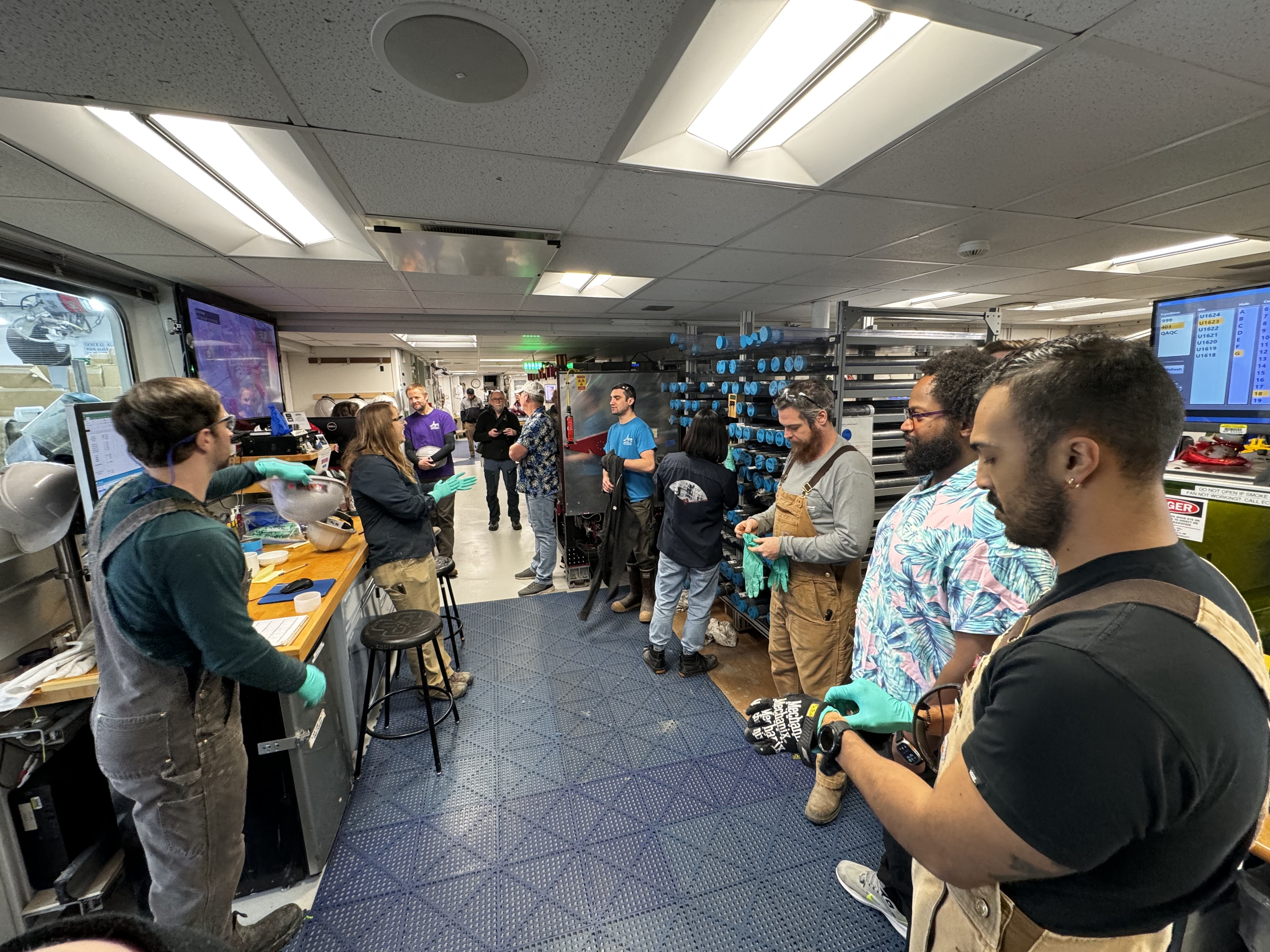
A stream of technicians come onto the catwalk and line up at the end, waiting for the roughnecks to pull the last core out of the core barrel and hand it off to them. I feel that I have to witness this; I can’t stand idly by in the Core Lab. Despite the chaos of the moment and the two film cameras pointed at the action, I sneak to the end of the catwalk to watch this moment, to be within it. The techs do their jobs, pulling the core onto the core deck, laying the long plastic tube containing precious seafloor sediments on the core holders. Wipe them down, measure them, cut them, cap the ends, take them into the Core Lab for labeling and to warm up to room temperature before being processed further. I sneak back inside through the Paleontology Lab side door so as not to disturb the flow of the work on the catwalk. Walking through the Core Lab, the scientists are gathered at the other end of the lab, lined up near the door where the techs bring in core sections. As the techs bring in the cut sections of the core, we cheer and clap for them.
The technicians on the catwalk bringing in the last core to be drilled on the JOIDES Resolution.
As the last core section is put in the racks in the Core Lab, it is approximately 12:40 pm. The roughnecks will now begin to disassemble the drill string, pulling up pipe that is dangling to the bottom of the ocean. Last minute tasks will be done, and we’ll set sail back to port in a few hours. In about six days, we’ll pull into port in Amsterdam, and for the last time, the crew, techs, and scientists will disembark from the JOIDES Resolution.
I go down to the mess hall for dinner, as it’s now close to the time dinner will stop being served. Oddly, I feel some relief; the anticipation of the last core is over. The heavy sadness remains, but this will dissipate in the coming days as I decide to enjoy the last remaining time on the ship with my new science family, absorbing all the good moments that I can. I walk back up the stairs after dinner, heading past the Core Deck on my way to Bridge Deck. The door to the Core Deck has a large window, and through it is the whiteboard for which the techs write the site we are currently drilling, the cores that we’ve drilled, the time they’ve come up, and the recovered length. It is customary at the end of every expedition to write ‘EOH’, ‘EOS’, EOX’ at the base of the board. But this time, there is a different three letter acronym written in blue: ‘EOP’.
End of Hole, End of Site, End of Expedition, End of Program.
The Core Lab board as seen through the Core Deck door.
On fieldwork in Texas sampling an outcrop of Cretaceous sediment to understand local conditions prior to the extinction event. Photo credit Chris Lowery.
Tell us a little bit about yourself. I am from the Northwest of the UK so was incredibly fortunate to grow up surrounded by national parks such as Eryri National Park (Snowdonia) and the UK coast. Thanks to this upbringing I am passionate about the outdoors and enjoy walking, cycling, bird watching and paddleboarding. I also enjoy travelling and have been lucky enough to visit some amazing places through my research. When I am at home, I enjoy cooking and exploring new cuisines.
What kind of scientist are you and what do you do? I find it quite hard to define what I do but broadly I am a palaeoecologist. My research focuses on understanding ecosystem responses and recovery from environmental stress using single celled marine organisms called foraminifera. Using a combination of techniques including geochemistry, statistical analyses and more recently micro-CT scanning I can understand how these marine organisms were growing, living, and evolving over millions of years and how that relates to the climate through geological time. I love learning new techniques and combining them with traditional methods to view ecosystems from a new perspective. One of the great things about my research is I get to wander through geological time and investigate interesting periods for example my current research focuses on ocean recovery following the end-Cretaceous mass extinction event (the one that killed the dinosaurs) but I am now also working on projects related to the Messinian Salinity Crisis when the Mediterranean Sea dried up.
What is your favorite part about being a scientist, and how did you get interested in science? I have always been interested in science, even as a small child I loved reading books about volcanoes and marine life. I really enjoyed science in school but really struggled with the pure science aspects, especially anything involving math, which I always felt would hold me back from being a scientist. Luckily, I had a great support network, and I was able to overcome a lot of these struggles and gain a place at the University of Leeds to study geology, a subject I was always curious about but never saw myself doing as a career. 14 years later and I’m still studying geology, so it was definitely a good choice! Geology turned out to be the ideal subject as it combine all the sciences to understand the world we live in. I am still intimidated by maths but try to push through that so much so that most of my research involves statistics and coding something I would never have though possible even five years ago. One of my favorite things about being a scientist, and a geologist, is the opportunity to travel. I have been able to visit at least six different countries including Chile and New Zealand and have participated in research expeditions to the South Atlantic and currently the Tyrrhenian Sea.
This is me on-board RRS Discovery in the South Atlantic standing next to the sediment cores we had just collected from the Falkland Plateau.
How does your work contribute to the betterment of society in general? A lot of my research focuses on understanding how ecosystems respond to climatic events which is really important and fundamental to understanding how ecosystems will respond to current and future human induced warming events. There is a lot of focus on ecosystem restoration in current scientific policy, particularly in the marine environment, yet there are still a lot of gaps in our understanding of recovery processes. My research works to address these gaps by using various events in geological time and uncovering the patterns and processes of ecosystem recovery. By filling in these gaps policy makers can make more informed decisions about marine restoration projects and marine monitoring.
What advice do you have for prospective scientists? I have been extremely fortunate to have had amazing mentors in my career and have therefore been given a lot of useful advice. The best piece of advice I’ve been given was to be patient. There is a pressure to continuously get results and keep moving on to bigger and better things and it’s very easy to get caught up in that mentality. But science takes time and sometimes in your career it can be much more beneficial to maybe take a sidestep and learn something new rather than pushing forward all the time. I still struggle with this advice but now try and take a step back before making big decisions. Another great piece of advice that is applicable for everyone is to write everything down. You might think you will remember, but you won’t! Even now I refer to notebooks from 8-10 years ago to get information or to go back to ideas I had but never had time to explore.
Southampton National Oceanographic Centre (NOCS) which hosted the event
Thanks to the support of the Time Scavengers’ travel grant, I participated to the 2023 annual meeting of the Micropaleontological Society (TMS). The meeting was held in Southampton (United Kingdom), a lovely coastal city known for being one of the most famous liner ports in Europe. It was actually from Southampton that, the world’s most famous liner called the Titanic, embarked towards the North America. Besides that, Southampton has also a sensational historical heritage. Among all the historical sites, it is worth to mention the well-preserved medieval city wall and the incredible Tudor’s House built in 1495, which still preserves the original walls and furniture.
The Tudor House, one of the major historical attractions in the city
The TMS conference started with a nice icebreaker event held the 15th of November at the Southampton National Oceanographic Centre (NOCS). It was an incredible occasion for early career scientists like me to meet the other conference attendees and discuss with them about science. This also can help people to establish future collaborations and discover new scientific approaches which could benefit their study.
The actual conference begun the 16th of November in the Seminar room of the NOCS center. The 2023 theme of the conference was “Bridging the Gap: Connecting microfossil groups, environmental system and people”. I particularly like this year’s theme as it aims to underline how all microfossil groups are essential to study the Earth’s environments and how they are even more powerful when combined. Long scientific talks were subdivided in 5 major sessions: Climate, Assemblages, Locations and environments, Morphology and taxonomy, and Earth System. The variety of studies was really impressive, spanning from the use of microfossils for paleoclimate and paleoenvironmental reconstruction to new technological advances for species taxonomic identifications and biostratigraphic applications.
Presenting my research during the flash talks
Besides the long talks, the TMS committee allowed 1 min” elevator pitch” talks for attendees having a poster presentation, in order to share with the audience, the major points of their current research. I definitely took advantage of the short talk to promote my study on the use of microfossil groups (calcareous nannofossils and planktic foraminifera) as tools for biostratigraphic and paleoecological reconstructions in a serpentinite mud volcano setting during the Pleistocene.
Poster presentation had two time slots of 1h and 30 min each. I must say that the participation to the poster session was very useful as I received very nice feedback about my work and valuable suggestions to improve it. Presenters also received poster evaluation sheet filled out by one of the keynote speakers of the conference. I really appreciate the intent as it is valuable to know how efficiently the presenter was able to communicate with other scientists and how the poster was made in a way to clearly convey the major points of the research.
Showing my poster to the TMS attendees
The TMS society also organized a conference dinner in the spectacular medieval wool house which was recently turned into a pub/restaurant. Food and drinks were incredible as well as the great company of my colleagues.
As an active member of the TMS, I am so grateful about this experience and how the society is actively promoting the importance of the application of microfossils within the scientific community. For people who are interested in the event, next year the conference will be held in Kraków (Poland) and I am sure it is going to be another incredible experience! Last but not least, if you want to join The Micropaleontological Society visit the organization’s web page https://www.tmsoc.org/membership/#join
The astonishing Dancing Man Brewery where the conference dinner took place
Science communication is an often overlooked aspect of science, with most scientists focusing on the research rather than sharing their findings. When they do share it, it is often coded in difficult-to-understand jargon which limits who can understand what is being explained to them. This is not good. What is the purpose of doing science if what you are discovering is not accessible to be shared with others?
The main problem when it comes to science communication is that most scientists will act as their mentors when it comes to teaching and leading. This is not necessarily a bad thing if their predecessors were focused on being good science communicators, but if they were shown to “gatekeep” and only share with those who they think are useful there is a high chance that they will not be the best science communicators. Thankfully I have been able to be mentored by great science communicators who make it a priority to share not only their science but that of their colleagues as well.
This semester I had the privilege of taking Dr. Adriane Lam’s science communication course, where I have been able to learn how to be a better scientist, not just in the lab but in the real world. Her class gave me more insight into how to talk to my friends and family about what I do for research and the importance of it. Talking with the guest lecturers, like Dr. Sarah Sheffield, opened my eyes to the importance of science communication by giving me more insight into how just by changing your language and tone, you can communicate science to those who are a little bit more reluctant to listen. Before, I felt it was too difficult to explain what I do because it is not “revolutionary” and geology is not always seen as a primary science, meaning it is a bit unknown to the general public. So explaining glacier mechanics did not seem like the best use of time but now I will try to take caution when explaining my work by using easier-to-understand language and when met with resistance to change my tone so that my work comes across as more understandable.
This post was written by Halima Ibrahim, a graduate student at Binghamton University in the seminar Science Communication for Scientific Ocean Drilling (SciComm for SciOD), Spring 2023.
Throughout this course, I have had the privilege to explore and reflect on various concepts and ideas related to science communication. One of the key takeaways for me has been the vital role of effective communication in conveying scientific ideas and findings to a broader audience. Through this class, I have learned about the best practices in science communication and the various strategies and techniques that can be used to engage with diverse audiences.
The class discussions on the science communication book, “Getting to the heart of science communication: A guide to effective engagement” by Faith Kearns, were particularly fascinating. The author did an excellent job of sharing her career experiences and challenges as well as other science communicators in communicating science to the general public. The book also highlighted the need for scientists and researchers to be transparent and clear in their communication with both scientific and non-scientific communities. Our discussions over each chapter of the book were enriching, as they provided me with different perspectives and opinions from other people’s points of view.
I also appreciated the opportunity to listen to the five invited speakers who shared their research work, experiences, and how they communicate their science to a broad range of people, from the classroom to the general public. Most of the speakers had an extensive background in scientific ocean drilling, which is the area of my research interest. Some of them were involved in outreach programs to communicate science to non-experts as well as the younger generation, which was insightful to learn about their achievements. The peer review process was another aspect of the class that I enjoyed. Reviewing another person’s webpage and providing constructive feedback was fun, and it presented an opportunity to learn about other expeditions.
One of the reasons I took this class was to improve my science communication skills and contribute to the advancement of scientific knowledge through creating web pages of past International Ocean Discovery Program (IODP) Expeditions on the Time Scavengers website. These web pages will eventually be consumed by the Flyover Country app. It is fulfilling and humbling to know that someone may find the write-up that I produced in this class useful at some point in their life. The knowledge and skills I have gained from this class will enable me to effectively communicate scientific ideas in the future. I plan to apply these learnings to communicate scientific concepts and research findings more clearly and transparently to both scientific and non-scientific audiences. Furthermore, I intend to engage with different science communication strategies and seek feedback from various audiences to improve the effectiveness of my communication skills.
I appreciate Dr. Adriane Lam, our instructor, for doing an excellent job, especially as it was her first time teaching the class. From curating the course outline and choosing the book for the class to carefully selecting the invited speakers who had a wealth of knowledge to share with the class, she was amazing. I particularly liked the engaging and hands-on nature of the class. Dr. Lam is an excellent science communicator, which was evident in how she made in-class communication a two-way process by transmitting information to us students and receiving our feedback and opinions. The in-class exercises were helpful, and Dr. Lam was readily available to guide us and answer all our questions.
In conclusion, this class has been immensely valuable in enhancing my knowledge and understanding of science communication. I feel much more confident and better equipped to effectively communicate my research to people who do not have a scientific background. I have also come to appreciate the role science communication plays in shaping public opinion and understanding of complex scientific concepts such as climate change, oceanic drilling programs, and various scientific policies. I highly recommend this course to anyone interested in science communication, be it to learn how to communicate their scientific knowledge to folks from different knowledge backgrounds or to venture into a science communication career.
This post was written by Yiran Li, a graduate student at Binghamton University in the seminar Science Communication for Scientific Ocean Drilling (SciComm for SciOD), Spring 2023.
For me, one of the key takeaways from graduate school was learning that being able to effectively communicate and share your research with others is just as important as the research itself, and that it is a crucial skill for integrating oneself into a collaborative research environment such as the one we have in the geosciences community. Participating in the SciComm seminar was an eye-opening experience for me. As a student of observational seismology, I had a general idea of what the International Ocean Discovery Program is through course works, but was completely unfamiliar with the aspect of community culture that advocates and invests in mentorship opportunities.
Many topics explored in this course were very new to me. It was really interesting to hear about journal studies that evaluate the effectiveness of different pathways in scientific communications, whether that’s interactions on social media or through outreach programs. I also empathized with the experiences of students who are just starting out in earth sciences, and how they discovered a community by participating in research opportunities – I had no idea that these literatures existed, and really appreciated the fact that there are published works highlighting the emotional aspects of pursuing careers in geoscience research. It helped me reflect over my own experiences as well. I hope to get more involved, and further explore more opportunities in science communication in the future.
Hello! My name is Alex Corsello and I recently graduated from Binghamton University studying Biology and Earth Science. I’m originally from Virginia, but grew up in Katonah NY, about an hour from New York City (yes there are dirt roads). Additionally, I will be staying at Binghamton to pursue my Masters of Arts in Teaching Earth Science. I am a big fan of hiking, running and baking. While not in the lab I have visited over 100 national parks across the United States, ranging from Yosemite to a tiny house on the corner of a street in Philadelphia.
I am a paleontologist who studies foraminifera, or forams for short, particularly within the Miocene Period (roughly between 5 and 23 million years ago). My research specifically focuses on determining two things. First, where does the foram species Globoquadrina dehiscens live in the water column in a mid-latitude site? Second, can G.dehiscens be used as an indicator for past ocean temperatures conditions? Samples are taken from cores drilled through the International Ocean Discovery Program, washed and then picked by size for the particular species that I am studying. Then, using the shell of the organism my samples are sent to Hamilton College, where they are analyzed for both oxygen and carbon isotopes. These isotopic ratios help to provide a picture of the temperature of the water where the organism lived and how productivity there was in the region where this was taking place. Thus it becomes possible to reconstruct ocean conditions. The goal of our lab is to help determine how ocean conditions changed in response to various climate variables in the past in order to best predict how they might change again under a warming climate.
Alex and a class of second graders at Finn Academy in Elmira, NY, where he conducted an outreach program with the students.
I have always been a bit of a nature nerd… I went to ecology camp starting in first grade. But growing up I always thought I would be a historian. This changed when I took Biology in high school and I became fascinated with how life works. Every part of life, even if it seems really distant, is connected in some way and I think that’s really cool. I started as a Biology major and after taking my first geology class as part of my Biology degree I was hooked. I have been working on earth science research ever since. My favorite part of science is getting to tackle real world problems and to try to make a positive difference for others through your work. You never know what idea could be the key to a big discovery or the tool that solves a pressing problem. There is also something incredibly magical about getting people interested in science. The excitement that comes with learning is infectious and watching those who may have previously been adverse to science start to connect is really powerful.
Alex presenting his research in poster format the Joint Southeastern/Northeastern Geological Society of America meeting in Reston, VA.
Take risks- That seemingly crazy idea that you came up with while on the toilet at 3 am may help define your path. A lot of the time, yeah, you’ll fail. But it is those few experiences where you succeed that can help to define your path both as a scientist and human being. They are what lead to more opportunities and a whole host of new people and places. Also don’t be afraid to use your resources. There are people who are in your corner who will be there to advocate for you. Don’t be afraid to get their help. You will be much better off for it.
This post was written by Charlotte Heo, a graduate student at Binghamton University in the seminar Science Communication for Scientific Ocean Drilling (SciComm for SciOD), Spring 2023.
Here’s a picture of me presenting my research at the spring 2023 regional Southeastern/Northeastern Geological Society of America conference and it’s an example of what I think of when I imagine science communication but casually talking about research at the dinner table with family and friends can also be considered science communication as well!
I decided to take SciCommSciOD this semester because I had some free time in my schedule and I wanted to show my support for a new class. I am so glad I decided to because I have learned so much about science communication that I was not aware about before. Science communication is a growing area of interest in the scientific community and I definitely think it should be talked about more and prior to the formation of this class my university lacked a curriculum like it. SciCommSciOD opened me up to new perspectives about sharing science, such as how science communication can be used as a tool to connect with people directly affected by science and it shifted my perspective to think more about the people I want to share my science with. I think sometimes I struggle with SciComm because a lot of the time I’m sharing my science with people with strictly science backgrounds such as at conferences or seminars but it is really important for me to make my research accessible to the public. The work that I do directly pertains to climate change which impacts a ton of different people within different communities and backgrounds (both in science and in public audiences) so it’s necessary to be able to have a discussion about it in an accessible way. Overall, I hope that learning about science communication becomes more of a standard in the scientific community, and as scientists I believe we have a responsibility to effectively communicate our findings in accessible ways.