On fieldwork in Texas sampling an outcrop of Cretaceous sediment to understand local conditions prior to the extinction event. Photo credit Chris Lowery.
Tell us a little bit about yourself. I am from the Northwest of the UK so was incredibly fortunate to grow up surrounded by national parks such as Eryri National Park (Snowdonia) and the UK coast. Thanks to this upbringing I am passionate about the outdoors and enjoy walking, cycling, bird watching and paddleboarding. I also enjoy travelling and have been lucky enough to visit some amazing places through my research. When I am at home, I enjoy cooking and exploring new cuisines.
What kind of scientist are you and what do you do? I find it quite hard to define what I do but broadly I am a palaeoecologist. My research focuses on understanding ecosystem responses and recovery from environmental stress using single celled marine organisms called foraminifera. Using a combination of techniques including geochemistry, statistical analyses and more recently micro-CT scanning I can understand how these marine organisms were growing, living, and evolving over millions of years and how that relates to the climate through geological time. I love learning new techniques and combining them with traditional methods to view ecosystems from a new perspective. One of the great things about my research is I get to wander through geological time and investigate interesting periods for example my current research focuses on ocean recovery following the end-Cretaceous mass extinction event (the one that killed the dinosaurs) but I am now also working on projects related to the Messinian Salinity Crisis when the Mediterranean Sea dried up.
What is your favorite part about being a scientist, and how did you get interested in science? I have always been interested in science, even as a small child I loved reading books about volcanoes and marine life. I really enjoyed science in school but really struggled with the pure science aspects, especially anything involving math, which I always felt would hold me back from being a scientist. Luckily, I had a great support network, and I was able to overcome a lot of these struggles and gain a place at the University of Leeds to study geology, a subject I was always curious about but never saw myself doing as a career. 14 years later and I’m still studying geology, so it was definitely a good choice! Geology turned out to be the ideal subject as it combine all the sciences to understand the world we live in. I am still intimidated by maths but try to push through that so much so that most of my research involves statistics and coding something I would never have though possible even five years ago. One of my favorite things about being a scientist, and a geologist, is the opportunity to travel. I have been able to visit at least six different countries including Chile and New Zealand and have participated in research expeditions to the South Atlantic and currently the Tyrrhenian Sea.
This is me on-board RRS Discovery in the South Atlantic standing next to the sediment cores we had just collected from the Falkland Plateau.
How does your work contribute to the betterment of society in general? A lot of my research focuses on understanding how ecosystems respond to climatic events which is really important and fundamental to understanding how ecosystems will respond to current and future human induced warming events. There is a lot of focus on ecosystem restoration in current scientific policy, particularly in the marine environment, yet there are still a lot of gaps in our understanding of recovery processes. My research works to address these gaps by using various events in geological time and uncovering the patterns and processes of ecosystem recovery. By filling in these gaps policy makers can make more informed decisions about marine restoration projects and marine monitoring.
What advice do you have for prospective scientists? I have been extremely fortunate to have had amazing mentors in my career and have therefore been given a lot of useful advice. The best piece of advice I’ve been given was to be patient. There is a pressure to continuously get results and keep moving on to bigger and better things and it’s very easy to get caught up in that mentality. But science takes time and sometimes in your career it can be much more beneficial to maybe take a sidestep and learn something new rather than pushing forward all the time. I still struggle with this advice but now try and take a step back before making big decisions. Another great piece of advice that is applicable for everyone is to write everything down. You might think you will remember, but you won’t! Even now I refer to notebooks from 8-10 years ago to get information or to go back to ideas I had but never had time to explore.
Tell us a little bit about yourself, describe your hobbies and interests outside of science. I like to hike with friends, mountain bike, climb, football, basically all kind of sports that imply being outdoor in the mountains. In Germany, I trained a football team of international students and we played a European tournament in Athens (Greece).
What kind of scientist are you and what do you do? I am a PostDoc researcher in Marine Geology, especially focusing on i) mud volcanoes, gas- and mud-spewing structures similar to magmatic volcanoes; and ii) paleoseismology, studying the effect of extreme events related to earthquakes on the sedimentary archive of the ocean seafloor. In a sense, I am using i) mud volcanoes as deep boreholes to explore the interior of subduction zones (unreachable through scientific drilling), by analyzing their sediments’ / fluids’ geochemical and mineralogical composition; and ii) event deposits to reconstruct the paleoseismic history of a certain region.
Trying on a thermal immersion suit during a safety drill onboard a research vessel.
Do you conduct outreach, and if so, who do you communicate science to? I am trying to convey my science to the general public through diverse media (radio podcasts, news magazines, conferences/talks), in order to explain the societal application (and relevance) of what can be seen as quite abstract such as scientific research.
What is your favorite part about being a scientist, and how did you get interested in science? I started as and onland geologist as a university student due to my love for the outdoors and evolved into a marine geologist. I did not know anything related to marine geology until my PhD. I like basically everything that has to do with scientific innovation and green-energy, plus I am fascinated by biology.
How did you learn about scientific ocean drilling? If you are a marine geologist you should know the history of DSDP-ODP-IODP by heart 😉 I also participated in a previous IODP expedition.
How does your work contribute to the betterment of society in general? Subduction zones are where all the most destructive earthquakes (Mw>8) happen on earth. Nonetheless, several aspects of these complex geotectonic settings still remain obscure. Through the study of mud volcanism and paleoseismology I am trying to understand fluid and solid cycles in subduction zones, which play a role in their evolution and record past earthquakes. Understanding the seismic hazard coming from subduction zones and informing the population and the stakeholders on the risk implicated is key for an effective risk management.
Securing a gravity corer on the deck of a research vessel after retrieval.
Are you training the next generation of scientists? I am advising several PhD/MSc/BSc students, and I taught university courses/gave seminars to future scientists in the past.
Do you engage in community science? Whenever I discover something new on the seafloor I try to involve the local population in taking part with the naming process of the features.
What advice do you have for prospective scientists? It is above all a vocational path, in particular marine geoscience. I was born in the Italian Alps and could never have imagined that I would love being on a research vessel so much. Nothing will forge you better as a scientist then your motivation and drive for knowledge.
Brandon working on the deck of the R/V Marcus G. Langseth during a marine seismic expedition offshore Mexico. Brandon was helping retrieve seismometer instruments that traveled all the way down to the seafloor and recorded geophysical data to understand earthquake hazards along the Middle America subduction zone. Having the night shift means getting to experience amazing sunrises with nothing but endless ocean.
Tell us a little bit about yourself. I grew up in Colorado along the foothills of the Rocky Mountains. I am passionate about the outdoors and spending time in nature. In my free time, I enjoy skiing, mountain biking, hiking, paddle boarding, disc golf, fitness, and cooking. I recently got into BBQing (smoked meats and veggies), and various fermentation projects (kombucha and fermented hot sauce).
What kind of scientist are you and what do you do? I am a solid-earth geophysicist and my research lies at the intersection of tectonics, geophysics, structural geology, and basin analysis. I am interested in the structure and evolution of the Earth’s lithosphere at tectonic plate boundaries. I primarily use active-source geophysical data to indirectly image the properties of rocks deep in the subsurface that we cannot “see” otherwise. I get excited about using new technology to make stronger connections between tectonic processes and the geologic record. My research studies processes in the Earth’s lithosphere on both geologic time scales and human time scales. Tectonic plates move very slow, so it can be challenging to think about dynamics that take place over millions of years! I am also interested in geology on human time scales, such as earthquakes, volcanic events, and the role of geosciences in providing energy for our society.
What is your favorite part about being a scientist, and how did you get interested in science? I got interested in geology at a young age growing up in Colorado Springs where I was naturally curious about strange rock formations, such as the vertical sedimentary rocks in the Garden of the Gods. I decided to attend Western Colorado University, a small school in Gunnison, Colorado. In the Western geology program, I was exposed to the incredible rock formations and was fascinated by the stories they told about Earth’s past. I also became interested in mathematics and ended up getting a double major in geology and math. After graduation, I wanted to combine geology and math which led me into geophysics and PhD studies at UT Austin. At UT, I was fortunate to participate in several marine field expeditions that got me very excited about sea-going research and all the amazing tectonic processes happening in the Earth’s oceans. What I love most about my work is the feeling of exploration and discovery and contributing to our knowledge about some of the remote areas of our planet.
How did you learn about scientific ocean drilling? I first came across scientific ocean drilling in graduate school where I was learning about the history of Plate Tectonic theory. I was amazed at how much we could learn by sampling rocks in the oceans where we cannot easily “see” them like rocks on land. I am very grateful to participate in a scientific ocean drilling expedition and contribute to the legacy of the program.
How does your work contribute to the betterment of society in general? My research helps us better understand aspects of plate tectonics that we still have outstanding questions: How do continents break apart and form new oceans? How do subduction zones initiate and terminate? Why do some faults break in large earthquakes and others release energy slowly? I am passionate about sharing the joy of geosciences with the public. General knowledge of the geosciences is important for many pressing problems in society: climate change, energy industry, life on earth, and hazards such as earthquakes, volcanoes, and tsunamis. Nearly 40% of the global population lives within 100 km of the coastline where there are many geologic processes that can affect their lives. I hope that my research on geologic hazards at tectonic plate boundaries will help strengthen our societal resilience to these events and better understand the risks and threats to various communities.
Hanging out on folded rocks in Crete, Greece. This outcrop is famous for its beautiful Chevron-style of folds evident in the deformed “zig-zagging” rock layers. The angled fold limbs made for a perfect spot to relax after spending time looking at the rocks in detail.
What advice do you have for prospective scientists? Anyone can do science! I had a non-traditional background into science and was a bad student in high-school. At that time, I would never have thought I would be capable of getting degrees in geology and mathematics and doing science for a living! It turns out that success in academia is really about good mentorship and finding what you are passionate about. Just because you were not good at something does not mean it will always be that way. I am fortunate to have had a lot of amazing mentors and teachers along my journey that were patient, supportive, and gave me unwavering encouragement. Don’t fear the failures (which are inevitable), but instead stay determined and follow your dreams.
When you are a field geologist that studies beaches, chances are you have to work at the beach, sleep at the beach, eat at the beach and brush your teeth there, too.
Hey there! My name is Michaela and I am a cat-lady, sci-fi-nerd and hobby illustrator, who gets paid to hang out on tropical beaches a lot – how is that possible, you ask? Well… I got lucky.
The first time I got lucky was when I was eight years old and announced to my flabbergasted parents that I had decided to become a paleontologist like my hero at the time: Dr Alan Grant (also known as “guy with the cool hat in Jurassic Park”). My parents, who did not have the opportunity to go to university themselves and had never heard of paleontology, would have been perfectly justified to believe that my career goals were nothing to be taken seriously and move on, but they did not. Instead, they bought piles of dinosaur books, spent countless hours in museums and corrected everyone who confused paleontology with archeology with admirable patience. I was still set on becoming a paleontologist 11 years later, when I first set foot in the geoscience department of University Bonn. It is certainly not my parents’ fault that I didn’t.
Sedimentology is the study of rocks that were broken down into smaller pieces and transported on the surface of the planet by wind, gravity, and water. Here, I look at a river sediment in Oman that was turned into hard rock by a natural cement.
The second time I got lucky has to do with the fact that becoming a paleontologist in Germany requires you to become a geologist first. It only took a couple of rock identification classes for me to realize that yes, dinosaurs are amazing, but evolution is only one of the natural processes that shape our planet, and the others are even more fascinating to me. I had never thought about mountains being crumbled into tiny pieces by weather and time, these pieces then being transported by wind and rivers into the ocean, while being reshaped again and again, before they come to rest somewhere along the way. As a sedimentologist you look at the pieces of rock that are shuffled around on the planet’s surface and make them your own personal window through time. Sedimentary rocks let you study rivers that rushed by millions of years ago or watch coral reefs grow and die and regrow in a millennial cycle. By the time I finished my bachelor’s degree I was hooked. I still have a cool dinosaur model on my desk, but sedimentary rocks are what is on my mind, what pays my bills (sometimes) and what got me into another field of science with a very relevant application: sea level research.
Me on a beach in South Africa, happy about a freaky beachrock that I just discovered. The rocks that I am standing on formed within the last 77 years, before that it was just a sandy beach.
This brings me to the third time I got lucky. This one really did not feel like luck at the time. In 2016, I got rejected for three possible projects for a master thesis and thus one day stumbled into the office of the new professor at the department, who had nothing to do with sedimentology. I stood in the doorframe a little desperate and ready to take whatever the man would offer. This professor, who would later become my PhD supervisor and close friend, offered me an opportunity to study sea level change at the coastline of Oman – turns out you can squeeze sedimentology into any project.
Sea-level and coastal research became the focus of my scientific journey and Oman somewhat of a second home. For my masters and PhD, I studied beachrock. That is essentially beach sand that turned into hard rock, because a natural cement forms in between the individual grains of sand. Think of it as a bunch of sand and gravel glued together by carbonate, the white stuff that forms in your kettle or washing machine. Beachrocks are not only very cool, but also useful when we are trying to understand how sea level changed in the past and make assumptions on how it is going to change in the future. Climate driven global sea level rise might be something you are familiar with, but that is only part of the story. Yes, global sea level is rising, but the land might move as well. In some areas it is sinking, making global sea level rise an even bigger problem, in other areas the land is uplifting, mitigating the effects of global sea level rise. Beachrocks can help to understand what is happening on one individual stretch of coastline, giving coastal communities the chance to adapt and me the chance to hang out on tropical beaches a lot. While on the beach, I study the sedimentological characteristics of the beachrock and take samples. The samples are then taken to the lab – either to determine their age or to use a microscope to look at the cement between the grains.
Beachrock under the microscope. The empty space between the sand grains is filled by a natural cement that first forms as a rim around each grain and will later fill up the entire pore space turning loose sand into hard rock within years.
Right now, I am (sadly) neither at a beach nor in a lab, but at a desk in Germany preparing for my PhD defense and applying for postdoc positions – a tedious task that involves a lot of rejection. I don’t think there is a career in science without tedious tasks, be it repetitive lab work, marking piles of exams or never-ending application forms to fill out. Nevertheless, science allows me to keep my inner child alive, it allows me to follow my curiosity, all while making a contribution that helps coastal communities deal with the threat of sea level rise. I don’t know if I’ll get lucky one more time and be allowed to do this for a few more years, but I certainly hope so. One thing that I wish I had known from the beginning is that people are more important than the academic disciplines they belong to – looking back I would always choose a mentor outside my specialty with whom I have a great connection over the greatest expert in my field who does not care about me.
Update: By the time this is posted, I successfully defended my PhD thesis and started a Postdoc position in Heidelberg, Germany, where I get to teach sedimentology (yay) and work on a grant proposal for studying the incorporation of trash into beachrock on the Bahamas (even bigger yay)!!
Me, two other PhD-students from our lab and my supervisor Gösta at a field trip in the Wahiba Sands in Oman. Pro tip for everyone pursuing a career in science: choose your lab based on the people not on the prestige, the lab gear or the expertise… you can get all of these elsewhere. A good relationship with the PI is irreplaceable.
Hi everyone! I am a postdoctoral candidate at the Geosciences Division, Physical Research Laboratory, Ahmedabad, India. I have recently submitted my thesis and am now waiting for the final defense/viva. My primary research interest is in the field of biogeochemistry in different ecosystems (terrestrial and aquatic) using stable isotopes.
Trying to explain what we do in our lab to a 6th grade student on National Science Day (NSD) in GeoSIL, Physical Research Laboratory. (We were posing for the pic.)
My current research revolves around the biogeochemical study of the early ocean during the late Neoproterozoic-Cambrian transition period. I obtained limestone rock samples from Marwar Supergroup (Rajasthan, India) and am extracting the remnant of ocean life (organic matter) from those rock samples for stable isotope analysis. I will use carbon, nitrogen, and sulfur isotopes of organic matter to address the outstanding questions about the early Earth’s biology and associated biogeochemical processes. I am a curiosity driven early career researcher, always motivated to learn new techniques/methods and gain knowledge that would help develop a better understanding of the Earth’s environment. To expand my expertise, I am also involved in various parallel works. In one of my ongoing projects, I am using black carbon in Himalayan lake sediments (produced during the partial combustion of biomasses) to decipher the paleofire events and vegetation history of the region. I am also involved in the establishment of the clumped isotope measurement of carbonate (speleothems) in our lab. Clumped isotopes are a newly introduced technique to reconstruct the temperature of the water body in which carbonate precipitates.
Taking a break to pose for photographs during sample collection for the biogeochemical study.
During my Ph.D., I have focused on the reconstruction of the Himalayan environment and lake biogeochemical evolution using stable isotopes in live- and paleo- lake sediments. My Ph.D. work has covered the last 45 ka of Himalayan environmental history and highlighted various extreme cold periods in the region. In one of the studied western Himalayan lakes, the carbon isotopes of occluded organic matter within diatom frustules have shown the influence of catchment geology on the lake carbon-biogeochemical cycle during 45-29 ka. The nitrogen isotopes of bulk sediments and carbon isotopes of authigenic carbonate and diatom in the western Himalayan lake sediments (Manasbal Lake, Kashmir, India) have shown the influence of climate on the lake stratification and associated biogeochemical cycles. Apart from the impact of natural stress, my Ph.D. also focused on the impact of the increasing human population and associated urbanization on the biogeochemistry of Garud Lake, Nainital, Uttrakhand during the last 70 years. This study has been performed using the stable carbon isotopes of organic matter and black carbon along with the nitrogen isotope of bulk sediments.
What is your favorite part about being a scientist, and how did you get interested in science?
After receiving my high school degree, like any other kid from my village, I was told to go for an early job and get settled. But the rebel child under the guidance of a few wise cousins ended up enrolling for a Bachelor’s degree in Geology at a reputed Central University. Being an avid reader, I connected with the subject in no time. Geology turned out to be more than a mere paper, it took me back to my early village days where I would take several breaks from school to roam around the banks of Ghaghra River (A major tributary of the Ganges, that flows through Uttar Pradesh, India), along with my friends. The little observations made out of sheer curiosity, the colored rocks, the ripples on the sands, the meandering river, all of those childhood observations, all of those many questions and crazy theories made sense then. The time spent in the university and the several departmental field trips brought me a bit closer to nature. Looking at things, sedimentary structures to predict the dip and strikes, it was a fun journey of learning and falling in love with the subject.
Getting relaxed and enjoying the lake with my lab colleague after completing the sample collection.
I eventually followed the course and joined the Masters of Science with Geology as the major. Me and my batchmates were now quite familiar with academia. Like in several other Indian hostel dorms, famous for heated debates and loud late-night discussions we would often end up talking about the career ahead. I still remember that after several long hours, we did manage to agree on a single point, that the most beautiful element a career in research would constantly provide, was the uncertainty in the knowledge acquired and the constant pursuit for truth. For me, pursuing a scientific career means to be a curious student forever in the class of nature.
What advice do you have for up and coming scientists?
Based on my personal experience, I would encourage you to be patient, have faith in yourself, be bold and fierce, and always inspire yourself. In this profession, setting a major goal for a long period of time can be frustrating, so I propose defining small objectives for a day or a week and ticking them off as you move ahead. When you reach your objective, you will feel inspired and happy, which is necessary in our field. Another point I’d want to make is that you should be open to criticism, suggestions, and comments from people both inside and beyond your field of expertise. It aids us in our professional development.
Learn more about Abdur by following him on Instagram, Twitter (@shant_admi), and Facebook!
The “masked scientist” in front of the Institute of Anthropology entrance at the University of Bologna, where he performs his bioinformatic magic with human genetic data.
What kind of scientist are you and what do you do? I currently am a Research Fellow at the University of Bologna, where I participate in several projects pertaining human evolution and environmental, as well as biocultural, adaptation. My main occupation is developing and implementing computational, analytical, and statistical methods for large-scale genetic datasets, in order to infer population composition, relationships, dynamics and instances of adaptation due to natural selection. I mainly handle data produced from modern human groups, but also integrate ancient DNA to provide a temporal framework and disentangle episodes of adaptive introgression, where the genetic elements providing evolutionary advantage have been acquired through admixing events with the cousin populations of Homo sapiens (Neanderthals and Denisovans). As part of a team in the highly interdisciplinary field of anthropology, we are trying to answer human-related questions from several viewpoints, integrating molecular expertise with socio-cultural perspectives, as well as geo-archeological and linguistic data. The methodology that we employ is very flexible and can be easily applied to any other living (or extinct) population, provided that reasonably good quality DNA can be recovered.
What is your favorite part about being a scientist, and how did you get interested in science? I have been interested in science since middle school, where biology and maths were my favourite subjects. I actually started a degree in Physics, but later realized that I wanted to study something more real, concrete and “dirty”, so I switched to Biological Sciences and graduated with a thesis in Biophysics. During my undergraduate degree, I have been particularly fascinated by two courses, Anthropology, and Introductory Bioinformatics (an emerging discipline in Italy at that time). I decided to enroll in an International Master’s Degree in Bioinformatics (something only two Italian universities were offering), where I graduated with a thesis in Molecular Anthropology, studying the differential composition of the Italian population in terms of ancestry and possible adaptive pressures. I then pursued a PhD in Earth, Life and Environmental Sciences, again focusing on human evolution and adaptation to changing environments, dietary influences, socio-cultural and linguistic isolation, as well as the evolution of cultural and behavioral traits in the context of genetic variation. Lately, I am broadening my academic interests towards issues that are close to my heart: neurodegeneration, science education/communication, conservation biology and public health in minority groups. And this is what I love about being a scientist: being able to blur disciplinary boundaries while working at the cusp of knowledge, towards novel fields of study.
The “masked scientist” in front of the poster he is presenting at the XVI National Congress of the Italian Society of Neurology for Dementias. Here, population genomic methods have been applied to contextualize and estimate the age of a rare mutation causing Alzheimer’s disease in Southern Italian families.
What advice do you have for up and coming scientists? Based on personal experience, my advice for the new generation of scientists it would be this: if you want to pursue a career in any field, you must believe in yourself, be fierce and fearless, and know that there are no limits to what you can do. Be patient and open-minded: you will have to deal with despicable people, but also with the greatest and most generous minds you will ever meet. The future of science (and of all other academic fields) is interdisciplinary and transdisciplinary, so think big, be bold and try to stretch your brain and the boundaries of knowledge as far as you can.
Me, animating a climate modeling workshop with middle school students for a Science day in the lab (CEREGE, Aix-en-Provence, France).
How did you get interested in science in general? To some degree, my family probably played a role by cultivating my curiosity. My dad, by making some electricity home experiments from time to time (I think his favorite, and more impressive to us was: putting a light on from a potato!), my mom by loving plants and growing flowers everywhere, my aunts by occasionally brining my sister and I to zoos and museums. However, I don’t think any of my family and friends would have predict I would work in the science field. Until my 20’s I was more on the road to become stage director, art or theater critic, or even visual artist. After studying theater, languages, philosophy and literature in high school, I decided to start medical studies with the motivation to learn about the human machine functioning. After a few months, I realized it was hard but not exciting at all. Therefore, I decided to move to another discipline and while I was hesitating between art history and biology, I choose the second option. And this was the good one. I will always remember how my BSc botany and zoology classes were captivating. It was like learning about so many aspects of our world I never questioned before: what muscles make an earthworm move? How does a clam breath? What processes enable plants to move? How many lichens are there on the trees around? Without mentioning field trip on country side identifying plants and fungi, or on an island, collecting algae for herbarium… All these experiences really change the way you apprehend your environment! A tipping point in my formation was my first research internship in paleontology, during this experience I measured a hundred of belemnites (an extinct group of marine cephalopods) but more importantly, I realized I wanted to become a researcher. Of course, I feel really lucky that our public education system is (for the moment) not expensive, as compared to most other countries’. This enabled me to test for different branches and find my own.
Late Eocene Eotrigonobalanus furcinervis fossil leaf (Museum für Mineralogie und Geologie, Dresden, Germany).
In laymen’s terms, what do you do? My work aims at reconstructing deep-time (i.e., millions of years old) environment and climate characteristics using fossil plants (wood and leaves) and Earth System Models.
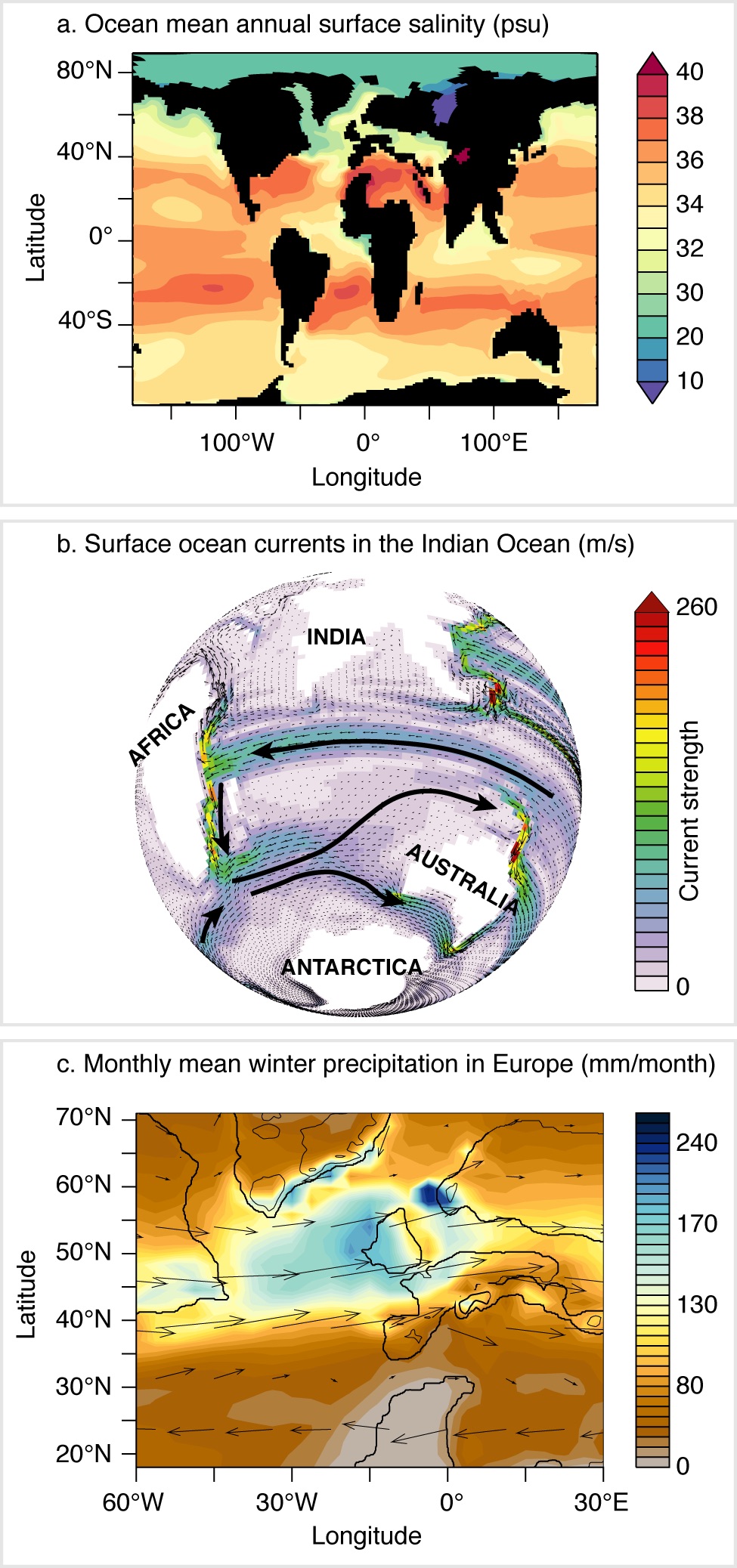
An Earth System Model is a numerical tool that calculates the earth’s climate according to a number of parameters. It is often used to predict how the climate will be in the future. It allows us, for example, to estimate how much the earth should warm up for a given increase in greenhouse gases concentration in the atmosphere. For the past, climate models allow us to assess the effects on paleoclimates of big changes, often suggested by fossils, such as changes in continent position, relief, volcanic activity, sea-level, or greenhouse gases concentration.
Fossil plants enable the reconstruction of past local to regional environment conditions. We can use fossil plants in different ways: (1) by identifying them and looking for their current closest cousins (called nearest living relatives). As we know in what conditions these live, we can then hypothesize the related fossil species had close preferences (in terms of temperature, need for water, nutrients); (2) – this is what I prefer by far – by looking at the size and shape (called physiognomy) of the fossil leaves. We know, thanks to numerous measurements of global modern vegetation, that leaf size and shape change according to the conditions in which the plant develops. For example, leaf size changes with the amount of rainfall: leaves are larger in wet areas, where plants are not likely to dry out.
Examples of results from different climate simulations made with the French Earth System Model (IPSL-CM5A2). Hundreds of parameters can be analyzed! Our experiments use a middle Eocene paleogeography, which explains some differences in continent location!
Here is an example of my work to better illustrate the use of these tools. My MSc internship and PhD were focused on the Eocene climate (between ~56 and 34 Myr ago). We know from several indicators, notably because fossil plants close to extant tropical vegetation and crocodilian bones were found at very high latitudes, near the Arctic Ocean, that this period was globally warmer. Despite on average higher temperatures, this period is particularly known for a long-term climate cooling, responsible for the Antarctic ice-sheet growth! By studying the evolution of leaf shape of a fossil beech leaf assemblage, I tried to see if this cooling was visible in Germany. Then, using climate models, I tried to understand which parameters were responsible for this change. In the different modelling experiments, we tried to understand how the major changes described at that time: changes in paleogeography (more precisely, the Drake Passage opening), drop atmospheric concentration in CO2, Antarctic ice-sheet expansion, and the associated drop in sea level (the growth of continental ice-sheet result in sea-level lowering), may have affected the Eocene climate and if some of these parameters could explain the global cooling!
How does your research/goals/outreach contribute to the understanding of climate change, evolution, paleontology, or to the betterment of society in general? My research aim at better reconstructing the evolution of Earth climate and environment through life history, but we always learn from knowing our past. Eocene temperatures correspond to those predicted for 2300 following the worst climate change scenario (RCP8.5). Studying this period of time may provide some information on the manner a globally warmer climate works. It also constitute the opportunity to test the validity of climate model predictions for the future: paleoclimate modeled can be compared to climate estimates obtained from proxy-data. However, Eocene and modern world aren’t fully comparable, there are important differences, notably in the continent location (ex. North and South America were not connected during the Eocene). This means that we cannot necessarily apply our knowledge of the Eocene to the future. For my part, I find that my research is important for its historical significance, to understand how global biodiversity got here.
Jurassic coniferous fossil wood from Antarctica, University of Kansas, Paleobotany Collection
What methods do you use to engage your community/audiences? What have you found to be the best way to communicate science? During my BSc I get a half time job, as a guide at the Museum of Natural History of Toulouse. It was a great experience that really made me want to connect people to science. Since then, I designed and animated some workshops around biodiversity and climate for children. I am not a professional in Sci Comm, but for me, communicating science starts by establishing an equal relationship between researchers and the general public. We all know things. I like to instill confidence in people, by making them participate, and then share original anecdotes on a given topic. These anecdotes are not necessary complex mechanisms, nor the most recent scientific discoveries, but stimulate curiosity and raise interest, and I think it’s the first step for people to get into science.
Me, looking for Permian fossil plants in the Lodève Basin (France) during a field trip organized by the association Agora Paleobotanica.
What is your favorite part about being a scientist ? There are different aspect of working in science I really like:
To marvel and play –To me being a scientist in paleo- is like a game, there are some clues around (and not always your favorite) and you must get some information from that to picture how the environment was millions of years ago. For now, I’ve been working on 35 to 180 Myr old periods which differs through many aspects of our everyday life context. To me working on these ancient landscapes is somehow like traveling (I guess that fiction authors may also feel this way).
Being part of something bigger – Although, we sometime feel like being in a very specific research niche, there are at least dozens of people working on similar/complementary questions around: you are part of one community! This network structure really opens up research questions that can be addressed. I like contacting people from other country asking for their expertise and exchange.
Being free –One of the big advantages of research is also that you are relatively free in the work you do and the way you do it. It certainly depends on the labs and teams you’re part of, but in general you manage your time and projects, being your own boss in a way and this is something I really like. I’m currently writing my first postdoctoral research project and I really feel like I can build something that fits me 100%.
What advice do you have for aspiring scientists?
Do as many internships as you can: these experiences will help you define your interests and what you want to do, and meet inspiring people.
Do not hesitate to contact / talk to people! Although everybody is busy, people generally like you being interested in their work and may provide you help (e.g. on special methods) or advice (including for your career!).
Do not censor / limit yourself: just because you never worked in a given field/with some methods doesn’t mean you won’t be able to succeed. Believe in yourself and work hard enough to explore research areas that interest you.