What is your favorite part about being a scientist and how did you get interested in science in general? I got into science out of curiosity. Not many people I know are in the sciences which I think called out to me to explore what a scientist does, what do they look like aside from how they are portrayed in popular culture, or in general. I chose chemistry because understanding the universe from a molecular point of view appealed to me. Now, I am focused on oceanographic work employing biogeochemistry tools and techniques.
The best part about being a scientist is that you can allow your curious mind to think freely. There is always so much more to learn. When you’re out doing fieldwork, or simply processing samples in the lab, the thrill you get whenever you’re making a discovery is irreplaceable. This doesn’t mean obtaining purely positive results- insights and observations on negative results and failed experiments make you appreciate the scientific process more. Unlocking life skills in pursuit of science is a thing! I learned SCUBA diving, and programming, because these are requisites needed to tackle the research problem I am working on at the moment.
With my work, I hope to encourage more Filipinos to pursue a career in the sciences.
In laymen’s terms, what do you do? My research involves enumerating the lipids found in microbial mats, the water column and sediments in an area where groundwater bubbles out from the seafloor. These areas have very dynamic chemistries and my objective is to understand how micro- and macroorganisms thrive and adapt to these conditions.
Submarine groundwater discharge research group of the OASIS Lab, UP-MSI collecting biomass, sediment and gas samples.
How does your research/goals/outreach contribute to the understanding of climate change, evolution, paleontology, or to the betterment of society in general? Knowing the lipid composition gives us an understanding of the metabolic processes employed by microorganisms in adapting to their environment. Looking at the adaptation in areas affected by submarine groundwater discharge can very well contribute to assessing how organisms may behave in response to the changing oceans. The research also employs stable isotope measurements to go hand-in-hand with lipid studies. Another goal is to test how paleotemperature proxies behave in tropical climate as most studies are being done in temperate regions.
Leisure dive after sample collection: We make time to have a leisure dive after completing the sample collection dives to appreciate the rich biodiversity in Mabini, Batangas.
What are your data and how do you obtain your data? In other words, is there a certain proxy you work with, a specific fossil group, preexisting datasets, etc.? The data that my research uses are lipid mass spectrometry profiles as well as isotopic compositions from isotope-ratio mass spectrometry analysis. Isotopic data are both compound-specific and bulk analysis. We also perform the standard physico-chemical measurements of the study site, as well as obtain DNA data of the microbial mats we’ve collected from the field. The team is also exploring the use of imaging to profile the microorganisms across the water column.
Bubbles emanating from the seafloor.
What advice do you have for aspiring scientists? Scientists come in all shapes and sizes. As long as you have that curious mind to hold on to, there is no mold that you should follow on how to be one. Find an inspiration and follow it through with hard work and a lot of readings, and you’re good. More importantly, engage people on your work. Science is meant to be communicated to the larger population outside the scientific sphere and now more than ever is citizen science a force we definitely want to tap into.
Hello folks! My name is Marie-Charlott and currently I am working on my master’s thesis in theoretical ecology. To be honest, I never expected to get this far in my scientific career and everyday when I get up in the morning (when coffee is involved) I am happy to contribute some knowledge to our scientific world.
What is your favourite part about being a scientist, and how did you get interested in science in general? Well, I have kind of a romanticised story of how I decided I want to be a scientist; when I was a child, I was obsessed with animal documentaries, atlases about animals and especially with dolphins. I had tons of books about the life of the ocean (spoiler alert: I changed to bears!) When I graduated high school, I did not really know what I wanted to do with my life or where I could see myself in the future. I decided to apply for all kinds of studies that I thought might be suitable for me at universities all around my hometown. Eventually I only got accepted at the University of Cologne for the bachelor’s program in biology. I had my very first big mind-blowing moment when I sat in a lecture of inorganic chemistry and the professor explained to us that all matter on our planet, as far as we are concerned, is made of the same quality: atoms. It is only the protons, neurons and electrons that make the difference. Only these three things determine how matter is and how it is able to react. At this very moment, I fell in love with science in general. I could not believe how great everything around us actually appears to be, how many fantastic secrets are out there to uncover. I decided I want to get to know and contribute AS MUCH AS I COULD. And since that moment, many more mind-blowing moments like this followed. And I undoubtedly believe this will never stop for the rest of my life.
Science also literally saved my life and gave me a place to belong to. Both of my parents passed away during my Bachelor’s studies and I was lost in this big world. I found support and passion in working for something bigger than me, something that is real and can be proven. It gave me stability.
What I truly love about science and the scientific community: No matter who you are, where you came from, who you love or who you decide to be: We all agree on the general principles of logic, causality and reproducibility. We all work for the same goal.
How does your research contribute to the understanding of climate change, evolution, palaeontology, or to the betterment of society in general? It is not a secret anymore that humanity contributed well to destroy its own home planet by climate change, globalisation, urbanisation, biodiversity- and ecosystem loss. There is undoubtedly an immense amount of work to do – and I started with my master thesis at a point where I try to understand what went wrong in our approach to maintain species diversity so far. Many biodiversity conservation programs were designed to reintroduce species into their natural habitat to maintain ecosystem workability when they disappeared. Unfortunately, many of them failed and the programs were not successful. But how do we investigate the reasons for a failed reintroduction? Interview the released animals one by one?
Scientists have found another, feasible solution to get to the bottom of the matter.
When we try to model an event or reproduce a mechanism on the computer in a simulation, preparation and evaluation is a dynamic process where we learn from what we model and try to improve this model to get as close as possible to the real event we try to simulate. In my master thesis, I created a simple model based on equations which solution represents the population density of different animal species. My model is not adapted to one species in particular but held general to investigate the event of what we call community closure: A ecosystem loses a species and begins to dynamically re-calibrate itself towards a new equilibrium. The interactions within the system change when one interaction partner just disappears; and this is where I start my investigation. I force one of the species which used to interact as a competitor or as a predator or prey into extinction and then try to reintroduce it back into the system when a new equilibrium is reached. When we find out more about the major forces that keep ecosystems closed, we might find a way to manage some of these factors and tackle the issue of failed reintroduction programs.
One of the biggest problems in nature is: We can only see the system in its status quo as it appears to us right now. Due to environmental uncertainty, it is often hard to approximate what happened in the past and what led to the state we observe right now. This is also what computational models are for: We can play around with our models and maybe are able to reveal completely new phenomena we might also find in nature when we know what to look for.
What advice do you have for aspiring scientists? Never let anyone else tell you what you are able to do or not. Don’t be afraid to reach for the stars. My Mom used to say: It is always possible if you are willing to work hard, and I truly believe in that. There is nothing you can’t learn, even when you don’t feel apt or suitable for the task. Go for what you are passionate about in life and also learn from your mistakes. A bad grade or a rejected paper do not mean you suck as a scientist. Struggle means improvement and we are all in this together, so don’t worry about one thing in particular you haven’t been perfect at.
Deepak in the field and holding an archaeological stone tool in a field area.
Hi!! I am Deepak, a final year PhD student. I have recently submitted my thesis for evaluation at the Indian Institute of Science Education and Research (IISER) Kolkata, India. I am quite passionate about my research work as a scientist, exploring and digging the Earth’s surface to answer some of the curiosity-driven questions such as “the role of climate instability in human evolution”.
What is your favorite part about being a scientist, and how did you get interested in science?
The most important aspect of being a scientist “who deals with sediment and rock records” is that you get the opportunity to explore scientific questions that have a broader implication in understanding the past climate under which hominins evolved to become Homo sapiens. As a scientist, I get the opportunity to visit archaeological sites that have fossilised records of stone tools and artefacts used by prehistoric humans. Seeing archaeological samples and working on them to unravel human history feels exhilarating, and the realisation of holding artefacts used by humans thousands of years ago gives me goosebumps. The experience of working in the field and digging the sediment sequences to understand the past environment feels like time travelling. This excitement and curiosity have been the source of motivation for exploring the relationship between the past climate and prehistoric humans evolution.
Deepak working in the laboratory and analysing soil samples for charcoals under a stereomicroscope.
It all started during my undergraduate coursework in Geology, where I was introduced to various topics ranging from the Vertebrate Paleontology, Earth Climate, Quaternary Geology, and Evolution of Life through time etc., which built the foundation of my research career. The Quaternary period due to its association with human evolution fascinated me a lot. The research papers that correlate the fall of Harappan Civilisation with climate instability, particularly to the Indian summer monsoon weakening at ~4.2 ka and the collapse of well-known 8th or 9th century’s old Maya civilisation was linked to the arid climate, and excessive deforestation attracted my attention in this field.
Curiosity to unravel the mechanisms through which climate has shaped the evolution of Homo species brought me closer to my PhD project. My PhD research work at the stable isotope laboratory of IISER Kolkata, India, was oriented towards the understanding human-environment relationship. With the help of my supervisor Prof. Prasanta Sanyal, I was able to formulate my PhD project, which utilises stable isotopic tools to decipher changes in climatic conditions and their resultant effects on the prehistoric human population. Throughout this project, I thoroughly enjoyed every aspect of my research work.
Deepak operating the Dionex Accelerated Solvent Extraction (ASE 350) to extract the total lipids from the sediments.
What do you do?
I try to reconstruct the environmental conditions using multiple proxies to understand the relationship between climate and culture changes. By doing this, we would be able to understand the climatic situations through which human evolution took place.
How does your research contribute to the understanding of climate change, evolution, paleontology, or to the betterment of society in general?
My graduate research work aimed to understand the course of human evolution during the Late Quaternary period in the Indo-Gangetic region. The Quaternary period encompasses numerous key advancements in human evolution such as early migration, brain size development, typo-technological evolution, adaptation to an extreme environment, hunting to sedentism lifestyle, agriculture and domestication of animals. However, any advancement in human evolution cannot be deciphered in isolation without understanding the prevailing climatic conditions, since humans like every other organism also respond and adapt to their changing environment. To comprehend the complex research questions of Late Quaternary in the Indian subcontinent, I have used the multidisciplinary (Geology, Organic and Stable Isotope Geochemistry, Archaeology and Anthropology) approach to decode the early-human environment and their behaviour in extreme climate scenario. I have employed a multi-proxy approach that includes compound-specific isotopic analysis of n-alkanes and soil carbonates from paleosols to understand the past climate and vegetation in the Belan River Valley situated in north-central India. My research highlights the vital linkage between the prehistoric human populations and climate variability.
Deepak presents a scientific poster at a conference (INQUA 2019) held in Dublin, Ireland.
At the same archaeological sites, further research work on the study of macroscopic charcoal particles suggests the controlled use of fire by hominins during the Middle Paleolithic phase dated around ~55 ka BP. This charcoal record provides the oldest evidence of fire use by hominins from the Indian subcontinent. Additionally, I aim to decode the provenance of sediments deposited in the Indo-Gangetic plains during the Late Quaternary period. To achieve this, we have planned to measured Strontium (87Sr/86Sr) – Neodymium (143Nd/144Nd) isotopes to understand the provenance of fluvial sediments and stone tools from archaeological sites. Therefore, through this project, I have targeted novel questions and used the latest measurements techniques to provide an overall idea of climate, vegetation, fire and provenance and its linkage to prehistoric phases in India. The results of my project have helped in filling a scientific void by presenting results from the Indian subcontinent, which will lead to an improvement in the understanding global-scale picture of human evolution.
What advice do you have for aspiring scientists?
I would say to them, “The only way to achieve your dream is not to give up”. The journey is not easy, but the curiosity in you will find a path that will lead you to success.
What is your favorite part about being a scientist, and how did you get interested in science in general?
My favorite part about being a scientist is being able to see fantastic geological sites and learning about some of the weirdest species of Earth’s past. I wish I could say I always had an interest in paleontology, but it wasn’t until the end of my freshman year of college that I realized I had a passion for this field. As a general education requirement, I took Life of the Past. One day, while rapidly taking notes, a slide changed to a photo of a Quetzalcoatlus skeleton. I lost the ability to focus on my scribblings and my mind wandered. So many questions: did this creature fly, how could it fly, could I have ridden it while it was flying? I don’t know if it was the thought of riding this gigantic pterodactyl, or the realization of this ancient yet new world had just come into existence, either way at that moment I was hooked. Within a week I added on Geology as a dual major and started volunteering at the Missouri Institute of Natural Science.
Raptor claw replicates!
What do you do?
Currently I am an undergraduate student, I am studying Geology and Anthropology emphasizing on Paleontology and Archaeology. I am hoping to be a vertebrate paleontologist and a science educator one day. I also volunteer at our local natural science institution. Here I apply what I have learned in my majors and because of this I’ve been able to get my hands into a lot of different projects. I have worked with triceratops bones to prepare them to cast and mold. I have also worked on reshaping the replicated portions of the triceratops to make them biologically accurate. I’ve made replicas of different dinosaur’s teeth and claws to raise funding for the museum. I help classify newly donated rocks and minerals when they come in. I have helped create some of our displays in our mineral exhibit. The museum has also given me the privilege to be a part of their lectures and field trips. During these field trips, I would give guided tours of the museum and take the families to hunt for marine fossils on the premises. I have also given lessons at a local school about varying dinosaurs and what it is like being a paleontologist.
Working on Henry the triceratops
How does your research and outreach contribute to the betterment of society in general?
Being a part of the museum gives me the ability in having a part in outreach programs. These types of programs work with younger generations and stimulates the interest for the field at an early age. These are the next generation of paleontologist, chemists, or biologists that will continue to make advancements in science and history. When we work with the younger generations you know amazing things are bound to happen!
What advice do you have for aspiring scientists?
My advice is to aspiring scientists is never be afraid to put yourself out there. Ask the questions that are pounding in your head. Reach out and talk to that scientist you look up too. Never be ashamed to ask a silly question! Science is founded on hunting down the answers to questions that no one has yet answered.
What is your favourite part about being a scientist and how did you get interested in science in general? When I was young, I was, as many kids, particularly interested in dinosaurs and other fossils. I liked nothing more than visiting a natural history museum marvelling at the wonders of nature‘s past. And of course, I had a proper collection of dino toys. My primary school teachers gifted me a small book about Earth history before I left, knowing very well about this passion of mine. I suppose I just didn‘t grow out of this passion (Certain movies by Spielberg might have played a part in it as well …). Thus, still aspiring to become a palaeontologist, I registered in Bonn University for the geosciences Bachelors program in 2010, which I finished in 2013. I really enjoyed my studies there, so naturally I followed up with the master‘s program that I finished in 2016.
What interests me the most in sciences is the pursue of knowledge. To enhance our knowledge by finding the natural coherence of things. Finding traces of what is yet hidden in the dark, making hypotheses, searching for more clues, trying to see and understand more and more. A great aspect in geosciences is field work. It is such a thrilling experience to visit an outcrop and reconstruct the past, which is, for me, quite a lot like detective work. Looking at all the little puzzle pieces of past ecosystems, such as fossils and sedimentological features, then trying to put it all together into a bigger picture. Since I was young I would read with excitement about the explorers of old times – Humboldt, Darwin, Shackleton, Fawcett, and the like – dreaming of going on such expeditions myself one day. Indeed, my studies brought me to many places, not seldom quite off of touristic trails, and sometimes even a slight bit dangerous. It‘s as close to the travels of these past explorers as I could have wished for.
In laymen‘s terms, what do you do? My current research is focused on ancient marine organic-walled phytoplankton. Plankton describes the organisms that float in the water column. Within the plankton we have zooplankton and phytoplankton. The former are heterotroph, which means they need to consume other organisms to gain energy, while the latter are autotroph, meaning they obtain energy through photosynthesis, just like plants on land. In today‘s oceans we find a variety of groups in the phytoplankton, such as diatoms, coccolithophores, green algae, dinoflagellates and cyanobacteria. I am working on phytoplankton from the Palaeozoic, a time interval dated roughly between 541 Million and 250 Million years ago. During this time the phytoplankton was represented mostly by what we call acritarchs. So what are acritarchs? I‘m not sure, actually. And that‘s why they are called acritarchs, as the name means „uncertain origin“. We don‘t know the biological affinity of acritarchs, and they surely belonged to a variety of groups, but most of them are interpreted to represent the remains of phytoplanktic organisms, some of which might be related to today‘s dinoflagellates.
So how can we study microscopic remains of organic-walled plankton that lived hundreds of millions of years ago? Actually, these little things are quite resistant. In order to process a rock sample for palynological analysis, we dissolve the rock in different acids. What remains are organic-walled microfossils, so called palynomorphs, such as the acritarchs, that we can study under a microscope. But what is so interesting in microscopic organisms that were floating in the ancient seas? First, they help us to define the age of sediment rocks. Many palynomorphs represent important index fossils, and thus, have a stratigraphic value. Then, since phytoplankton is often bound to certain environmental conditions, palynomorph assemblage analyses can help us reconstruct parameters, such as water temperature, depth, or distance to land, during the time of the deposition of the sediment: That is how the distribution of different taxa of phytoplankton can give us valuable information about the palaeoenvironment. Another and major aspect of phytoplankton is their photosynthetic activity. While often the continental forests are called the „lungs of the Earth“, phytoplankton are responsible for 50–80 % of the production of the oxygen in the atmosphere. Through their photosynthetic activity phytoplankton take up great amounts of CO2 from the atmosphere. Large quantities of this carbon is then stored in deeper parts of the ocean when phytoplankton die and sink to the seabed. During the early Palaeozoic the importance of phytoplankton within the carbon cycle was much bigger, since plants were yet to conquer the land. Another important aspect is the fact that phytoplankton is at the base of marine food webs. For these reasons we assume that changes in phytoplankton through time must have had an impact on both Earth‘s climate and marine ecosystems. My studies aim to find correlations between biodiversity changes of the phytoplankton and changes in different palaeo-environmental parameters, such as temperature, atmospheric O2 and CO2 concentrations, sea level, and palaeogeography.
Different acritarchs from the Ordovician of Columbia (from Kroeck, D. M., Pardo-Trujillo, A., Torres, A. P., Romero-Baéz, M., Servais, T., 2020. Peri-Gondwanan acritarchs from the Ordovician of the Llanos Orientales Basin, Colombia. Palynology 44, 419–432).
How does your research/goals/outreach contribute to the understanding of climate change, evolution, paleontology, or to the betterment of society in general? While palaeontology is the study of past processes, it can be of great value for the present. Awareness of climate change as a major global crisis has significantly increased in the last decades. Its effects are already perceptible in many of the Earth’s ecosystems. It has become an important task to estimate future consequences of the rapidly changing climate. Palaeontological investigations provide an important tool for predicting processes in changing environments by reconstructing past intercorrelations. Inversing the famous quote of the Scottish geologist Sir Charles Lyell, “The present is the key to the past”, our knowledge of processes in Earth history may help us to estimate future developments. Several important extinction events are known, some of which are related to increases in greenhouse gases. Thus, investigating biotic changes during these crucial time intervals and comparing the results with recent developments is very important. I want to contribute with my work to our understanding of today‘s profound changes in the biosphere caused by human activities.
If you are writing about your research: What are your data and how do you obtain your data? In other words, is there a certain proxy you work with, a specific fossil group, preexisting datasets, etc.? During my Ph.D. project I mostly worked on a database of the Palaeozoic phytoplankton comprising occurrence data from published literature including stratigraphic and geographic information. We used this database to create diversity curves for the Palaeozoic phytoplankton. But I also went on sampling trips myself, which is basically taking rock samples from different stratigraphic layers. In the laboratory these samples are being processed, generally by dissolving the rock in acids and sieving the residues. Then palynological slides are being produced by distributing the sieved residues on glass slides and embedding them in a clear medium. After, the samples are analysed under the microscope. For some of my work I did morphometrics, which is measuring certain parameters of microfossil specimens in larger population in order to statistically analyse them. This can help assessing morphological variability and to review taxonomic classifications.
What advice do you have for aspiring scientists? Working in science can be frustrating at times. That‘s part of it, I suppose. Don‘t let it discourage you. Follow your passion. Other than that, „Explore. Dream. Discover.“ – H. Jackson Brown Jr.
Nicole Torres-Tamayo focuses her research on reconstructing the paleobiology of our ancestors through the study of their anatomies.
I am a biologist currently doing my PhD in the field of Paleoanthropology and I am interested in the application of innovative methods to reconstruct key fossils in human evolution. I started my PhD program in Evolutionary Biology and Biodiversity in 2016 and the focus of my research is the origin and evolution of the body shape in thegenus Homo, which emerged in Africa around 2 million years ago. In particular, I use quantitative methods to reconstruct missing fossil elements of the torso of extinct hominins to shed light on their lives in the past: behavior, locomotion, diet, etc. and their relationship with the environment (paleobiology).
Fossils are priceless, scarce and unique, and they are what paleoanthropologists have to infer the morphology and function of extinct species. Fossil specimens are usually confined to institutions located in the country where they were excavated, and because of their fragility, they are rarely transported out of these places. For this reason, the emergence of virtual techniques in the last decades has been crucial to expand the work with fossil specimens worldwide: they allow for doing research in a virtual environment, avoiding fossil manipulation and damage, while working thousands of kilometers far from where the specimen is hosted.
Among these virtual techniques, 3D scanning is one of the most widely used data collection methods in Paleontology. The morphology of a bone is captured by means of a 3D surface scanner, and the resulting 3D scans are fused to generate a 3D virtual model of the original bone. In my Ph.D. research, I measure these 3D models using 3D geometric morphometrics to quantify the size and shape variation of different anatomical traits through points called landmarks and semilandmarks. The Cartesian coordinates collected by these points reflect the morphology of the bones and can be analyzed using multivariate statistics.
Original fossil hipbone KNM-ER 3228 (~1.9 m.a, putative Homo erectus) hosted at the National Museum of Nairobi (Kenya).
My Ph.D. research has been funded by the Spanish Ministry of Economy and Competitiveness and by several supporting travel grants (Synthesys program, AMNH collection study grant, Erasmus +, etc.). Thanks to this funding I have travelled to many places to scan skeletal and fossil collections hosted in different institutions. However, I am very aware that this is not the rule in science, at least in Spain, the country where I was born, grew up and started my research career. There are manyyoung researchers across the world who do not have funding to cover their living expenses during the Ph.D. and who need to combine their Ph.D. research with a part-time job out of academy (e.g. coffee shops, restaurants, etc.). It is not surprising that these people cannot afford the expenses to collect data for their own research. I have heard many stories about truncated Ph.D. projects from people who had not access to the data necessary for their own research and who sometimes lack support from their own laboratories. The COVID-19 pandemic is highlighting how necessary research data sharing is for the progress of science, as many people who have not had access to data hosted in their labs or in foreign institutions have suffered a great impact in their investigations as a consequence of mobility restrictions. All these stories have been a turning point in my career and because of them, today I am a huge advocate of open science and research data sharing, which defines my interests and concerns above any discipline.
3D surface scanning is a widely used data collection method and allows for the digitization and virtual conservation of valuable fossil specimens.
One of the greatest advantages of the virtual techniques that I use is the production of virtual models that become part of the virtual collections of the institutions where the original specimens are hosted, contributing to the digital conservation of the specimens in a virtual archive. But also, the virtual nature of these models make them suitable for being shared within the scientific community and the derived datasets (3D coordinates, raw measurements, methodological protocols, etc.) can be hosted in open online repositories (e.g. GitHub, Open Science Framework, Morphosource, etc.) to be available for the scientific community. Sometimes these data are subjected to strict ethical protocols (e.g. clinical data that come from medical institutions) and cannot be shared, but once again, this is not the rule: the majority of the research data that Palaeontologists use can be (and should be) shared with the scientific community, and researchers, especially the young ones, are increasingly willing to do it. But unfortunately, an important part of the Paleo-community is still reluctant to share their research data, something that in my opinion hinders the progress of science and makes it more opaque and inaccessible. For this reason, my Ph.D. research has been bolstered by two incentives. Firstly, I encourage young students to learn why transparency and reproducibility are important beyond any field of research and the role data sharing plays on this. And secondly, I contribute by making my research data and code freely available in open online repositories for researchers who experience restrictions in data collection.
These good scientific practices are not only applicable to Palaeontology; they are valid in all scientific disciplines. Sadly, I encountered many difficulties when promoting research data sharing, most of them under the argument of “we are not going to do this because we have never done it before”. The pioneering computer scientist Grace Murray Hopper (1906-1992) once said: “The hardest thing in the world is to change the minds of people who keep saying, ‘But we’ve always done it this way.’ These are days of fast changes and if we don’t change with them, we can get hurt or lost.” My advice for aspiring scientists is to keep Dr. Hopper’s words in their minds during their entire scientific career.
What is your favorite part about being a scientist and how did you get interested in science in general? My favorite part about being a scientist is that it is always changing. I always get to build on what we already know, and the possibilities are endless. As a kid, my mom would buy me science kits that grew crystals, allowed me to build microscopes, and insect collection kits that all made me fall in love with the how and why behind environmental science. Since my childhood I simply remember asking why/how that works and now I have the capabilities to ask questions and do the science to figure it out.
In laymen’s terms, what do you do? I consider myself a microbial ecologist, so I essentially work to identify how microbes control the surrounding environment. I’ve worked with microbes that eat oil, microbes that live on monkeys, microbes in the water, and microbes in the ground. I try to understand how the little things make the world go ‘round.
For my master’s I am using microbes to better assess water pollution in Delaware waterways.
How does your research/goals/outreach contribute to the understanding of climate change, evolution, paleontology, or to the betterment of society in general? A lot of research I have done is applicable to water quality management. We can use oil degrading microbes to mitigate oil pollution or tracking microbial pollution through waterways can help better assess management policies.
If you are writing about your research: What are your data and how do you obtain your data? With the help of the Department of Natural Resources, we have actually been collecting all of our data ourselves. We have collected a lot of animal, water, and sediment samples to analyze for microbes.
What advice do you have for aspiring scientists? My advice to aspiring scientists would be to never be afraid to ask for help and learn. There are many other scientists that were in the same position you may be in, and many are willing to help and see you through it. The best science is collaborative science but you must ask for help first.
Allison ready for field work in Montana. Photo from “Learning From the Ground Up”, University of Washington.
Hello, my name is Allison, and I’m a master’s student at Indiana University. I have a bachelor’s degree in Earth and Space Science from the University of Washington. For a few years, I worked across the western US on public lands as a park ranger and field technician. Now that I’m back in school, I’m researching wolves.
What do you do? The main question I’m trying to answer is are red and grey wolves one or two species? This is a complicated question, as red wolves have historically interbred with coyotes. The interbreeding means that they may have been a group of grey wolves that mated with coyotes and now seem different enough to be called red wolves. I use measurements of wolf skulls to see if I can find a difference (size or proportions) between grey and red wolves. Currently, I’m using pre-existing datasets, but if Covid-19 allows, I hope to visit museums and measure more skulls.
This is an important question for conservation efforts that focus on wolves. Conservation efforts typically focus on one species, and the ambiguity makes this difficult.
Allison digging a soil pit to assess landscape change in Eastern Nevada. Photo by Eli Rolapp.
How did you get interested in paleontology, and what’s your favorite part of being a paleontologist? During the second year of my bachelor’s degree, I took a class on volcanoes. After that class, I declared a geology major and my sedimentary geology classes talked about fossils. In class, I got to see and touch fossils, and I was hooked.
As for my favorite part of being a paleontologist, I have two parts. The first is the field work! I love hiking with a backpack full of gear looking for fossils. The second part is the outreach. I enjoy talking to people about what has been found, what sort of creatures they were when alive, and in what kind of environment they lived.
What advice do you have for aspiring scientists? Keep asking questions! Questions and curiosity are what push science forward.
What is your favorite part about being a scientist and how did you get interested in science in general? I remember long visits to the Berlin zoo with my father where we spent hours nurturing our shared passion for the natural world and fulfilling our curiosity. When I was seven years old, I asked for an encyclopaedia for Christmas and I recall the absolute joy I felt when I was presented with a huge book full of knowledge. I read it front to back. My second huge passion is music, and I diverted my attention away from science towards hard rock for a number of years before going back to my roots and returning to university at 37 to study first Environmental and Sustainability Sciences (BSc) and then Marine Environmental Protection (MSc). My favourite part of being a scientist is that the learning never stops, the exploring, re-thinking, questioning and boundary-pushing. I love meeting all the inspiring colleagues and I love being able to pass my knowledge on to others and trade it in for theirs. This is why I am especially interested in transdisciplinary work and science communication.
Plover Rovers Shirt
In laymen’s terms, what do you do? Currently, I mainly run The Plover Rovers, a marine science communication charity which I founded last year when I was put on furlough from my job as a benthic taxonomist – benthic taxonomists spend most of their time staring down microscopes, identifying tiny marine invertebrates. I’m loving all the outreach and communication I get to do with the charity and meeting all the wonderful colleagues who want to get out there and talk about their passion.
How does your research/goals/outreach contribute to the understanding of climate change, evolution, paleontology, or to the betterment of society in general? With the Plover Rovers we want to enable knowledge exchange between science and local communities. We want to bridge the gap between science and society – we believe science can play an important part in empowering communities by giving them the broader knowledge to understand what is happening locally, what affects them in their day-to-day life, like flooding, collapsing fish stocks, pollution, or offshore energy installations; to put it all into a bigger context. At the same time, we believe that scientists need to regularly talk to people outside of academia, people who deal with the effects of the issues the scientists are researching. With the “Talking the Coast” project, we hope to help establish lasting direct links between marine scientists and local communities and help make marine science accessible for a broad demographic. Our events will not just be pure science. We want to collaborate with local partners to provide some hands-on outdoor activities, with artists and sustainable businesses, for example, local micro-breweries or small-scale fisherfolk, to design events which appeal to a wide audience. By improving the ocean literacy of coastal communities, we are adding our little grain of sea salt to the United Nations Decade of Ocean Science for Sustainable Development.
What methods do you use to engage your community/audiences? What have you found to be the best way to communicate science? We strongly believe in the power of positive messaging, of giving people a sense of empowerment and purpose rather than scaring them stiff with doom and gloom messages. Communicating about the ocean in ways that enhances and increases awareness, concern, connection and positive behaviours, requires an understanding of how different people and communities think about, and value, the ocean. Crucially, we want to focus on understanding where people are, what their values are currently, and exploring how these can be used to develop effective communication around the ocean and ocean literacy. In order to achieve this, we use a four-tiered approach: 1. Present relevant science with a focus on dialogue rather than top-down knowledge transfer 2. Collaborate with artists to provide an additional more emotive access to the topic 3. Collaborate with local organisations to provide people with the possibility of local engagement 4. Heritage & storytelling: We collect stories from local people to explore and understand their connection to the sea, their concerns, hopes and visions.
What advice do you have for aspiring scientists? Follow your dreams, don’t stress, accept that life is never a straight line (and who’d want that anyway– a cardiac flatline means you’re dead!) and free yourself from concepts like “making a career”, “rising up through the ranks”, “competition” and “better salaries with a PhD” – all of these concepts are rooted in a capitalist system focused more on competition and hierarchies than on knowledge gain and collaboration. Build a good support network, seek out the out-of-the-box thinkers, act on crazy ideas, be bold, explore, change the world.
Me, animating a climate modeling workshop with middle school students for a Science day in the lab (CEREGE, Aix-en-Provence, France).
How did you get interested in science in general? To some degree, my family probably played a role by cultivating my curiosity. My dad, by making some electricity home experiments from time to time (I think his favorite, and more impressive to us was: putting a light on from a potato!), my mom by loving plants and growing flowers everywhere, my aunts by occasionally brining my sister and I to zoos and museums. However, I don’t think any of my family and friends would have predict I would work in the science field. Until my 20’s I was more on the road to become stage director, art or theater critic, or even visual artist. After studying theater, languages, philosophy and literature in high school, I decided to start medical studies with the motivation to learn about the human machine functioning. After a few months, I realized it was hard but not exciting at all. Therefore, I decided to move to another discipline and while I was hesitating between art history and biology, I choose the second option. And this was the good one. I will always remember how my BSc botany and zoology classes were captivating. It was like learning about so many aspects of our world I never questioned before: what muscles make an earthworm move? How does a clam breath? What processes enable plants to move? How many lichens are there on the trees around? Without mentioning field trip on country side identifying plants and fungi, or on an island, collecting algae for herbarium… All these experiences really change the way you apprehend your environment! A tipping point in my formation was my first research internship in paleontology, during this experience I measured a hundred of belemnites (an extinct group of marine cephalopods) but more importantly, I realized I wanted to become a researcher. Of course, I feel really lucky that our public education system is (for the moment) not expensive, as compared to most other countries’. This enabled me to test for different branches and find my own.
Late Eocene Eotrigonobalanus furcinervis fossil leaf (Museum für Mineralogie und Geologie, Dresden, Germany).
In laymen’s terms, what do you do? My work aims at reconstructing deep-time (i.e., millions of years old) environment and climate characteristics using fossil plants (wood and leaves) and Earth System Models.
An Earth System Model is a numerical tool that calculates the earth’s climate according to a number of parameters. It is often used to predict how the climate will be in the future. It allows us, for example, to estimate how much the earth should warm up for a given increase in greenhouse gases concentration in the atmosphere. For the past, climate models allow us to assess the effects on paleoclimates of big changes, often suggested by fossils, such as changes in continent position, relief, volcanic activity, sea-level, or greenhouse gases concentration.
Fossil plants enable the reconstruction of past local to regional environment conditions. We can use fossil plants in different ways: (1) by identifying them and looking for their current closest cousins (called nearest living relatives). As we know in what conditions these live, we can then hypothesize the related fossil species had close preferences (in terms of temperature, need for water, nutrients); (2) – this is what I prefer by far – by looking at the size and shape (called physiognomy) of the fossil leaves. We know, thanks to numerous measurements of global modern vegetation, that leaf size and shape change according to the conditions in which the plant develops. For example, leaf size changes with the amount of rainfall: leaves are larger in wet areas, where plants are not likely to dry out.
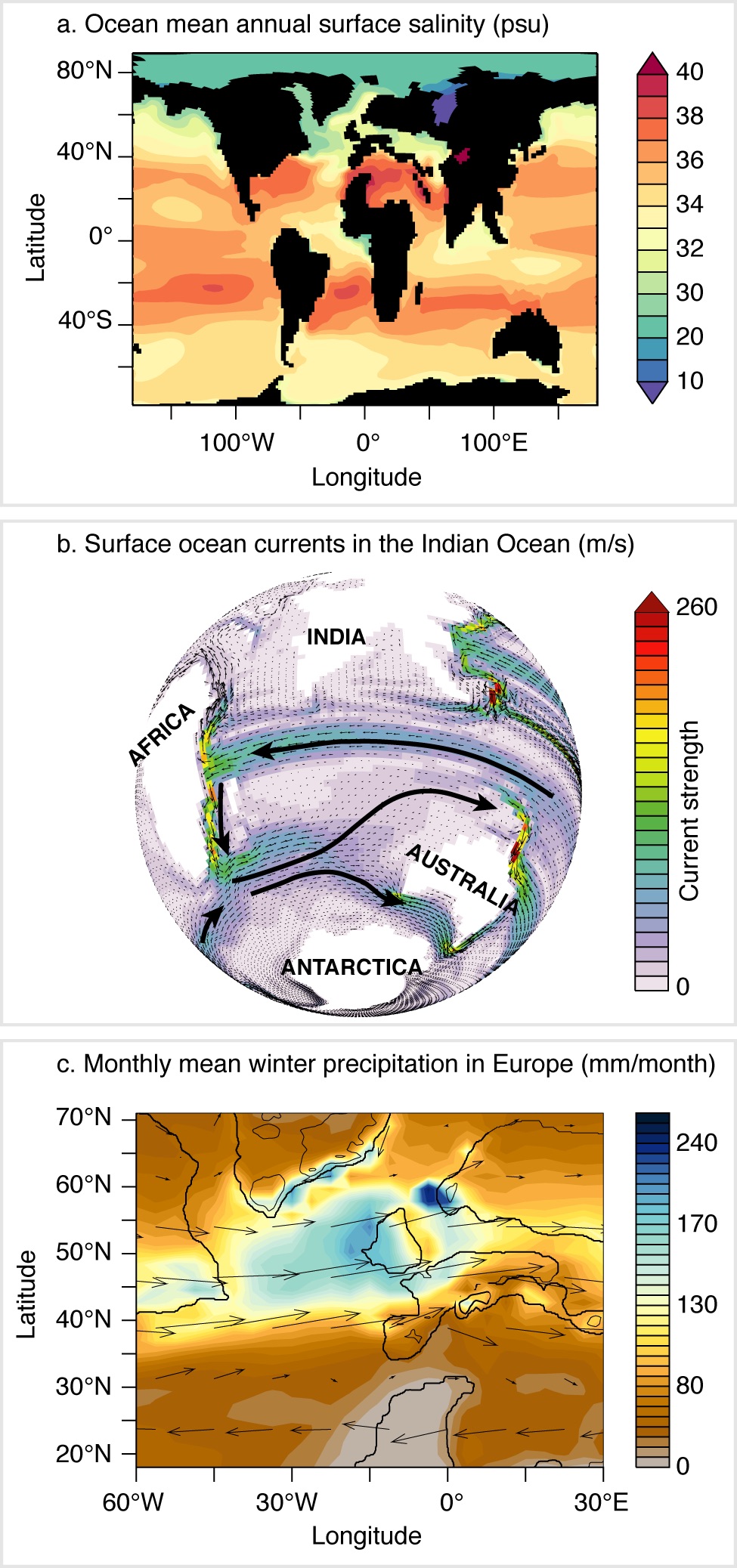
Examples of results from different climate simulations made with the French Earth System Model (IPSL-CM5A2). Hundreds of parameters can be analyzed! Our experiments use a middle Eocene paleogeography, which explains some differences in continent location!
Here is an example of my work to better illustrate the use of these tools. My MSc internship and PhD were focused on the Eocene climate (between ~56 and 34 Myr ago). We know from several indicators, notably because fossil plants close to extant tropical vegetation and crocodilian bones were found at very high latitudes, near the Arctic Ocean, that this period was globally warmer. Despite on average higher temperatures, this period is particularly known for a long-term climate cooling, responsible for the Antarctic ice-sheet growth! By studying the evolution of leaf shape of a fossil beech leaf assemblage, I tried to see if this cooling was visible in Germany. Then, using climate models, I tried to understand which parameters were responsible for this change. In the different modelling experiments, we tried to understand how the major changes described at that time: changes in paleogeography (more precisely, the Drake Passage opening), drop atmospheric concentration in CO2, Antarctic ice-sheet expansion, and the associated drop in sea level (the growth of continental ice-sheet result in sea-level lowering), may have affected the Eocene climate and if some of these parameters could explain the global cooling!
How does your research/goals/outreach contribute to the understanding of climate change, evolution, paleontology, or to the betterment of society in general? My research aim at better reconstructing the evolution of Earth climate and environment through life history, but we always learn from knowing our past. Eocene temperatures correspond to those predicted for 2300 following the worst climate change scenario (RCP8.5). Studying this period of time may provide some information on the manner a globally warmer climate works. It also constitute the opportunity to test the validity of climate model predictions for the future: paleoclimate modeled can be compared to climate estimates obtained from proxy-data. However, Eocene and modern world aren’t fully comparable, there are important differences, notably in the continent location (ex. North and South America were not connected during the Eocene). This means that we cannot necessarily apply our knowledge of the Eocene to the future. For my part, I find that my research is important for its historical significance, to understand how global biodiversity got here.
Jurassic coniferous fossil wood from Antarctica, University of Kansas, Paleobotany Collection
What methods do you use to engage your community/audiences? What have you found to be the best way to communicate science? During my BSc I get a half time job, as a guide at the Museum of Natural History of Toulouse. It was a great experience that really made me want to connect people to science. Since then, I designed and animated some workshops around biodiversity and climate for children. I am not a professional in Sci Comm, but for me, communicating science starts by establishing an equal relationship between researchers and the general public. We all know things. I like to instill confidence in people, by making them participate, and then share original anecdotes on a given topic. These anecdotes are not necessary complex mechanisms, nor the most recent scientific discoveries, but stimulate curiosity and raise interest, and I think it’s the first step for people to get into science.
Me, looking for Permian fossil plants in the Lodève Basin (France) during a field trip organized by the association Agora Paleobotanica.
What is your favorite part about being a scientist ? There are different aspect of working in science I really like:
To marvel and play –To me being a scientist in paleo- is like a game, there are some clues around (and not always your favorite) and you must get some information from that to picture how the environment was millions of years ago. For now, I’ve been working on 35 to 180 Myr old periods which differs through many aspects of our everyday life context. To me working on these ancient landscapes is somehow like traveling (I guess that fiction authors may also feel this way).
Being part of something bigger – Although, we sometime feel like being in a very specific research niche, there are at least dozens of people working on similar/complementary questions around: you are part of one community! This network structure really opens up research questions that can be addressed. I like contacting people from other country asking for their expertise and exchange.
Being free –One of the big advantages of research is also that you are relatively free in the work you do and the way you do it. It certainly depends on the labs and teams you’re part of, but in general you manage your time and projects, being your own boss in a way and this is something I really like. I’m currently writing my first postdoctoral research project and I really feel like I can build something that fits me 100%.
What advice do you have for aspiring scientists?
Do as many internships as you can: these experiences will help you define your interests and what you want to do, and meet inspiring people.
Do not hesitate to contact / talk to people! Although everybody is busy, people generally like you being interested in their work and may provide you help (e.g. on special methods) or advice (including for your career!).
Do not censor / limit yourself: just because you never worked in a given field/with some methods doesn’t mean you won’t be able to succeed. Believe in yourself and work hard enough to explore research areas that interest you.